
Every executive conversation about AI comes down to the same question: what will actually move the needle – productivity, cost-to-serve, employee experience or all three?
We see enterprises responding by spinning up separate AI tools for search, chat, ticket summarization, knowledge authoring and automation. This only leads to integration tax, where governance is duplicated, experiences are inconsistent and run cost is higher in the long term.
Instead, the fastest path to sustained ROI is platform-native agentic AI, that is, AI grounded in trusted enterprise data, governed by the same policies and existing approvals and able to execute through workflows, not just generate responses. Employee service and IT Operations are primed for this transformation since they are high-volume, highly measurable and directly tied to employee productivity.
In 2026, ServiceNow is betting against AI sprawl with EmployeeWorks (a single “front door” for employees) and Autonomous Workforce (role-based AI Specialists that execute work), unified on the Now Platform. What ServiceNow is doing is instead of stitching together multiple AI platforms, it is offering a standardized AI, natively integrated into one system of action for experience, retrieval, orchestration and controls.
Where ServiceNow Moves from “Assist” to “Execute”
Employees expect fast self-service and organizations need lower cost-to-serve without compromising governance. As a directional indicator of this behavior, Harvard Business Review reported 81% of customers try to solve issues independently before contacting a live agent. Employee service often follows the same pattern: if self-service fails, contact volume and frustration spike.
ServiceNow designed EmployeeWorks as the employee “front door”: one place to ask, find and complete work across IT and business services by combining conversational AI, enterprise search and ServiceNow workflows. Native AI allows intent, context, approvals and audit trails to be seamlessly managed in one platform, rather than being split across a chatbot, a separate search experience and multiple automation tools, leading to:
- Grounded answers with enterprise permissions: AI agents retrieve approved content and generate responses from it, an approach ServiceNow describes in Now Assist in AI Search
- One front door across services: Agents create consistent experiences for IT and business requests
- From “answer” to “complete”: Agents execute requests through governed workflows, approvals and audit trails
- Cleaner handoffs: Agents escalate with context when a human is required to reduce rework and MTTR
- Reuse at scale: They standardize journeys and expand coverage iteratively
Source: ServiceNow EmployeeWorks
What “Moving the Needle” Looks Like
If you want to know whether agentic AI is “real,” don’t start with model benchmarks—start with operational metrics: containment, MTTR, SLA stability and employee time saved. This is also where a platform-native approach matters: when conversational entry, retrieval and workflow execution live in one system of action, it is easier to instrument the full journey and attribute outcomes.
Here’s what’s possible when conversational AI is tied to execution at scale:
- Containment: Issues resolved without creating/routing a ticket
- Operations: Faster triage, lower MTTR, steadier SLAs during peaks
- Productivity: Fewer handoffs and less time lost per employee request
Autonomous Workforce: AI Specialists that Work the Queue
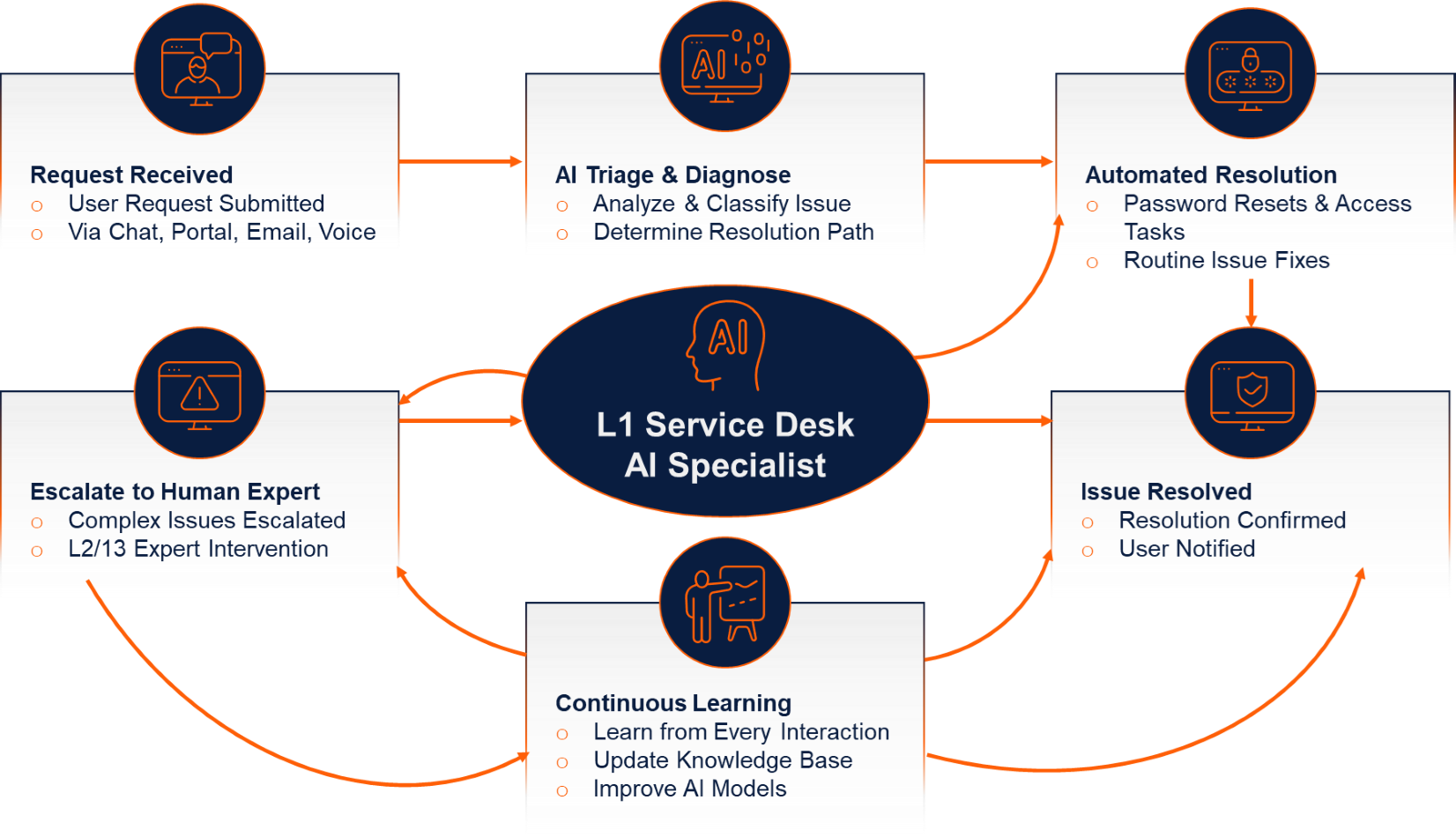
If EmployeeWorks is the front door, Autonomous Workforce is how you add capacity in the back office: AI Specialists that can take on defined Tier-1 work, execute approved actions and escalate with context. The key distinction versus “standalone bots” is that specialists operate with platform permissions, workflow controls and audit trails, so organizations can scale automation without creating a parallel, harder-to-govern AI operations layer (ServiceNow). Three pillars of impact here are:
- Capacity: Stabilized SLAs and reduced backlog during demand spikes
- Consistency: Standardized execution against validated knowledge and workflows
- Better escalations: Fewer reopens and faster resolution with full context at handoff
ServiceNow shared that, internally, AI co-workers handled 90% of L1 IT tickets during a demand surge, signaling what’s possible when scope, workflows and governance are designed upfront.
ServiceNow stated that the first of its AI specialists, the L1 Service Desk AI Specialist, will go GA in early Q2 2026 with the Australia release.
Agentic AI Transformation Levers
What separates the winners from the laggards is strategy. An AI-native workflow in isolation will not land the same impact as an AI-native platform that supports multiple workflows, reducing friction during hand-offs and making IT-business interactions as seamless as possible. The key to identifying areas of maximum impact and perfecting AI mechanics to create a playbook that helps scale up across functions.
In our ServiceNow practice, we use specific levers to get beyond “AI features” and into repeatable operating outcomes, while avoiding the integration and governance debt that comes with standing up separate AI platforms for every task:
- Journey-first design: Start with the top intents and redesign end-to-end resolution
- Knowledge & retrieval readiness: Governed sources, permissions and citations (Retrieval-Augmented Generation or RAG) to reduce guesswork
- Workflow-native execution: Approved actions encoded as workflows/runbooks for auditability
- Guardrails & escalation: Scoped permissions, approvals and clean handoffs when human judgment is needed
- Outcome instrumentation: Deflection/containment, MTTR, SLA, reopens and cost-to-serve
How Persistent Helps Clients Realize Value Faster
Our role is to convert ServiceNow’s native AI capabilities into production-grade outcomes, without creating new AI sidecars that have to be integrated, secured, monitored and governed separately. We help clients consolidate the experience layer, retrieval and execution on the Now Platform, then scale through a KPI-driven rollout and operating model.
Our ServiceNow implementation approach is three-pillared:
- Baseline & prioritize: We quantify current volumes/MTTR and select the highest-value employee journeys
- Make execution safe: We then improve knowledge quality, map approved actions to workflows and define permissions, approvals and escalation paths
- Launch & scale: We deploy, instrument outcomes weekly and expand coverage through reusable patterns across IT and business services
The opportunity for leaders is to resist the AI platform sprawl and instead standardize on a small number of measurable employee journeys, powered by native AI capabilities that are grounded, governed and executable.
When Employee Works improves the front door and Autonomous Workforce improves execution, the service organization can shift from handling tickets to returning time and productivity to the business.
The next wave of employee service and IT transformation will be defined by a simple standard: did AI complete the work, safely and measurably? With Persistent, clients design the journeys, harden the knowledge and workflows and operationalize governance to scale agentic AI on one platform and move the needle on cost-to-serve, experience and productivity.
Author Profile

Kshitij Sheth
ServiceNow & ESM Practice Leader, Persistent Systems