
In an era where speed, accuracy and cost-control shape competitive advantage, enterprises across sectors—from Healthcare Payers to Banking to Manufacturing—struggle with inefficient, manually intensive workflows. Rigid, human-driven processes slow innovation, increase operating costs and limit scale.
At the same time, advances in Generative AI are enabling a more dynamic model of Workflow Automation. Intelligent agents, often powered by Large Language Models (LLMs), can now collaborate autonomously. This shift clears the path for an accelerator like ProcessIQ, designed to help organizations deploy multi-agent systems that change how work gets done.
ProcessIQ: A New Paradigm for Workflow Automation
ProcessIQ moves beyond the conventional “sequence of tasks” model and embrace a framework where AI agents execute, coordinate and optimize full end-to-end functions. It does more than just automate individual steps. It re-imagines how operational workflows can be orchestrated by AI.
By becoming workflow-agnostic yet domain-adaptable, ProcessIQ applies a common engine across industries: from healthcare payer case flows to financial-services processes to telecom operations.
How ProcessIQ uses Agentic AI for enterprise automation
At the core of ProcessIQ sits a set of orchestration capabilities. It defines agents, tool-invocations and sequencing rules in a configuration layer. It binds to execution infrastructure, such as the open-source NVIDIA AgentIQ, and monitors runtime telemetry.
Rather than a running rigid chain of human-directed activities, the accelerator spawns specialised agents that may:
- Collect, normalise and prepare data from multiple sources
- Validate inputs and ensure compliance and rule-based correctness
- Use LLM reasoning and Retrieval-Augmented Generation (RAG) for insights or recommended next steps
- Trigger downstream actions such as API calls, system updates, or notifications
- Report, log and capture metrics for continuous improvement
By assembling these agents into a workflow, ProcessIQ enables automation of full job functions, not just discrete tasks. The result is greater agility, improved throughput and fewer manual hand‐offs.
ProcessIQ: Transforming Business Processes with Agentic Al
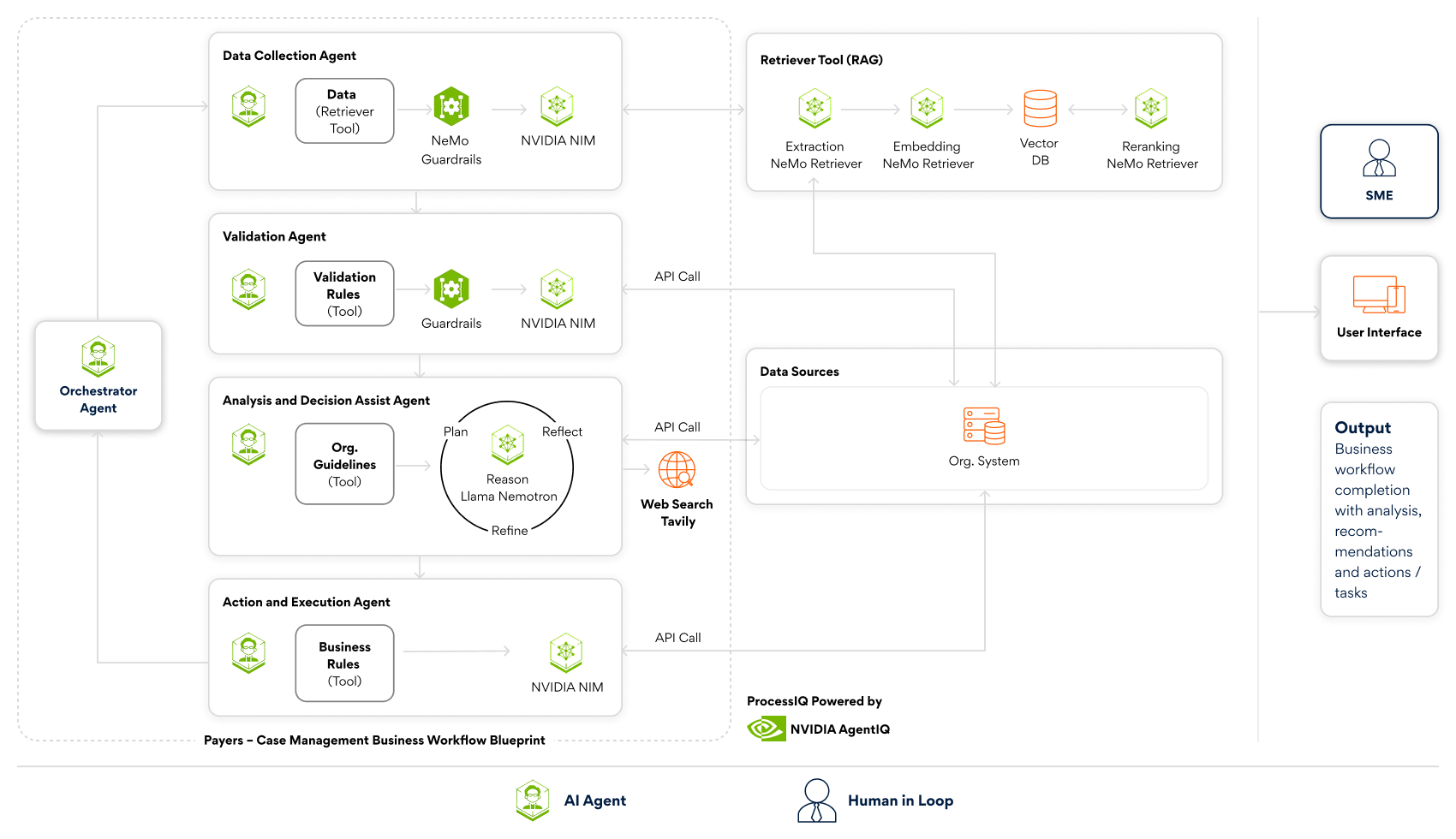
Orchestrator Agent (Leverages the ReAct Agent from AgentIQ): Manages the overall workflow, coordinating specialized agents and sequencing tasks or running them in parallel when appropriate.
Data Collection Agent (Leverages a Tool Calling Agent from AgentIQ): Automates data gathering and structuring from various sources. It uses AgentIQ-enabled tools like MCP Client tool which allows this agent to remote MCP servers through server-sent events.
Validation Agent (Leverages a Tool Calling Agent): Performs automated checks against predefined rules, policies, and validation criteria
Analysis & Decision Assist Agent (Leverages a Reasoning LLM): Uses LLM reasoning and contextual information retrieval (via RAG) to analyze data, identify patterns, predict outcomes, and propose recommendations.
Action & Execution Agent (Leverages a Tool Calling Agent): Automates task creation, triggers downstream actions via APIs, and ensures process completion.
NVIDIA NeMo Guardrails maintain compliance and policy alignment across data usage and agent actions.
Real-World Impact: An Example from Healthcare
In the Healthcare payer or provider environment, a new case, such as a complex claim or a Care-Management Referral, may require 30–40 minutes of human effort. It often passes through several review, data-entry, and decision points.

With ProcessIQ’s agent-based workflow, much of the data gathering, rule-checking and initial recommendation generation is handled autonomously. The human practitioner remains central but can focus on review and judgement rather than manual coordination.
By redesigning the workflow this way, the case-processing window shrinks dramatically. Organizations gain speed and improve decision quality.

Optimising Performance with Profiling & Metrics
ProcessIQ includes telemetry and profiling that track agent-latency, tool-call counts, token usage (for LLM interactions), and other metrics. These insights identify bottlenecks—for example, agents that wait synchronously when they could run in parallel.
One organization used these metrics to change certain tasks from sequential to parallel invocation and reduced processing time from about three minutes per unit to two minutes—an approximate 33% speed-gain at scale. In addition, by treating LLMs themselves as “judges” (scoring outputs on relevance, accuracy or compliance) you embed quality-feedback loops and accelerate refinement of your agentic workflows.
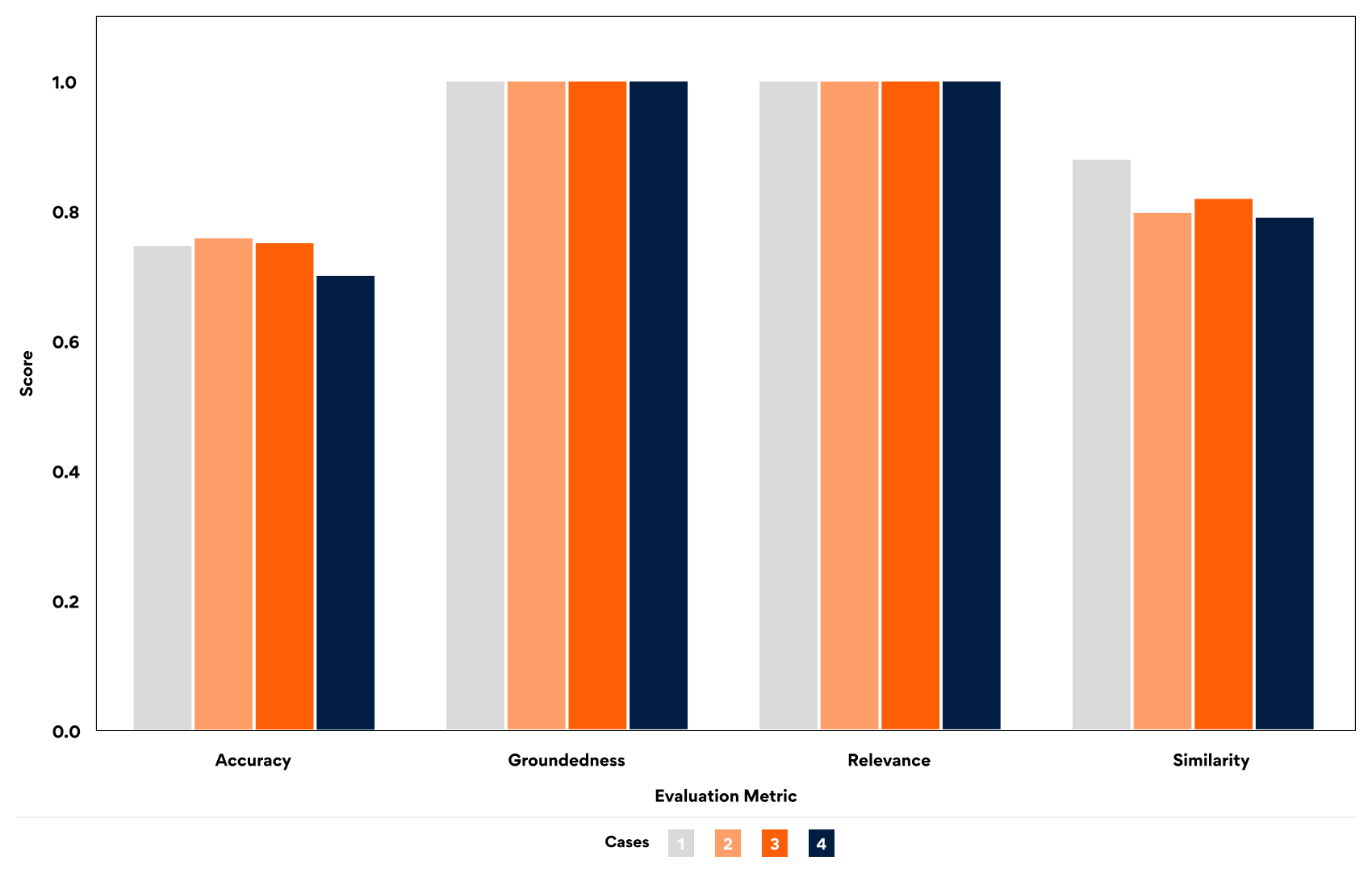
The Agent Intelligence toolkit provides built-in support for LLM-as-a-judge (RAGAS) evaluation, simplifying integration of this method into the development cycle. Fig. 5, shows Evaluation metric for different cases and can see outputs as Very Good for groundedness and relevance and good for accuracy and similarity.
Why ProcessIQ Matters: Strategic Advantages
Adopting accelerator like ProcessIQ offers multiple benefits:
- Throughput Gains: Large blocks of work that once needed human efforts can be completed much faster.
- Scalability: Automating job-functions rather than isolated tasks, allows scale across functions, geographies or business units.
- Better Human Allocation: Teams focus on high-value judgement and exception-handling instead of repetitive steps.
- Flexibility: A workflow-agnostic architecture adapts to claims processing, account onboarding, and customer-service escalation.
- Continuous improvement: Telemetry and feedback loops refine workflows for better accuracy, lower cost, and improved compliance.
In short, ProcessIQ represents a significant shift in how enterprise workflows can be designed and executed. By replacing linear, human-driven sequences with a network of collaborating AI agents, the accelerator unlocks faster processing, smarter decision-making and scalable operations.
For any organization seeking to automate not just tasks—but entire work-streams—this is a compelling next step.
At Persistent, we are redefining the future of work and operations with agentic workflows and AI agents that autonomously make decisions and automate job functions end to end. Let’s reimagine your agentic workflow automation together. Contact us to get started.
Author’s Profile

Shilpa Ramteke
Senior Data Scientist, Innovation Labs AI Research