
As enterprises become hyper-focused on enabling fractional teams, a fit-for-all Salesforce stack proves limiting. Moreover, mergers and acquisitions, independent business units, complex regulatory requirements, or performance optimization can further make standalone Salesforce environments fall short.
To fully support unique business needs without impacting speed and scale, enterprises need to reorganize their Salesforce environment. Especially as Salesforce Industry Clouds gain traction, updating existing add-ons in Sales or Service Cloud environments can no longer work.
However, this re-organization can be fraught with challenges, such as:
- Complexity of Integration: Rationalizing data, processes and customizations across business units can be challenging during an org merger or split.
- Regulatory and Compliance Requirements: Navigating legal and regulatory standards can complicate reorganization efforts, particularly in heavily regulated industries.
- System Limitations: Existing Salesforce instances may face governor limits or performance bottlenecks, hindering scale or optimization without significant changes.
- Standardization vs. Diversification: Balancing the need for consistent business processes with the flexibility to support unique requirements is a strategic call.
- Change Management and User Adoption: Transitioning to new Salesforce orgs or models requires comprehensive change management to minimize disruption and ensure user adoption.
- Maintaining Operational Efficiency: Ensuring operations continue smoothly during the transition is critical to minimizing downtime and avoiding productivity drain.
- Ensuring Data Security and Integrity: Protecting sensitive data and maintaining data quality during migration or reorganization can slow down reorganization efforts.
This blog presents a Salesforce re-org strategy tailored to enterprise business structure and growth ambitions, ensuring a smooth transition and a long-term competitive edge.
The Four-Quadrant Decision Framework for Salesforce Re-org
- Should different teams follow the same processes?
- Do system limits affect how much can be done?
- Is the customer profile the same across business units?
- Do processes need to be different to suit unique needs?
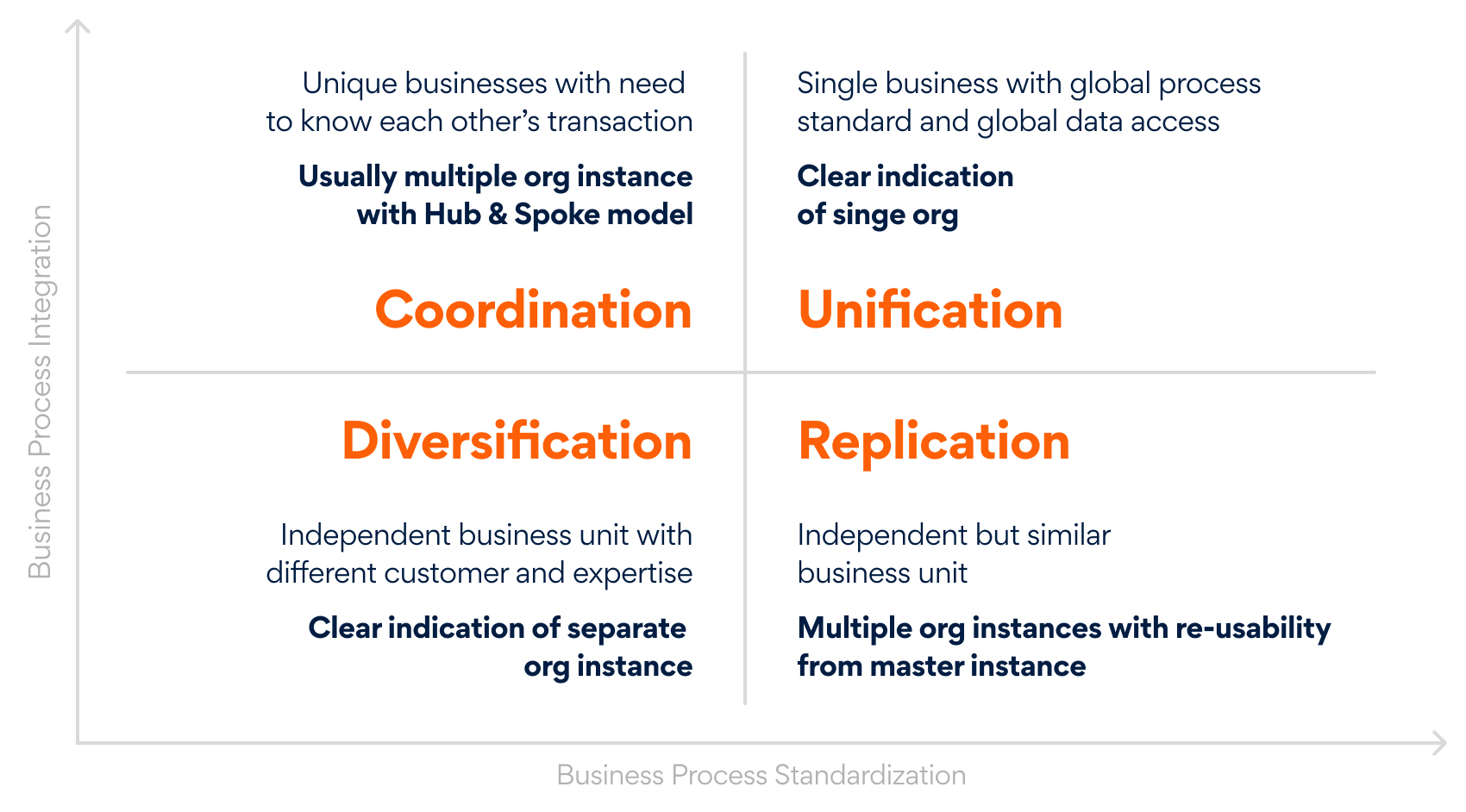
The four-quadrant analysis answers these questions for a successful re-org. It helps understand how similar business processes are and how much they depend on each other. It examines whether business units use standard processes or how different processes must work together.
How this works:
Coordination: If a single Salesforce instance cannot be made more efficient due to technical limitations, such as data storage or user limits, or due to system performance constraints, a “hub-and-spoke” model with a central hub (main instance) connecting to several minor instances (spokes) will work. Each spoke can handle its own set of processes or business units, while the hub manages common or shared data and processes. This structure helps overcome system limits by spreading out the workload. It allows each business unit to operate more efficiently within its own instance, while maintaining central coordination.
Diversification: If two business units frequently experience conflicts because different groups or stakeholders control their respective processes, maintaining a single Salesforce instance may lead to ongoing disagreements and inefficiencies. To resolve this, separate the Salesforce systems by creating distinct instances for each unit. By doing so, each group can customize its processes and system settings without interference from the other, leading to smoother operations and ensuring that the individual needs of both units are met.
Replication: If different business units use standard processes, share templates and have a common user base, it is usually best to keep them together in a single Salesforce instance. This makes things consistent and easier to manage.
Executing Salesforce Re-org Strategy with Persistent
Persistent’s re-org toolkit enables clients to implement the most suitable strategy efficiently, ensuring minimum time and effort with maximum precision. We use our experience to guide key tasks, such as migrating settings, static resources and AppExchange apps.
This diagram offers a high-level summary of our planning approach.
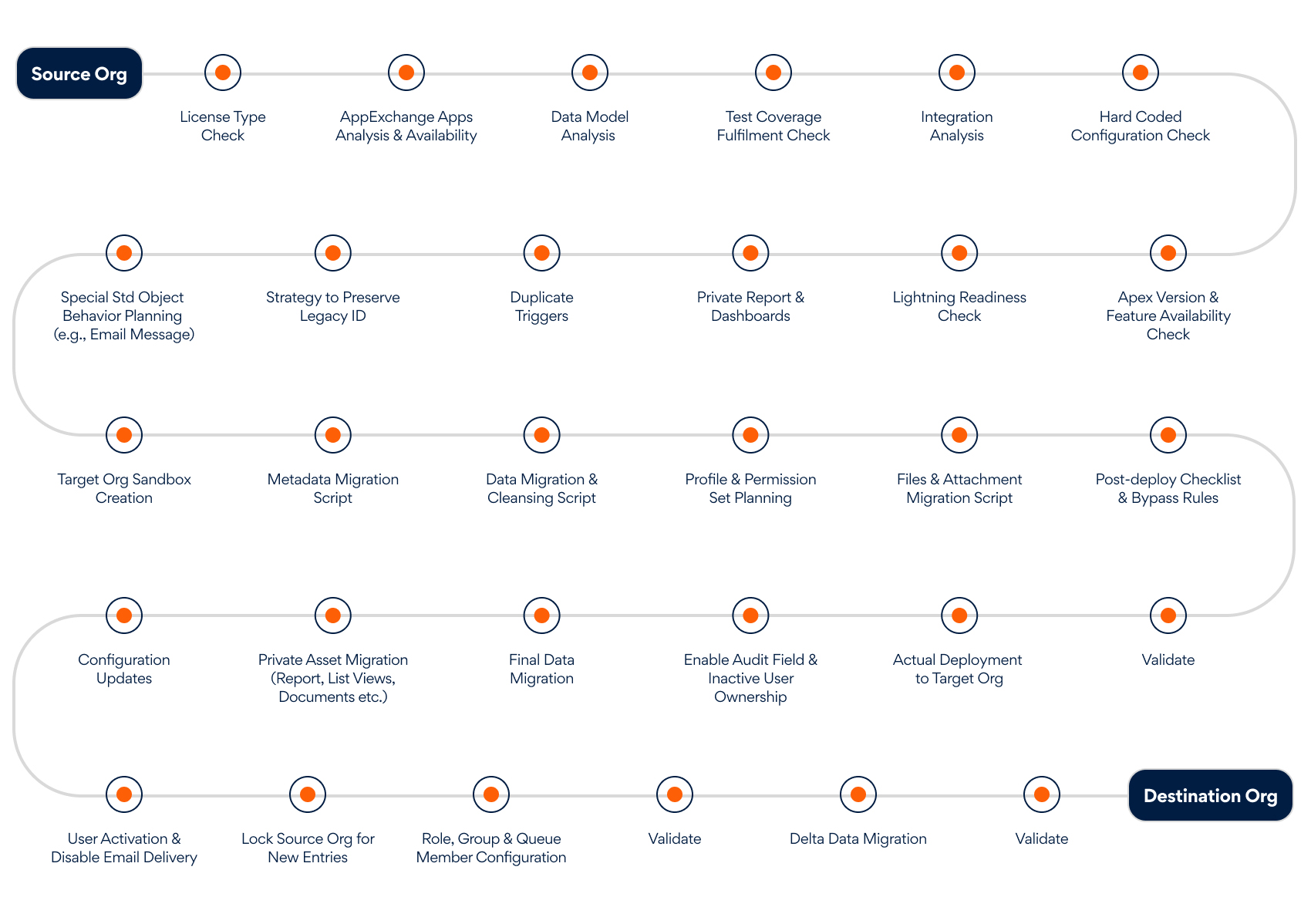
Our approach includes a comprehensive assessment leveraging the four-quadrant analysis with proprietary accelerators.
- MIGRATE: Automates data migration script creation by identifying object dependencies and enables data cleansing in a staging database. Scripts can be tested before final production execution, ensuring faster and more accurate migration.
- MySAFE: Automates fast, reliable file transfers linked to records, using parallel processing to bypass the 50MB limit of traditional methods. It filters records for migration, manages batches and handles errors or API limits efficiently.
- Delta: Compares two Salesforce instances to identify metadata differences and verify successful splits or mergers, saving significant effort by pinpointing specific causes of behavioral changes.
Success Levers
Post-migration validation, user impact analysis and go-live planning are critical to success, and that is where our expertise lies: building a smooth transition plan with minimal downtime.
Onboarding users, training and a smooth transition from the old Salesforce instance to the newer one are the biggest challenges. A smooth transition calls for incremental strategies based on factors such as persona or transaction state, along with thorough planning for cutover and rollback, and for identifying the point of no return.
The implementation of the reorganization strategy can also serve as an agent of change, provided certain considerations are taken into account.
- Technical debts: Re-org strategy is also an opportunity to reduce technical debt, such as merging the trigger, migrating to the latest offerings (e.g., Attachment to Files, Workflow/Process Builder to Flow) and re-imagining integration strategies, etc. Persistent’s toolkit saves up to 40% of time during Salesforce migrations, freeing up bandwidth to focus on technical debt and prepare a newer, optimized setup.
- Enhanced Salesforce Adoption: Merging or splitting an organization presents a valuable chance to establish new standards by leveraging Salesforce features that were previously unused, whether because they were released later or not enabled due to budget constraints.
- License/Cost Optimization: Misunderstanding requirements early in a Salesforce adoption can result in unsuitable licensing or DevOps strategies, such as unnecessary full-copy sandboxes. Correcting these choices can save a significant budget for further improvements.
A successful reorganisation strategy not only streamlines the migration process but also enhances the value of Salesforce investments. Persistent helps enterprises prioritize planning, address technical debt reduction and boost user adoption, setting up a robust Salesforce environment that supports efficiency, growth and sustainable cost optimization for the future.
Authors’ Profile

Rahul Gade
Vice President, Technology