Legacy data systems have quietly become one of the most significant barriers to AI transformation. Decades-old ETL jobs, rigid data warehouses, and fragmented pipelines were never designed for the speed, scale, and diversity of today’s AI workloads. According to Gartner, organizations that modernize toward AI-ready data foundations can improve GenAI model accuracy by up to 80% and reduce operational costs by as much as 60%.
At Persistent Systems, we recognize these challenges firsthand. That’s why we developed iAURA 2.0—our proprietary, Agentic AI-powered migration accelerator—purpose-built to help enterprises modernize with intelligence, automation, and speed on the Databricks Lakehouse Platform.
Why Databricks Lakehouse is the Foundation for AI-First Modernization
The Databricks unified Lakehouse architecture combines the strengths of data lakes and data warehouses, enabling data, analytics, and AI to coexist seamlessly on a single, governed platform. With Delta Lake, Unity Catalog, and Databricks Lakehouse, enterprises can operate with reliability, flexibility, and enterprise-grade governance.
Key advantages of the Lakehouse architecture:
- Elastic, unified performance across structured, semi-structured, and unstructured data
- Native integration with LLMs and AI workloads via Databricks Mosaic AI
- Built-in governance and lineage tracking through Unity Catalog
- Scalable compute orchestration with Databricks Workflows and Delta Live Tables
However, migrating from legacy tools such as Teradata, Informatica, and Oracle to a modern Lakehouse architecture presents significant challenges. This is where Persistent’s iAURA delivers measurable value—intelligently automating and accelerating every step of the migration journey.
Introducing iAURA 2.0: The Agentic AI-Powered Migration Accelerator
As a Persistent Systems innovation, iAURA 2.0 is an Agentic AI and LLM-driven migration suite designed to automate every phase of data warehouse and ETL modernization. Our deep expertise in enterprise data modernization is embedded in iAURA, which leverages advanced parsing logic, agentic workflows, and LLMs to read legacy scripts (such as PL/SQL or Informatica mappings), extract business logic, and generate Databricks-native code. It also automates data reconciliation, generating validation checks and row-level comparisons between source and target systems.
Platform capabilities include:
- End-to-end ETL and DWH migration automation
- Intelligent assessment of legacy code with lineage extraction and complexity scoring
- Automated legacy code conversion
- Automated reconciliation and quality checks across source and target
- Deep integration with Workflows, Unity Catalog, and DBSQL for governed execution
How iAURA Powers Migration to Databricks: Step by Step
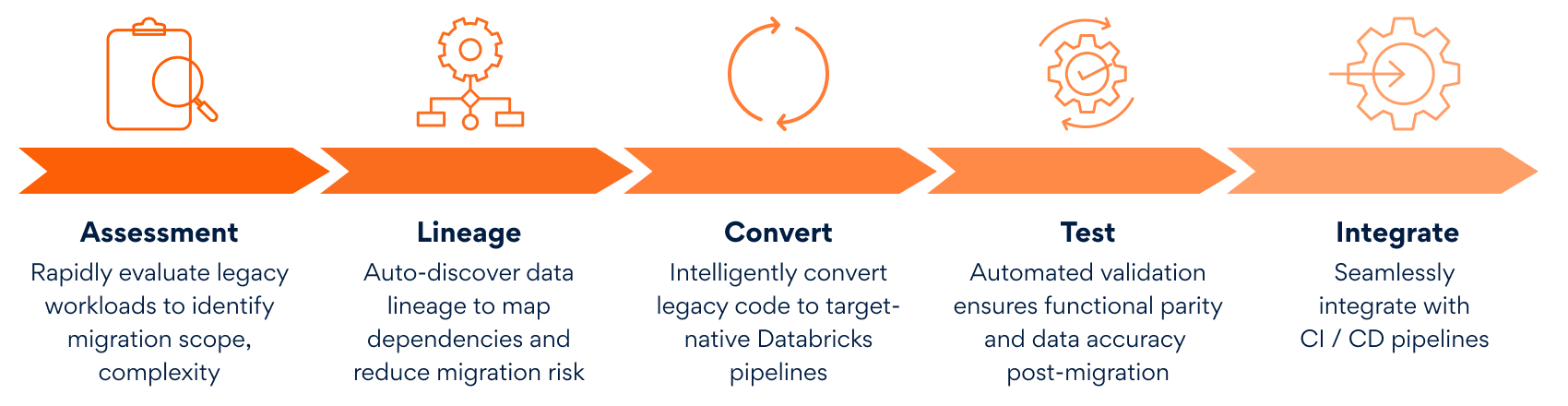
Migrating enterprise data warehouses is a complex, multi-stage process that requires careful planning, automation, and validation at every step. iAURA 2.0, developed by Persistent, orchestrates this journey through a series of intelligent, interconnected phases—each designed to minimize risk and maximize efficiency.
Here’s how iAURA streamlines the migration process:
1. Inventory Analysis: The Analyzer Agent scans legacy ETL tools, databases, and warehouses to catalogue code objects, DDL/DML logic, joins, procedural patterns, and complexity levels. It auto-generates flowcharts and sequence diagrams, accelerating understanding and planning.
2. Planning: Planning Agents use static code analysis to detect interdependencies between jobs built in legacy code (e.g., Informatica, BTEQ, Oracle). iAURA builds a knowledge graph mapping data lineage across pipelines, visualized through a graph database for traceability. It can automatically generate project tasks in tools like Jira or Azure DevOps, streamlining sprint planning and execution.
3. Automated Code Migration: iAURA automates the conversion of legacy ETL and DWH code into modern ELT and PySpark-based pipelines for the Databricks Lakehouse. It reads procedural logic, resolves dependencies, extracts business rules, and generates Databricks-native pipelines and SQLs.
4. Testing and Validation: iAURA ensures every migrated ETL and DWH component is technically accurate and production-ready through a unified testing and validation framework:
- Generates unit tests for SQL/PySpark logic and transformations
- Verifies schemas, data types, constraints, and column-level expressions
- Runs deterministic sample tests to validate operator behavior
- Executes parallel runs to compare legacy and Lakehouse outputs side-by-side
- Performs full data reconciliation (row-level, column-level, distribution checks)
- Tracks freshness, completeness, and overall data quality metrics
This approach guarantees both code-level correctness and functional equivalence before cutover.
5. Integration
iAURA seamlessly integrates migrated assets into enterprise development and documentation ecosystems. Once code is generated and validated, Integration Agents automatically:
- Commit SQL, PySpark, and workflow definitions into Git-based repositories for CI/CD
- Sync with Azure DevOps, GitHub, or GitLab for versioning, reviews, and automated deployments
- Publish technical documentation, flow diagrams, and lineage details to Confluence or SharePoint
This ensures all migrated components are production-ready, version-controlled, and fully documented within existing enterprise workflows.
Inside iAURA’s Agentic Architecture
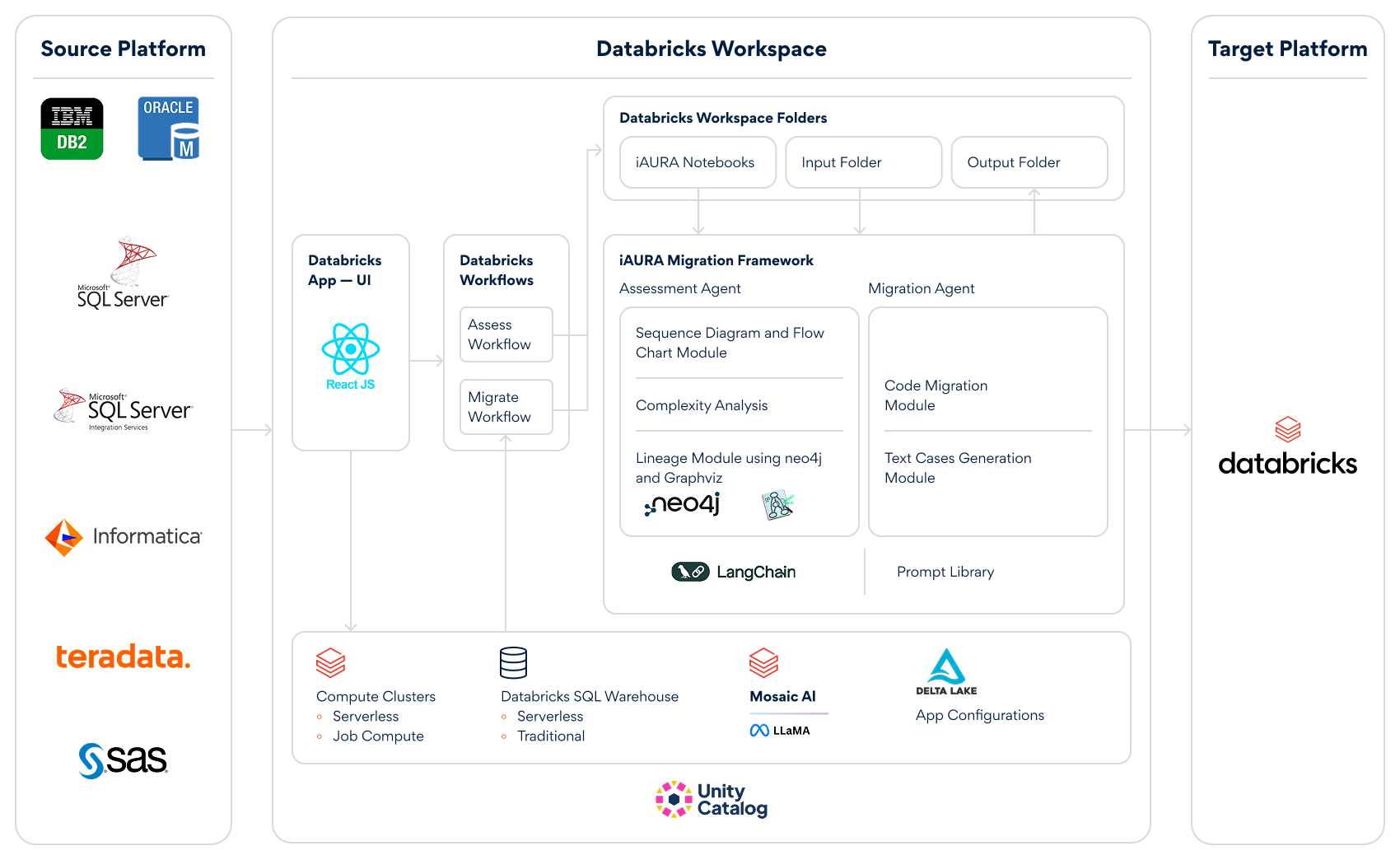
To deliver this level of automation and intelligence, iAURA leverages a modular, agent-based architecture, with each component specializing in a critical aspect of the migration journey. These autonomous, specialized agents coordinate through LLM-driven decisioning to ensure seamless execution.
Specialized Agent Portfolio:
- Analyzer Agents: Interpret metadata from legacy tools
- Code Conversion Agents: Transform ETL logic into PySpark or SQL ELT patterns
- Lineage Agents: Register end-to-end lineage into Unity Catalog
- Diagram Agents: Generate sequence diagrams and Lakehouse architecture views
- Integration Agents: Connect with Jira, Confluence, Databricks APIs, and Knowledge Graphs
iAURA as a Databricks Brickbuilder Solution
Our commitment to enterprise-grade modernization is further validated by Databricks’ endorsement of iAURA as a Brickbuilder Solution. iAURA Migration is now part of the Databricks Brickbuilder Solutions program—a curated ecosystem of pre-built, Databricks-validated accelerators designed to help enterprises modernize faster and with greater confidence. As a Brickbuilder Solution, iAURA is not only powered by Agentic AI and optimized for Delta, Unity Catalog, and Mosaic AI, but also endorsed by Databricks as a trusted path to modernizing data and analytics landscapes.
The Business Impact: Beyond Migration
The benefits of iAURA extend well beyond technical migration, delivering tangible business value for organizations seeking to become truly AI-driven. By combining Agentic AI, automation, and the open, governed Databricks Lakehouse, iAURA transforms how organizations modernize and scale data intelligence.
Key Business Benefits:
- Accelerated Modernization: Cut migration timelines by 50–70%, enabling faster Lakehouse adoption and quicker AI readiness.
- Lower Total Cost of Ownership (TCO): Automated conversion, testing, and optimization reduce migration effort by 20–35% and deliver long-term operational savings.
- High Data Trust & Reliability: Automated reconciliation, quality checks, and full lineage ensure audit-ready accuracy with fewer production issues.
- Reduced Modernization Risk: Dependency-aware planning, automated testing, and side-by-side validation minimize migration failures and ensure a smooth, predictable cutover.
- Future-Ready, AI-Native Architecture: Delta-native ELT pipelines and unified governance create a scalable foundation for GenAI and advanced analytics.
Conclusion: Building the AI-Native Future on Databricks
Modernizing legacy data platforms is no longer optional—it is a strategic necessity for any enterprise aiming to scale AI. With iAURA’s Agentic AI-driven migration capabilities and the Databricks Lakehouse platform, organizations can move from rigid, siloed systems to a unified, intelligent, AI-ready data foundation that supports governance, scale, and continuous innovation.
Author’s Profile

Mandar Baxi
Associate Vice President , Technology

Raghavendra Gowd
Senior Consulting Expert