
Research and Development (R&D) scientists have always been firm believers in the power of big data mining even before Big Data or other advanced tech became mainstream. Conventional scientific research include meticulous review of voluminous literature, knowledge synthesis, hypothesis generation, experimental design and medical writing. Furthermore, typical R&D workflows include challenges such as managing multimodal datasets, performing complex data analytics, identifying data insights and minimizing interobserver variability.
For decades, the pace of discovery was dictated by these workflows and challenges, leading to researchers and scientists being overworked and burdened with non-innovative tasks.
Thankfully, today this scenario is shifting. R&D processes are leveraging Artificial Intelligence (AI) and machine learning (ML) models to manage data and derive actionable insights from it. Meanwhile, scientists are no longer just domain experts. They are also data wranglers, compliance experts and storytellers, all fused into one.
But what if the process itself could be reimagined? What if scientists had a digital co-scientist that could shoulder the burden of data, accelerate insights and implement effective R&D workflows, freeing up human minds for creativity and critical thinking? This is where Sc(AI)Mitra enters the story; not as a replacement for human creativity, but as a digital co-scientist that can enhance R&D productivity.
What is Sc(AI)Mitra?
Sc(AI)Mitra is a smart solution with an advanced Agentic AI framework designed to assist scientists implement R&D programs in the Healthcare and Life Sciences (HCLS) industry. With support from multiple functional agents, Sc(AI)Mitra has been designed to improve research productivity and accelerate scientific discoveries.
How Does Sc(AI)Mitra Work?
Sc(AI)Mitra operates through various phases of R&D workflow using multiple integrated agents as described below:
Sc(AI)Mitra: Biomedical R&D Workflow
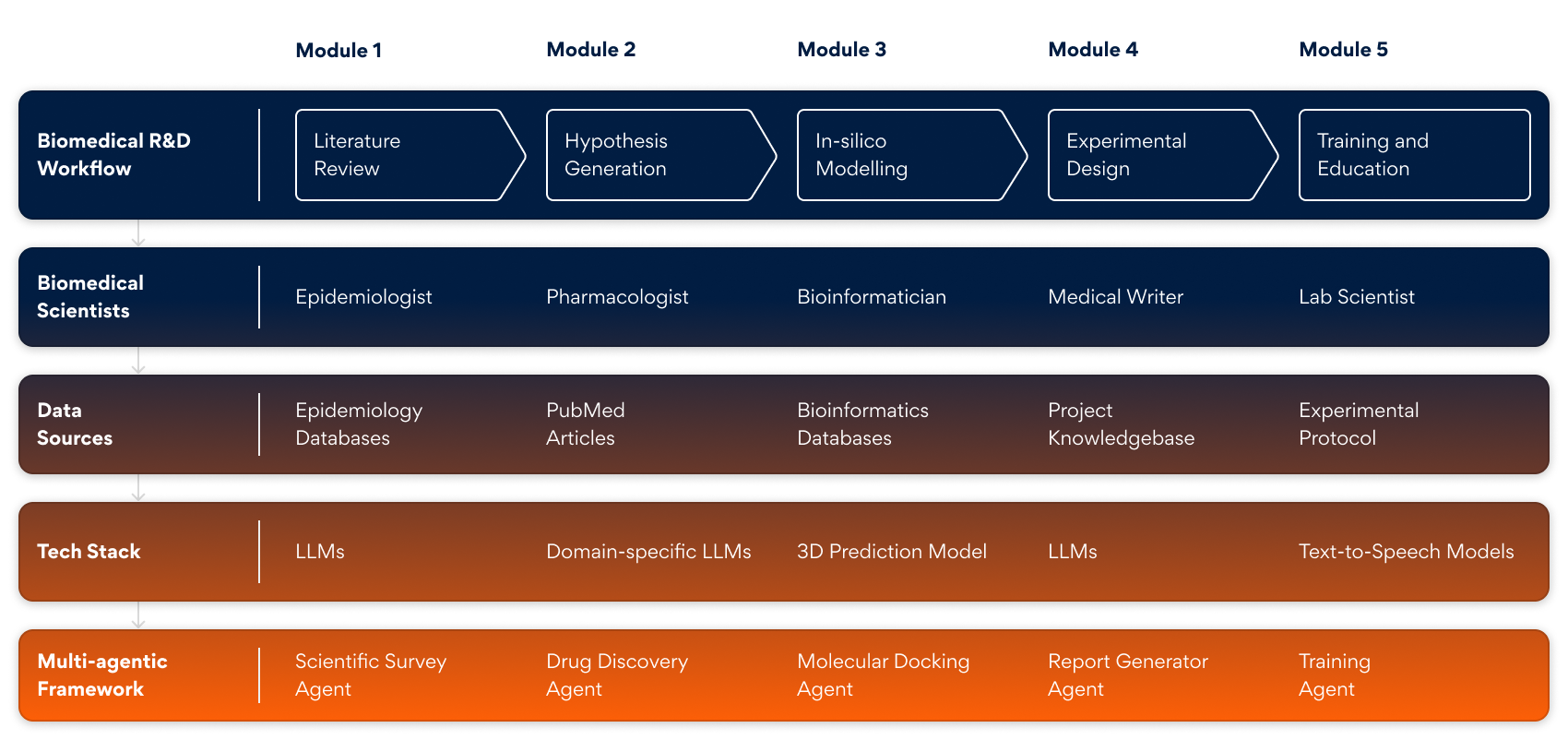
The crosstalk between planner and domain agents generates a comprehensive plan to execute various R&D functions with following features:
- Literature Review: The review agent meticulously compiles scientific literature from authentic sources through advanced web scraping. This process not only establishes a solid research foundation but also identifies critical gaps in existing knowledge, thereby paving the way for scientific discoveries.
- Hypothesis Generation: The generation agent plays an indispensable role by formulating rational hypotheses based on thorough literature review and feedback from scientists. This step is critical as it allows the integration of selected scientific tools, thereby enhancing the ideation process and setting a solid foundation for experimental designs.
- Experimental Design: This step adheres strictly to regulatory guidelines to plan experiments for basic, clinical and translational R&D protocols. It considers all experimental factors including study models, intervention groupings, dosage regimens and outcome variables ensuring accuracy and reproducibility.
- Medical Writing: AI can be leveraged to generate comprehensive biomedical content essential for regulatory compliance. The system comprehends the intricacies of application processes and ensures that all documentation is accurate, detailed and contextually appropriate, thereby facilitating successful submissions and approvals.
- Training : Generates easy to understand audio-visual content from final experimental protocol for training needs of laboratory staff.
Sc(AI)Mitra functions are based on the principle of Google’s “Agentic AI Co-scientist” that semi-autonomously performs complex research tasks by orchestrating a suite of specialized AI agents. By breaking down the scientific R&D goal into distinct agent-driven phases, Sc(AI)Mitra simulates the function of human research team with enhanced efficiency.
Re(AI)magining The Future of R&D
The story of Sc(AI)Mitra is a story of partnership between human ingenuity and machine intelligence. As agentic AI matures, we can expect even greater collaboration, with AI agents not just supporting but actively participating and co-creating scientific breakthroughs.
Sc(AI)Mitra offers significant business value by streamlining the R&D process, reducing time and resource expenditure and improving the accuracy and quality of research outputs. It is expected that adoption by researcher community will lead to faster innovation cycles, increased competitiveness and, a greater return on investment for scientists in the HCLS industry.
Ready to see how Agentic AI can transform your R&D journey? Discover how Persistent is pioneering the future of scientific innovation with Agentic AI.
Author’s Profile

Dr. Akash Saggam
Engineering Lead – Domain, Persistent Systems

Saurabh Jain
Principal Architect, Persistent Systems