
Why the most predictable source of claims leakage, fraud and abuse is also the one an insurer can now turn into measurable financial value.
For a decade, insurers have invested in making claims more efficient, through automation, digitization and fraud detection. Those investments have improved operations and customer experience. They have not, however, arrested the steady rise in claims cost, legal expense and missed recovery that continues to pressure loss ratios.
The reason is not a shortage of data or technology. It is that most insurers still manage claims reactively, recognizing risk only after the cost has begun to accumulate.
The single largest source of that avoidable cost: litigation. Read early litigation is not a fixed expense to absorb, but one that an insurance carrier, broker, MGA or reinsurer can actively reduce.
Claims Leakage Is Bigger Than Fraud
When claims leaders discuss leakage, the conversation usually begins with fraud, waste and policy abuse. These remain important concerns, but they represent only part of the problem.
Today’s claims organizations face several sources of leakage at once:
- Escalating litigation costs, e.g. external legal counsel
- Attorney-driven claim inflation, e.g. inordinate demands based on social inflation
- Delayed interventions, e.g. filings and notifications that delay internal legal awareness
- Reactive severity escalation, e.g. post-litigation notification reactions due to operational inefficiencies lead to higher claims awards
- Reserving inaccuracies, which impact cash availability for institutional investments
- Missed subrogation opportunities, e.g. due to timely missed identification or notice stagnation
Individually, each appears manageable. Collectively, they shape loss ratios and profitability with a direct impact on combined ratio. Broader industry trends compound the challenge. Social inflation continues to drive larger settlements and jury awards; litigation funding is expanding and attorney advertising has increased claimant awareness and representation rates.
Of these sources, litigation deserves particular attention for two reasons.
The first is scale. The annual cost of insurance leakage, fraud and abuse is estimated at $308.6 Billion [1], (e.g., P&C $45B, Workers Comp $34B, Auto Theft $7.4B, Disability $7.4B). US P&C Insurers spend $23B+ annually on litigation defense and cost containment within a $529B US Tort System, making earlier claim risk detection and proactive litigation strategy critical. As social inflation persists, exposure tends to grow rather than stabilize.
The second and more important, is that litigation is largely predictable. Litigation risk rarely appears without warning. It is signaled well in advance by factors already present in the claim: injury type and treatment progression, jurisdiction and venue history, attorney involvement patterns, demand behavior and severity development. The difficulty is not the absence of these signals, but the fact that traditional claims processes were built to handle claims efficiently, not to predict outcomes. By the time a claim progresses to litigation:
- Legal expenses are already accumulating
- Reserves may require adjustment
- Settlement opportunities may have passed
- Attorney involvement may have altered the trajectory of the claim
At that stage, claims teams are managing consequences rather than influencing outcomes. This limits an insurer’s ability to reduce leakage, allocate resources effectively and protect margins.
From Claims Intelligence to Litigation Insights Monetization
Leading insurers are adopting a different approach, investing in AI-enabled capabilities that provide earlier visibility into risk and opportunity across the claims’ lifecycle. Much of the market now describes this simply as “claims intelligence.” The more useful framing, however, is narrower and more commercial.
Historically, claims organizations have sought to minimize loss. The opportunity now is to capture value that currently leaks away: legal spending avoided, reserves set more accurately, recoveries identified and interventions made while they can still influence the outcome. Read early litigation ceases to be a cost that is simply absorbed and becomes a figure that can be actively managed. This is the principle behind Persistent’s Litigation Insights Monetization: directing predictive and prescriptive intelligence at the largest and most predictable source of leakage and treating it as a measurable lever on the P&L.
Put plainly, the objective shifts from minimizing loss to capturing value through leakage prevention.
A Unified View Across the Claims Lifecycle
While all insurer priorities are different, several use cases emerge as particularly valuable with our Litigation Insights Monetization solution.
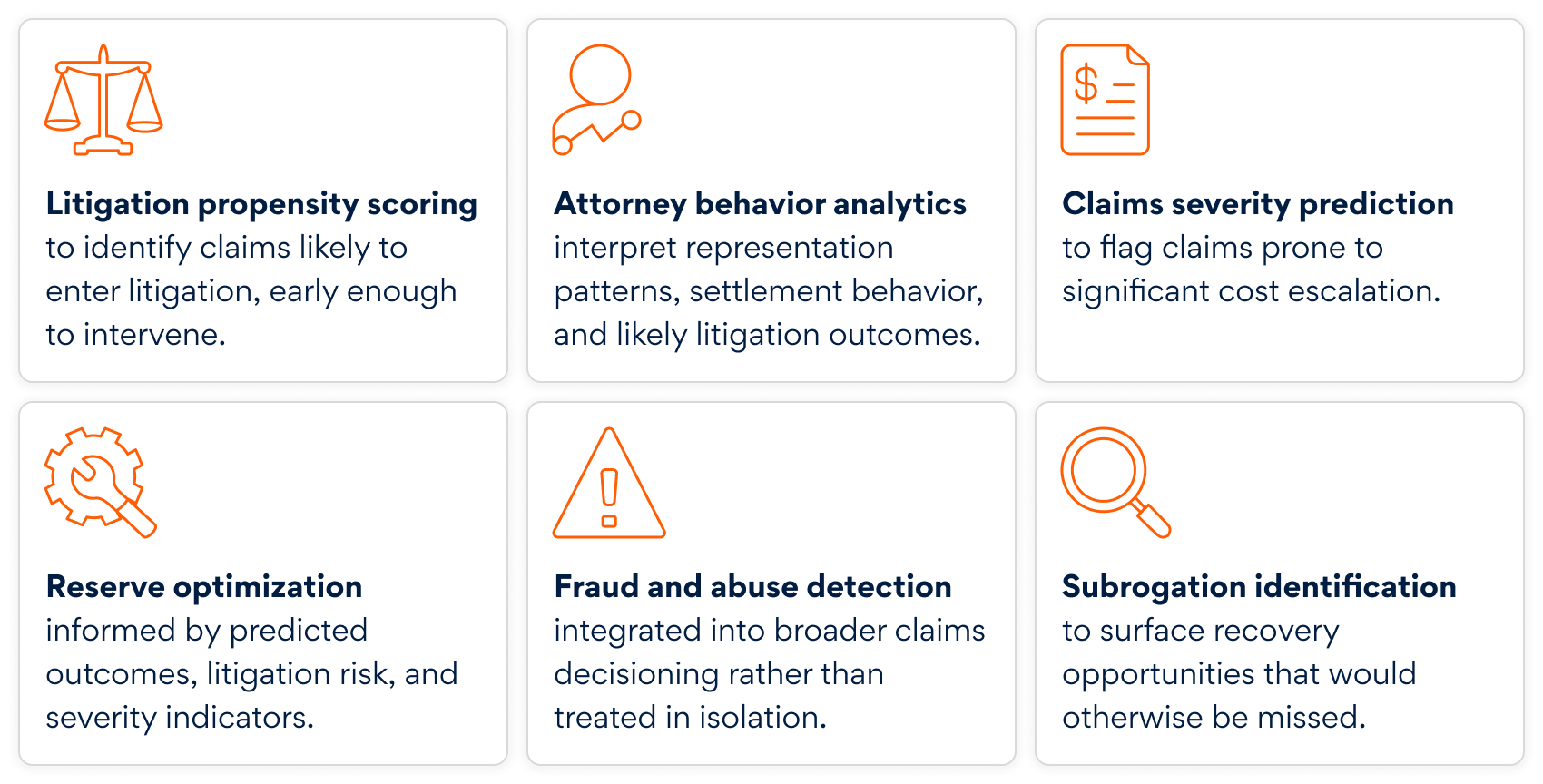
Throughout the process, intelligence supports the adjuster. Claim-level explanations show the reasons behind each score, so litigation managers, defense counsel and claims leaders remain the decision-makers.
How Persistent Helps Insurers Respond
Persistent’s Litigation Insights Monetization is built to convert that prediction into measurable financial outcomes, quickly and at low risk.
- Pre-trained on more than 65 million claims and powered by Charlee.AI, so it can be applied to a carrier’s data from day one
- Production in approximately 30 days per line of business, rather than through a lengthy build.
- In the near term, carriers can expect a 3% to 5% reduction in total legal spend and verdicts, up to a 30% reduction in leakage, fraud and abuse within the first year as the models learn a given line of business.
For regulated buyers, governance is built in. The intelligence is explainable, scoring can be configured to a carrier’s workflows and risk appetite, cross-customer learnings are anonymized and no client data is shared with another. The result is earlier visibility, more proactive intervention, improved reserve accuracy and stronger claims outcomes, delivered at low risk.
The Future of Claims Is Predictive
Claims’ organizations are entering a period in which decisions are informed not only by what has happened, but by what is likely to happen next. Litigation risk can be identified earlier, reserves can be set with greater confidence and claims professionals can be supported by intelligence rather than overwhelmed by data. The carriers that make this shift first will be better positioned to protect profitability, improve customer outcomes and compete in an increasingly complex claims environment.
What makes the shift durable is that the intelligence compounds. The AI-led platform improves both from the carrier’s own claim outcomes over time and, through an anonymised data consortium, from the collective learnings of other carriers. Each resolved claim sharpens the next prediction. For legal and claims teams, that means clearer insight into litigation and the litigators behind it and a steady reduction in total claims and legal spending as the engine learns.
The signals that predict litigation are already present in most insurers’ claims data. The challenge is not collecting more information but identifying which signals matter early enough to influence outcomes. As litigation costs continue to rise, insurers have an opportunity to move beyond reactive claims management and turn predictive insights into measurable financial value.
Ready to Assess Your Litigation Leakage?
A structured litigation monetization assessment can help insurers identify where avoidable legal spending, reserve inefficiencies, severity escalation and missed recovery opportunities are impacting claims performance.
Persistent’s Litigation Insights Monetization approach combines AI-powered predictive intelligence with deep insurance expertise to help carriers quantify litigation risk, prioritize interventions and improve claims outcomes.
To learn how much value may be recoverable within your claims’ portfolio, schedule a Litigation Monetization Assessment with Persistent.
References
[1] https://content.naic.org/insurance-topics/insurance-fraud
Author’s Profile

Tony Almeida
Vice President, Global Strategic Advisor & Client Partner

Kinshuk Bhattacharya
Global Client Partner, Insurance