
Where Databricks and Power BI need to align before AI analytics can be trusted
The next advantage will not come from more dashboards. It will come from governing meaning.
Think of the last time two teams walked into the same review with two different versions of the same KPI.
One number came from a dashboard. Another came from a SQL query. A third came from someone’s trusted spreadsheet. Everyone had data and everyone had a method, but no one was quite sure which version the business should believe.
In the dashboard era, that problem was inconvenient. In the AI era, it becomes much harder to contain. Once users start asking questions in natural language and expecting immediate answers, the system cannot simply work around competing definitions. It has to know what revenue, churn, margin or customer value actually mean.
This is where the argument in Your Conversational AI Pilot Is Going to Fail & It Won’t Be AI’s Fault starts to matter in practice. If trusted answers depend on more than a capable model, they also depend on a shared understanding of business meaning.
The Problem Is Not More Data. It Is Competing Meaning.
Most enterprises already have the ingredients: modern data platforms, mature BI environments and serious AI pilots. The problem is that business meaning still lives in too many places. It is embedded in Power BI models, Databricks SQL, notebooks, exports and prompt-specific logic. Each layer works for its immediate user, but definitions, calculation rules and filters gradually drift.
While this was tolerable when analytics was mostly report-led, it becomes dangerous when AI assistants and agents begin interpreting questions, generating queries and shaping decisions in real time. The issue is not whether the data is clean or the model is capable, but whether every dashboard, query, AI assistant and agent is working from the same governed interpretation of the business.
Meaning Needs an Architecture
AI-ready analytics depends on shared meaning as much as shared data. A governed semantic layer defines business meaning once, applies controls close to the data and makes that meaning available to reporting, exploration and AI experiences. Without that layer, every new interface becomes another place where definitions can diverge.
Databricks can anchor the governed foundation for data products, Metric Views, business vocabulary, lineage, certification and access policy. Power BI remains the place where many business users experience analytics every day. The mistake is making every Power BI model recreate KPI rules on its own. The stronger pattern is for Power BI to build on approved metric definitions while keeping the modeling flexibility business users need.
Metric Views help by giving teams an approved place to define important calculations. Instead of rebuilding the same KPI differently in Power BI, SQL, notebooks or AI tools, teams can reuse the approved definition and apply it to different questions, filters and levels of detail. That is the real purpose of the semantic layer: not to create another model, but to stop business meaning from splintering across every tool.
The semantic layer earns its keep in three distinct ways, by:
- Defining critical metrics once, so revenue, churn or margin are not quietly rebuilt in every tool.
- Giving AI the business context it needs to understand intent, including terms, definitions, relationships and access rules.
- Keeping KPI definitions consistent as they move across dashboards, SQL, notebooks and AI applications.
Once those jobs are clear, the architecture question changes. It is no longer about which tool owns the experience, but whether every experience draws from the same governed meaning.
Far from being a platform debate, this indicates that Power BI and Databricks AI/BI play different roles in the same operating model. Power BI works for governed reporting and curated decisions, while Databricks AI/BI Genie and agentic applications are suited for exploratory, conversational and workflow-embedded analytics.
The architecture below shows what that operating model looks like in a Databricks + Power BI environment. Curated data products sit at the foundation. Unity Catalog and Metric Views define the approved business meaning. Power BI, AI/BI, SQL, notebooks and agents consume that meaning through governed access paths.
Reference architecture
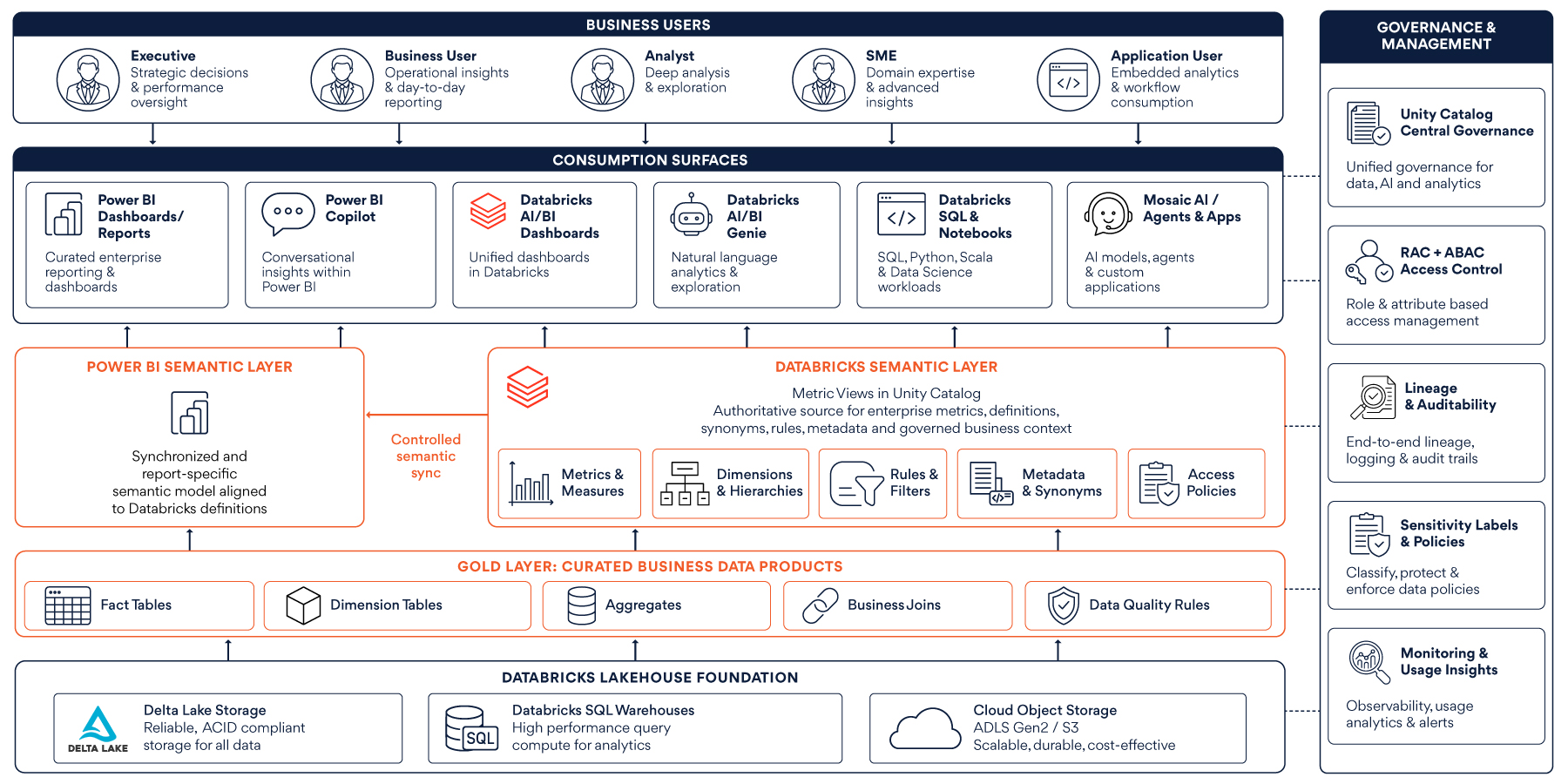
- Gold layer: Curated Delta data products for reporting, analytics, AI and semantic modeling.
- Unity Catalog Business Semantics: Authoritative KPIs, dimensions, vocabulary, lineage and policy.
- Metric Views: Approved metric definitions that can be reused across tools and questions.
- Databricks SQL Warehouse: Governed access points for Power BI, AI/BI, SQL, notebooks and downstream applications.
- Power BI semantic models: Reporting-ready models that use approved definitions while preserving Power BI flexibility.
In practical terms, the model is simple: anchor business meaning in Databricks, then reuse it across Power BI, Databricks AI/BI, SQL analytics, notebooks and AI-powered applications.
Strategic outcome: Less energy spent reconciling competing definitions. More confidence in the answers that shape reporting, exploration and AI-driven decisions.
That matters most in the places where analytics is changing quickest: conversational interfaces and everyday BI consumption.
Conversational Analytics: The Trust Test for Semantic Architecture
Conversational analytics raises the stakes because users are no longer limited to predefined views. They can ask follow-up questions, change context and expect answers immediately. For those answers to hold up, the system needs approved definitions, terms, relationships and access rules before it generates a query. Otherwise, the AI may sound fluent while the business still cannot trust the result.
That makes Power BI Copilot and Databricks AI/BI Genie complementary rather than interchangeable. Copilot is the strongest inside curated Power BI reports, dashboards and certified semantic models. Genie is better suited to ad hoc exploration over governed Databricks data products and semantic context. Both need the same underlying business meaning to avoid becoming two more places where definitions drift.
Power BI: The Experience Layer, Not the Only Semantic Layer
Power BI is not the problem. It remains critical because it is where many business users live. But Import, DirectQuery and composite models solve for performance, scale and user experience rather than shared meaning. The better pattern is to let Power BI keep its flexibility while drawing from approved definitions that also serve SQL users, notebooks, Genie and agents.
That is why connectivity mode should be treated as an execution choice, not the semantic strategy. Import, DirectQuery and composite patterns can coexist based on freshness, performance and scale requirements, as long as the business definitions behind them remain aligned.
What Changes for the Enterprise
When governed semantics flow through both conversational analytics and Power BI, the benefit is bigger than cleaner reporting. Business users get dashboards they can trust and questions they can follow. Executives can move from curated views to follow-up analysis without reconciling competing answers. Analysts, engineers and AI teams stop rebuilding context for every report, notebook or agent.
How to Move from Pilot to Platform
The move does not start with a sweeping semantic overhaul. It starts with one domain where the ambiguity is visible and the cost of unreliable answers is real.
- Start with a bounded domain: Choose the place where KPI ambiguity already creates friction and where answers can be checked against existing reports.
- Define the semantic contract: Document the entities, measures, grains, dimensions, synonyms, ownership, lineage and access rules that the business agrees to trust.
- Connect and validate the experiences: Synchronize required definitions into Power BI, expose Databricks SQL access patterns and validate conversational answers against certified reports and verified SQL.
- Operate for reuse: Monitor failed questions, semantic drift, performance, adoption and reuse across reports, SQL, Genie and agents.
The path is not a big-bang transformation. It is a disciplined progression from one trusted domain to repeatable semantic reuse.
From Pilot to Repeatable Practice
| Phase | Timeframe | Business focus | Technology focus |
| 1. Pilot | 1-2 months | Validate one domain and a small KPI set | Curated Gold product, initial Metric Views, one Power BI experience and one Genie prototype |
| 2. Productionize MVP | 2-3 months | Establish ownership, certification and support | Add CI/CD, testing, access controls, synchronization, validation and monitoring |
| 3. Scale iteratively | 3-6 months | Expand domains and rationalize KPI ownership | Reusable patterns for Power BI, Databricks AI/BI, SQL, notebooks and agents |
| 4. Mature | 6-12 months | Drive adoption and measurable semantic reuse | Optimize performance, cost, governance, drift monitoring and AI operations |
The Leadership Move
Conversational analytics cannot be treated as a chatbot pilot with a nicer interface. The work is more fundamental: ownership, certification and lifecycle discipline, so trusted definitions remain consistent as they move into reporting, exploration and AI experiences.
Bottom line: The organizations that lead AI analytics will not be the ones with the most dashboards or the most copilots. Instead, they will be the ones that know where business meaning lives, how it is governed and how every human and machine interface should use it.
Author’s Profile

Rahul Kulkarni
Senior Cloud & Big Data Architect at Persistent

Swapnil Bambal
Architect, Persistent Systems