
Conversational AI pilots rarely fail because of the language model alone. They fail when the analytics foundation provides conflicting definitions. A KPI may be calculated in a Power BI model, changed in SQL, reinterpreted in a spreadsheet and reused differently in an AI workflow. Each implementation may be valid locally, yet the enterprise is left with several versions of the same truth.
This creates reports that disagree, teams that have to reconcile numbers instead of acting, analysts that become translators of logic and governance teams that cannot easily trace where rules are applied. AI magnifies these gaps because users expect a direct, confident answer. If the underlying definitions conflict, the answer cannot be consistently trusted.
Our Point of View
The semantic layer should be treated as a core component of enterprise data and AI architecture, not as a feature owned by an individual reporting tool. Business entities, measures, calculations, relationships, hierarchies, synonyms and access rules should be defined once in a governed layer and made available consistently to dashboards, analysts, AI agents, applications and data science workflows.
In a Snowflake and Power BI ecosystem, Snowflake should hold authoritative business meaning close to governed data. Power BI remains the primary visualization and delivery experience, while Snowflake Semantic Views provide reusable context for Cortex Analyst and custom AI applications. The principle is simple: govern logic once and consume it many times.
The architecture is a two-surface model built on a single semantic foundation, as follows:
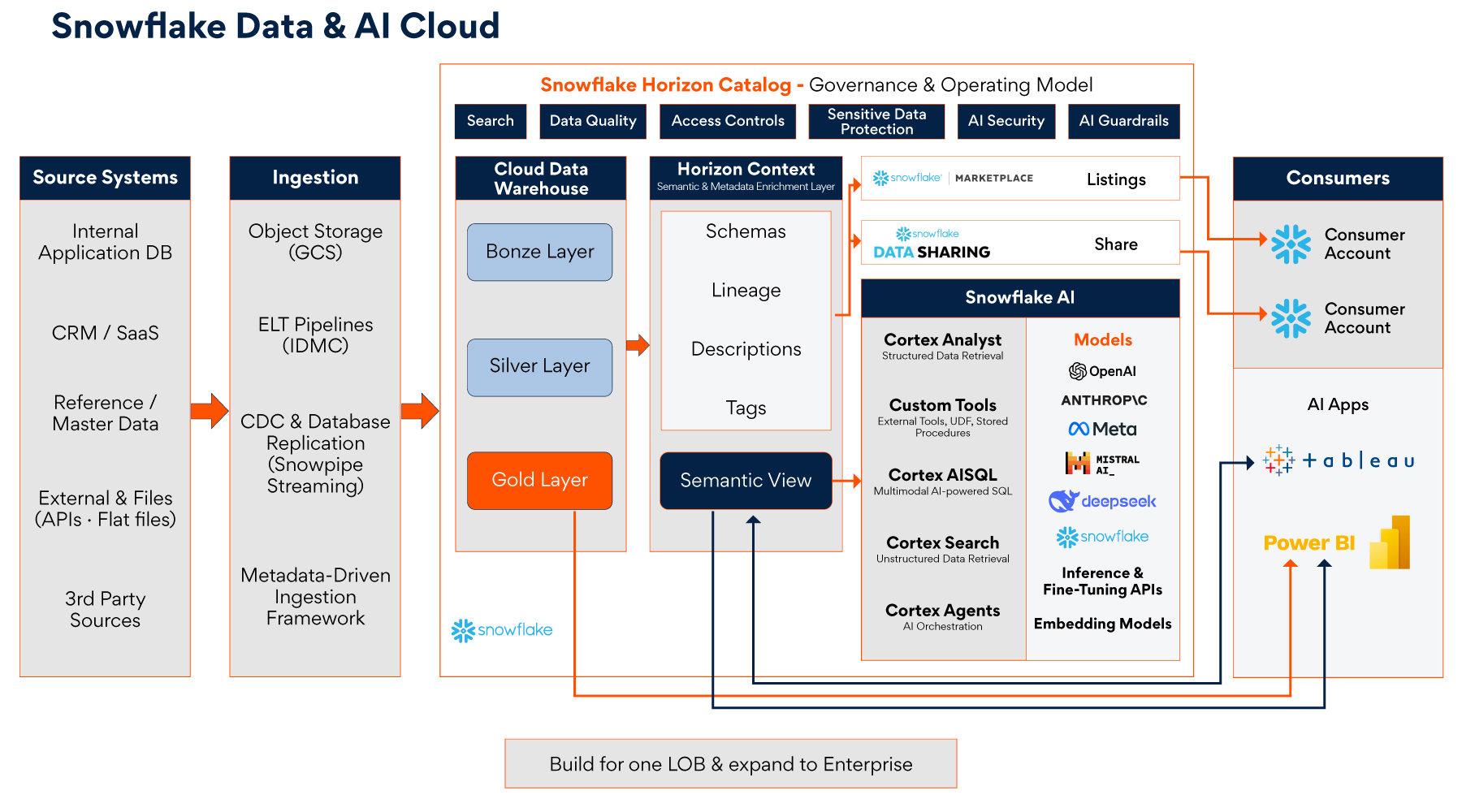
- The Gold layer acts as the core business layer, where data is curated, cleansed and conformed data is ready for consumption.
- Snowflake Horizon Catalog provides centralized governance and operating controls across the platform, including search, data quality, access controls, sensitive data protection, AI security and AI guardrails to ensure trusted and secure data consumption.
- Horizon Context is the governed context layer built into Horizon Catalog. It serves as the semantic and metadata enrichment layer ensuring all AI agents, BI tools and applications operate from a single source of truth.
- Snowflake Semantic Views are derived from the Gold layer and enriched by Horizon Context metadata. They contain all business logic, such as metric definitions, synonyms, hierarchies and RBAC context, creating a governed business representation of enterprise data.
- Power BI and Power BI Copilot connect to Snowflake Semantic Views via Direct Query for simple reporting needs, which is lightweight, governed and always current. Power BI connects to the Snowflake Gold layer via Import mode for complex dashboard needs requiring richer visualizations or offline capability.
- Cortex Analyst consumes Snowflake Semantic View directly for natural-language queries, translating business questions into governed SQL without human intervention.
- Custom and AI/ML agentic applications consume Snowflake Semantic Views for any AI or machine learning workflow, inheriting all governance controls.
- Existing Power BI models can also be exported to Snowflake Semantic Views. This capability is currently in preview.
The semantic layer is therefore not a constraint on any single tool. It is the common foundation that makes every tool more trustworthy and every AI interaction more reliable.
What this leads to: Shared business definitions improve trust, simplify governance, reduce model duplication and enable scalable BI, analytics and AI experiences.
Conversational AI Through Semantic Layer
A governed semantic layer enables conversational AI to answer business questions using approved metrics, business rules and definitions rather than exposing AI directly to raw database structures. This ensures consistency, transparency and alignment between conversational insights and enterprise reporting, regardless of how users access the data.
When both Power BI Copilot and Snowflake Cortex Analyst are aligned to the same semantic foundation, the decision is not about maintaining separate business logic. Instead, it is about choosing the user experience that best fits the analytical need.
Power BI Copilot is the preferred choice when Power BI serves as the primary analytics and reporting platform. It allows business users to interact with existing reports, dashboards, KPIs and visualizations using natural language, making it ideal for guided analysis, executive reporting and self-service exploration within a familiar BI environment.
Snowflake Cortex Analyst is the preferred choice when organizations require conversational analytics beyond traditional dashboards. It excels at ad-hoc questioning, root-cause analysis, advanced data exploration, AI-powered assistants and custom applications that need direct access to governed semantic definitions within Snowflake. It is particularly valuable when Snowflake is the strategic platform for enterprise data, analytics and AI.
By grounding both experiences in a common semantic layer, organizations ensure that business metrics are defined and interpreted consistently, whether users are consuming insights through Power BI reports or conversational AI experiences powered by Snowflake.
Visualization Through Semantic Layer
Visualization requirements vary between lightweight operational reporting and highly interactive analytical dashboards. Power BI can therefore consume Snowflake data through two pragmatic patterns.
- DirectQuery aligned with Snowflake Semantic Views is suited to lightweight, governed reporting where data freshness and centralized business definitions are important. Typical scenarios include current-state metrics, KPI scorecards, operational reports and dashboards with relatively simple interactions.
- Import mode from the curated Snowflake Gold layer is suited to complex dashboards requiring richer visual interactions, advanced DAX calculations, cross-filtering, offline capability or high responsiveness. Currently, Power BI import mode does not support native connectivity to Semantic Layer.
The appropriate pattern should be selected according to reporting complexity, freshness, performance and user-experience requirements. Both patterns can coexist within the same analytics environment. The objective is not to force every workload through one connectivity option, but to maintain consistent business meaning across the available consumption patterns.
Note:
As the platform ecosystem evolves, these consumption patterns may also evolve. Capabilities around Power BI model extraction, relationships, DAX calculation alignment and semantic interoperability are expected to influence how organizations design this layer over time.
Who Benefits
- Business users: Access consistent KPIs and trusted insights through familiar Power BI dashboards and natural-language experiences.
- Executives: Receive faster, explainable answers based on governed business definitions.
- Analysts: Use the same approved metrics for dashboards, ad-hoc analysis and conversational queries.
- Data and BI teams: Reduce duplicated logic, simplify model maintenance and manage semantic definitions through governed engineering practices.
- AI and application teams: Reuse trusted business context when building agents, analytical applications and AI-powered experiences.
Recommended Approach to Develop Conversational AI
Connecting an LLM to a database is not a production strategy. A reliable rollout requires coordinated business and engineering work:
Prioritize use cases: Begin with valuable, low-ambiguity questions in one domain.
Define domain boundaries: Specify in-scope entities, measures, time grains, filters and documents.
Prepare the semantic model: Document approved measures, business names, synonyms, verified queries, ownership and lineage.
Design orchestration: Route questions through retrieval, semantic mapping, policy checks and answer patterns.
Validate and govern: Benchmark against verified queries, explain important answers and review sensitive scenarios.
Measure and improve: Track question patterns, failures, adoption and semantic drift, then refine the model.
Implementation Roadmap
| Phase | Timeframe | Business focus | Technology focus |
| 1. Pilot | 2 months | Validate one domain with one or two KPIs | Build initial Semantic Views and enable AI, Power BI and SQL |
| 2. Productionize MVP | 2-3 months | Establish certified metrics, ownership and support | Add CI/CD, testing, governance, monitoring and standards |
| 3. Scale iteratively | 3-6 months | Expand KPIs and business domains | Extend catalog, integration patterns and self-service |
| 4. Mature | 6-12 months | Drive enterprise adoption and measurable reuse | Optimize performance, cost, governance and AI support |
How to Get Started
Select one business domain where metric inconsistency is visible and stakeholder demand is high. Establish approved KPI definitions, owners, synonyms, security rules and verified queries. Implement the semantic view, connect one Power BI experience and one conversational experience and measure consistency, adoption, response quality, performance and operating effort. The pilot should prove not only the technology, but also that governed meaning can be created once and reused across BI and AI.
The competitive advantage is not another dashboard or chatbot. It is an enterprise foundation where every user and every AI experience works from the same governed business truth.
Author’s Profile

Jolly Varghese
Senior Solution Architect

Yamini Godhani
Senior Architect