
Building the Enterprise AI Control Plane
As enterprises move from isolated Generative AI (GenAI) experiments to production-scale AI platforms, they face a common challenge: how do you securely govern, scale, monitor and optimize AI workloads across multiple Large Language Models (LLMs), clouds, agents and business applications?
While organizations need a platform to build and operationalize AI solutions, they also need a robust connectivity and governance layer to control AI traffic at scale.
This is where Persistent GenAI Hub and Kong AI Gateway create a powerful combination.
Together they help enterprises address three critical priorities:
- Accelerate AI adoption, govern AI usage and scaleg AI safely across functions
- Not treating governance as an afterthought
- Embed security, observability and policy enforcement into the AI delivery lifecycle
Persistent GenAI Hub provides the enterprise AI development and orchestration framework, while Kong AI Gateway delivers the governance, security, observability and traffic management layer required for production-grade AI deployments.
The Enterprise AI Challenge
Most enterprises today are dealing with:
- Multiple LLM providers such as Azure OpenAI, OpenAI, Anthropic and Google Gemini
- Growing adoption of AI agents and agentic workflows
- Data governance and compliance requirements
- Rising token consumption costs
- Need for observability and auditability
- Risk of vendor lock-in
- Security concerns around prompts, responses and sensitive data
Many organizations discover that building AI applications is relatively easy. Operating them securely and efficiently across the enterprise is significantly harder.
The challenge is not just technical complexity, it is achieving business outcomes at scale. Organizations are looking to accelerate AI solution delivery, reduce operational risk, optimize model consumption costs, improve governance readiness and avoid long-term dependency on a single AI provider. A successful enterprise AI platform must enable innovation while maintaining operational control and economic efficiency.
What is Persistent GenAI Hub?
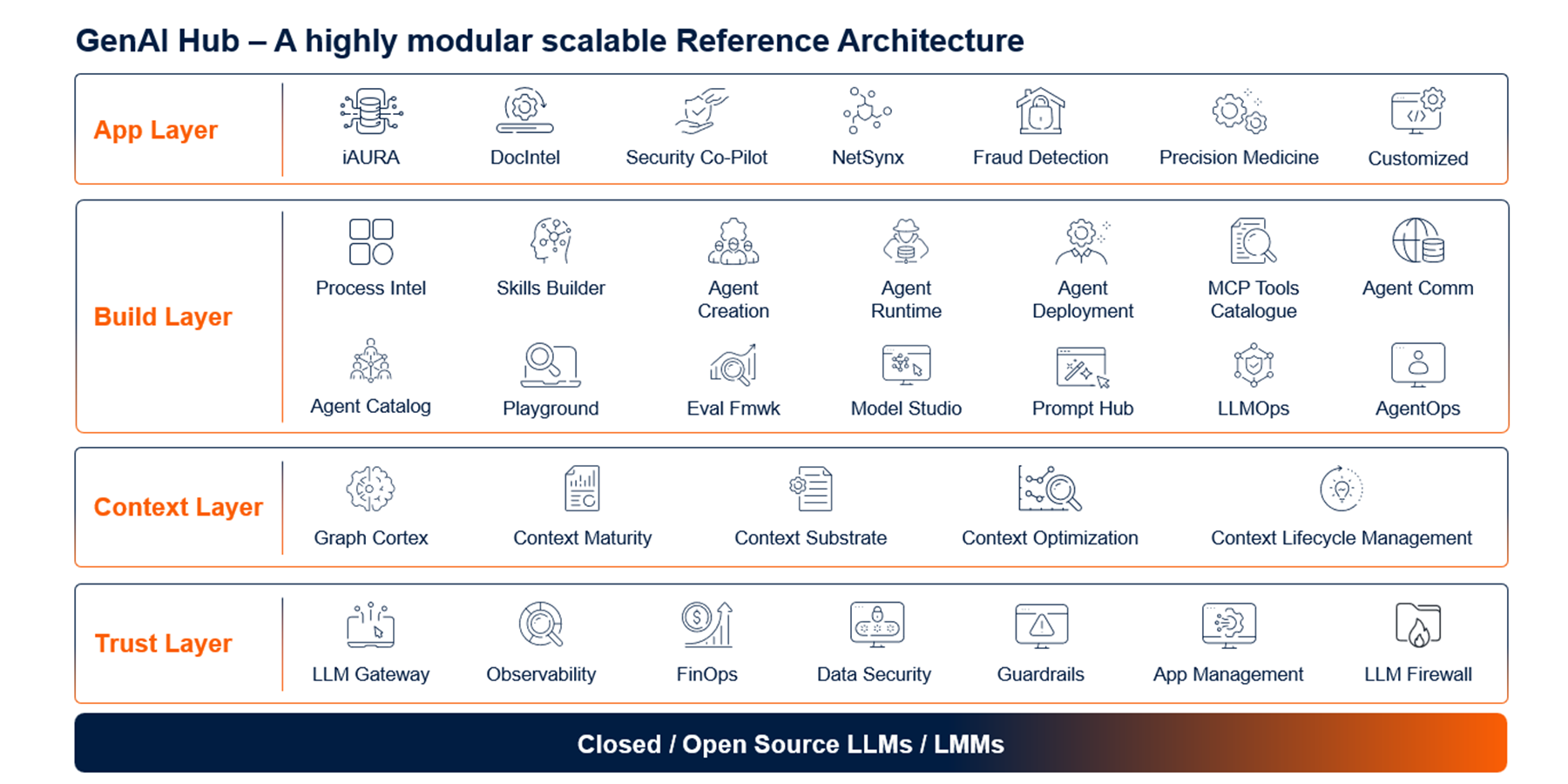
Persistent GenAI Hub is a Responsible AI platform designed to help organizations experiment, build, scale and govern GenAI applications across multiple LLMs and cloud platforms. The platform supports secure multi-model adoption while avoiding provider lock-in and includes key components such as:
- Playground
A no-code environment that enables business and domain users to interact with enterprise data through multiple LLMs using a unified interface. Supported providers include Azure OpenAI, AWS Bedrock, Google Gemini and open-source models. - Agents Framework
An extensible framework supporting AI application development and Retrieval-Augmented Generation (RAG) use cases using technologies such as LangChain and LlamaIndex. - Evaluation Framework
A governance capability that applies an “AI validating AI” approach to measure performance, bias, drift and overall application quality. - Gateway
A routing layer across multiple LLMs that helps manage compatibility, service prioritization, load balancing, token consumption visibility and cost tracking. - Custom Model Pipelines
Support for integrating custom LLMs and SLMs while enabling model preparation, tuning and deployment across cloud and on-premises environments.
Where Kong AI Gateway Fits
As AI adoption grows, enterprises require a specialized AI governance layer.
Kong AI Gateway provides a provider-agnostic AI connectivity platform that routes traffic to multiple model providers while enforcing security, policy, scalability and observability controls. Kong positions AI Gateway as a governance layer for modern AI-native applications, agents, MCP servers and multi-agent systems.
Key capabilities include:
- AI traffic routing and load balancing
- Authentication and authorization
- AI rate limiting
- Token usage analytics
- Prompt governance
- PII protection
- Semantic caching
- Guardrails and content safety
- Multi-provider abstraction
- MCP and Agent-to-Agent governance capabilities
A Reference Architecture
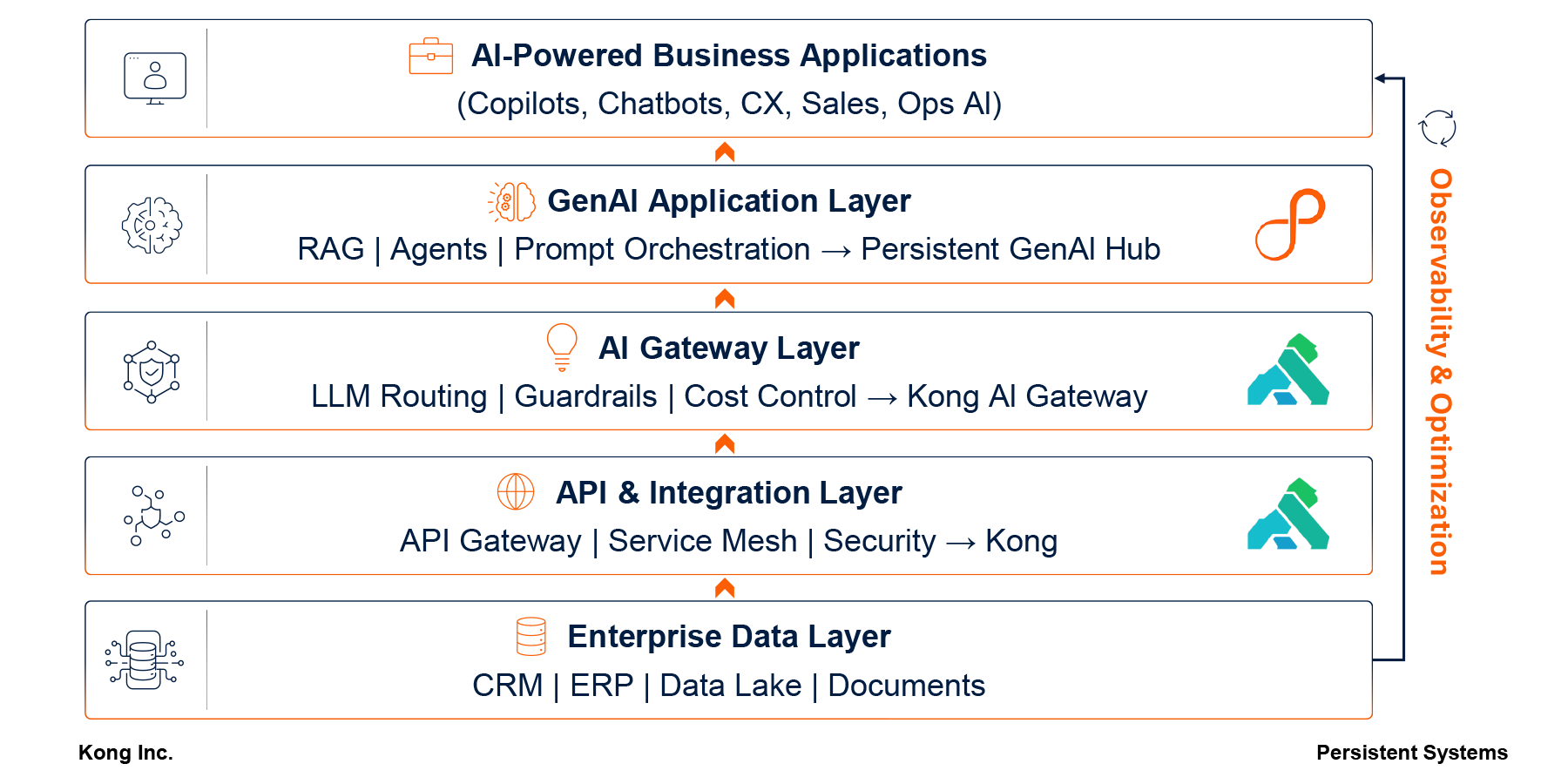
The combined architecture creates a clear separation of concerns between AI innovation and AI governance.
Consider a global life sciences organization building Medical Affairs copilots, Scientific Information assistants and Regulatory Intelligence solutions. Persistent GenAI Hub enables business users and developers to experiment with multiple LLMs, deploy RAG-based applications and orchestrate specialized AI agents. Kong AI Gateway provides centralized authentication, token monitoring, prompt governance, content safety controls and provider routing. This allows the organization to innovate rapidly while maintaining compliance, auditability and operational oversight.
Why This Combination Works
1. Accelerating Enterprise AI Delivery
Persistent GenAI Hub enables rapid experimentation and AI solution development through its playground, agent orchestration and model management capabilities.
Kong complements this by providing a consistent runtime layer that abstracts model providers and standardizes access across the enterprise.
2. Reducing Vendor Lock-In
Persistent GenAI Hub was designed to support multiple LLM providers and clouds.
Kong further strengthens this strategy through provider-agnostic AI routing and traffic management, allowing organizations to dynamically shift workloads between model providers based on cost, performance or availability.
3. Governing AI Consumption
Enterprise adoption often creates visibility challenges.
Kong’s AI traffic analytics provide insights into token consumption, request volume, latency, errors and usage trends.
These insights enable organizations to make data-driven decisions around model selection, provider usage and workload optimization. Combined with traffic routing, failover policies and semantic caching, enterprises can improve service efficiency while better managing AI operating costs.
When combined with Persistent’s evaluation and governance frameworks, organizations gain a comprehensive view of both AI quality and AI consumption.
4. Securing Enterprise AI
Security cannot be an afterthought.
Persistent GenAI Hub emphasizes Responsible AI and governance-driven AI adoption.
Kong extends these controls with:
- AI access control
- Prompt inspection
- Rate limiting
- Content safety integrations
- Data protection mechanisms
- Centralized policy enforcement
The Future: Agentic AI at Scale
As enterprises move toward agent-based systems, governance becomes even more critical.
Persistent’s Agent Studio and agent-centric AI capabilities help organizations build and orchestrate intelligent AI agents.
Kong’s emerging support for MCP and Agent-to-Agent (A2A) governance provides the operational controls needed when dozens or hundreds of agents begin interacting with enterprise systems and external AI services.
The result is an architecture capable of supporting the next wave of enterprise AI adoption without sacrificing security, compliance or operational visibility.
Conclusion
Enterprise AI success requires more than choosing the right LLM. It requires a platform for building AI applications and a control plane for governing AI traffic.
Persistent GenAI Hub provides the foundation for developing, orchestrating and scaling AI solutions across multiple models and environments. Kong AI Gateway adds the critical enterprise capabilities of security, governance, observability, traffic control and provider abstraction.
Together, they enable organizations to move beyond AI experimentation and establish a secure, scalable and future-ready AI platform that supports GenAI, RAG, AI agents and emerging agentic ecosystems.
Build with Persistent. Govern with Kong. Scale AI with confidence.
Author’s Profile

Satish Pagare
AVP Technology – Data and AI