
There is a problem hiding in plain sight inside most large enterprises today. It is not a shortage of AI. It is a surplus of it going nowhere. The average large organization has deployed dozens of AI tools across functions: a copilot here, a chatbot there, an automation layer bolted onto a legacy system that was already struggling. Each tool solves a fragment of a problem. Hardly any of them talk to each other. And the employee in the middle, the one who was supposed to benefit from all of this, is still toggling between portals, chasing approvals over email and waiting on a helpdesk ticket that has been open for days.
Persistent saw this fragmentation happening across its own 27,000-plus employee organization and made a decision that most technology companies are not disciplined enough to make. Before building anything for clients, they would build it for themselves. They would become their own toughest test case. And they would not ship it outward until it worked inward. That decision produced AssIstX.
AssIstX: One Umbrella, Thirteen Agents, One Philosophy
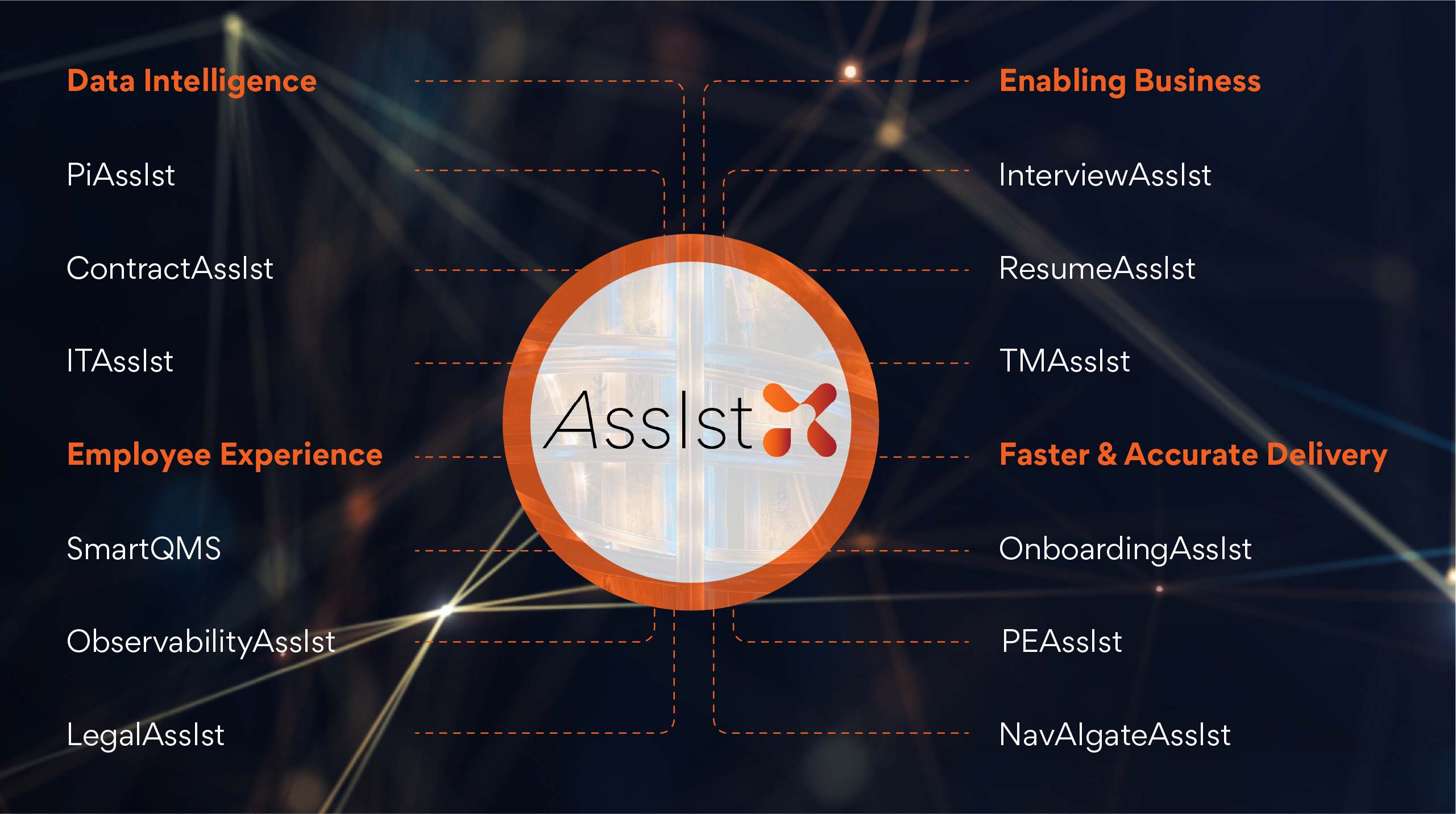
AssIstX is not a single product. It is an AI operating system: a modular, intelligent framework that sits across an enterprise’s core workflows and orchestrates a constellation of purpose-built agents, each designed to remove friction from a specific high-value moment in an employee’s day.

Sagar Laddha, Chief Product Officer at Persistent Systems and the architect of AssIstX, is direct about why the team chose depth over a single general-purpose layer. “Most enterprises make the mistake of building one AI layer and calling it done. A single assistant trying to handle HR, contracts, legal and IT simultaneously ends up being average at everything and excellent at nothing. We made a deliberate choice to build specialist agents, each one deeply trained on the specific data, rules and workflows of its domain. That specificity is what makes the difference between AI that impresses in a demo and AI that people actually use every day,” said Laddha.
That philosophy is visible across the full portfolio. Under the AssIstX umbrella sit 13 specialist agents spanning every critical enterprise function:
PiAssist
Handles the full HR lifecycle, from timesheets and leave requests to travel, onboarding, appraisals and career development.
ContractAssist
Streamlines contract management end to end, cutting cycle times by 70 percent inside Persistent.
ITAssist
Resolves IT support queries without escalation, reducing helpdesk dependency significantly.
LegalAssist
Puts policy guidance in the hands of the people who need it without a helpdesk ticket.
ResumeAssist
Accelerates talent screening and shortlisting for revenue generating roles.
InterviewAssist
Reduces time to hire by streamlining the interview and evaluation process.
CareerAssist
Gives employees agency over their own growth and development pathways.
SalesAssist
Supports pipeline management and deal execution for revenue teams.
RenewalAssist
Protects and grows recurring revenue by automating contract renewal workflows.
ObservabilityAssist
Monitors systems in real time and flags issues before they become incidents.
SmartQMS
Drives quality governance and audit readiness across delivery functions.
NavAlgateAssist
Simplifies navigation of complex internal business processes and approvals.
OnboardingAssist
Delivers a frictionless first-day and first-week experience for new joiners.
What makes AssIstX architecturally different from a unified copilot is precisely this: it uses the right agent for the right moment, orchestrated through Semantic Kernel and Azure OpenAI, delivered inside Microsoft Teams where employees already work and governed through a Zero Trust security layer integrated with Oracle Fusion, Salesforce, SharePoint and multiple other enterprise systems as live systems of record.
The Customer Zero Moment
What separates Persistent’s story from almost every other enterprise AI narrative being told right now is sequence. Most technology companies build a product, sell it to clients and then use client deployments to refine it. Persistent inverted that model entirely. Every agent in the AssIstX framework was deployed internally across its own organization first, stress-tested by real employees with real workflows before it went anywhere near a client. This is termed as the customer zero philosophy.
The number that stops people is this one: ContractAssist reduced contract cycle times by 70 percent inside Persistent, bringing average contract closure from around 20 days down to under six. Email communication in the contracting process dropped by 90 percent. For a company where deal velocity directly drives revenue, that is not an efficiency gain. That is a strategic advantage.
For Laddha, the deployment moved from a technology milestone to something more meaningful when the human impact became visible. “I remember the moment I knew this had genuinely changed something. One of our senior engineers told me she used to spend the first 40 minutes of every Monday morning just doing admin. Timesheets, reimbursements, access requests. Three months after PiAssist went live she told me her Mondays felt different. That is not a productivity metric. That is the whole point. We were not building a tool. We were building back time for people who had better things to do with it,” he recalled.
That internal proof gave Persistent’s leadership the conviction to articulate the philosophy externally. As CEO Sandeep Kalra put it:
When Satya Nadella takes notice

Independent validation at this level does not come often. In late 2025, Microsoft CEO Satya Nadella called out Persistent by name on stage as a leading example of enterprise AI done right. It was not a prepared mention in a partner announcement. It was a live, unrehearsed reference to what the company was doing as an example worth paying attention to.
Independent validation at this level does not come often. In late 2025, Microsoft CEO Satya Nadella called out Persistent by name on stage as a leading example of enterprise AI done right.
It was not a prepared mention in a partner announcement. It was a live, unrehearsed reference to what the company was doing as an example worth paying attention to.
That recognition extended further. The Persistent story was selected for Microsoft’s coffee table book “From First-Mover to Frontier: The Firms Driving AI’s Next Leap in India and South Asia” and the company earned the designation of Frontier Firm — reserved for organizations that are not just adopting AI but actively redefining what it looks like in practice.
ContractAssist drew specific attention as one of the earliest declarative Copilot use cases. It has since won multiple awards including a CII award for digital innovation and is now showcased to global clients as a market-ready blueprint.
The Discipline Most AI Programs Skip
For Laddha, the external recognition reinforced what the internal deployment had already proven: that the gap between AI that looks good and AI that actually works comes down to one discipline most companies skip. “The question I get most from CIOs is why their AI pilots are not delivering results. And the answer is almost always the same. They built AI for systems instead of building it for people. At Persistent we started with a different question entirely: will this reduce friction for the person doing the work? If the answer was not a clear yes, we did not build it. That discipline is what customer zero gave us. When your own people are the users, you find out very quickly what works and what does not,” he said.
Before a single line of code was written, the team mapped core enterprise journeys end to end: Order-to-Cash from lead generation through contracting to delivery, Hire-to-Retire from recruitment through career development and HR operations and Procure-to-Pay from vendor onboarding through approvals and payment. At every step the question was the same: will this reduce friction, speed up a journey, cut costs or improve a decision? If the answer was not a clear yes, AI was not applied.
That discipline produced something unexpected: a platform employees actually want to use. AssIstX lives inside Microsoft Teams and Outlook, so there is no new system to learn, no new login and no new interface. The AI comes to where people already work.
The same philosophy extended to how new agents get built. Gig Garage, a low-code and pro-code platform, allows employees across functions to co-create agents themselves. Domain experts, not just engineers, can design and launch agentic solutions — AI innovation embedded into the culture of the organization rather than handed down from a technology function.
The Blueprint is the Product
What started as an internal transformation engine has become something more significant. AssIstX is now how Persistent delivers AI-powered enterprise transformation for clients worldwide — the internal deployment is the proof of concept, the agents are the IP and the customer zero philosophy is the methodology.
For every CIO staring at a landscape of disconnected AI tools and wondering why the promised productivity gains have not arrived, the answer is direct: the problem is not the tools. It is the absence of an operating system that connects them, governs them and measures them against business outcomes from day one.
AssIstX is that operating system — built the only way it believes enterprise technology should ever be built: by living inside it first.
Contact us
(*) Asterisk denotes mandatory fields