
Product Engineering Challenges in Manufacturing
Today’s manufacturers face increasing pressure to deliver complex products faster while maintaining cost targets, quality metrics and compliance requirements. Modern products combining hardware and software systems require seamless collaboration across multiple engineering disciplines, making traditional workflows increasingly difficult to manage. With engineering teams spread across different locations, organizations struggle with data latency network security, and data architecture instead of focusing on innovation and product development. Physical infrastructure limitations make it difficult to scale resources based on project needs, creating bottlenecks during peak development periods. Additionally, meeting industry standards and regulatory requirements becomes more complex with legacy systems, while connecting ELM with modern tools, IoT devices, and analytics platforms requires complex, manual integrations.
This approach focuses on deploying cloud-based IBM Engineering Lifecycle Management (ELM) platform on AWS to overcome the limitations of traditional engineering infrastructure.
Recognizing these challenges, organizations are increasingly adopting cloud-hosted IBM Engineering Lifecycle Management (ELM) platforms to gain scalability, resilience, and operational efficiency. Persistent Systems Ltd, leveraging its two-decade partnership with IBM and Premier Tier AWS status, offers enterprises a pathway to modernize their ELM environments on AWS today.
Why Modernize IBM ELM
Traditional IBM ELM deployments were not designed for today’s systems-of-systems. Relying on on-premises hardware, VPNs, and siloed data architectures, they create bottlenecks across key areas:
Collaboration: Remote teams face slow access and limited connectivity, creating communication gaps that hinder productivity and delay project delivery.
Scalability: Physical infrastructure limits growth, requiring costly hardware investments, while modern digital solutions allow flexible, on-demand capacity.
Maintenance: On-premises setups demand constant upkeep, diverting resources from innovation and slowing response to evolving engineering needs.
This modern approach centers on establishing IBM ELM environment on AWS designed to address the limitations of traditional infrastructure.
Why Choose AWS for IBM ELM
IBM ELM on AWS allows organizations to modernize their engineering ecosystem while driving innovation, enhancing efficiency, and reducing costs. These capabilities are designed to support IBM ELM deployments on AWS. Key advantages include:
- On-demand global scalability: AWS facilitates the deployment of IBM ELM in a highly available architecture by distributing components across Amazon Elastic Compute Cloud (Amazon EC2) instances and Availability Zones. This allows scaling and managing key services such as Jazz Team Server, Engineering Workflow Management, DOORS Next, Engineering Test Management, and Global Configuration.
- High performance: Amazon Relational Database Service (Amazon RDS) for Db2 or Oracle supports the database layer, offering a fully managed, enterprise-grade solution. For shared storage needs, Amazon EBS volumes or SAN-based storage configured for NFS access provide reliable ensures reliable access to artifacts and configuration data. This architecture delivers resilience, scalability, and enterprise-level performance throughout the ELM ecosystem.
- Automated setup: For ELM v7.1, there is also a containerized deployment option that simplifies operations. A dedicated operator manages installation, configuration, upgrades, backups, and recovery, automating complex tasks to reduce manual intervention and ensure consistency. The operator streamlines the process for installing and rolling back preliminary fixes.
- Full traceability: Continuous monitoring of nodes, with automatic restart on failure, helps maintain uptime. The backup and restore processes encompass container configurations, settings, and secrets. Automated collection of logs and configuration details accelerates diagnostics and problem resolution. This containerized approach guarantees that ELM environments remain stable, secure, and easier to maintain.
- Security and compliance: With AWS’s Well-Architected Framework, robust security, including encryption, identity management, and compliance certifications, becomes the default. Organizations can confidently host ELM in the cloud while meeting industry and regulatory requirements.
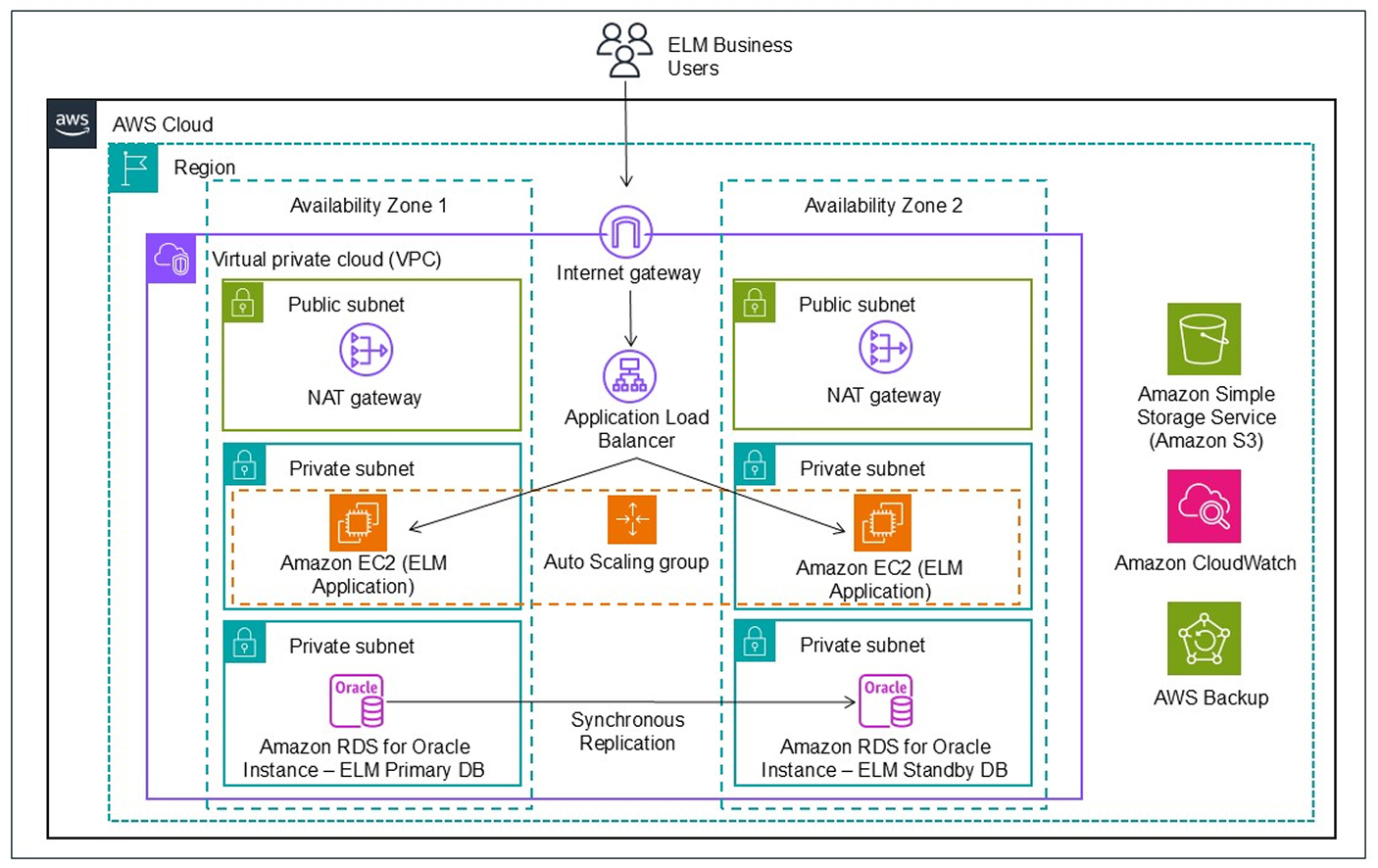
The following reference architecture applies to IBM ELM deployments on AWS.
We’re setting up a secure and scalable cloud environment:
- Private Network (VPC): Your own isolated space in the cloud.
- Public Zone: Handles internet traffic through a load balancer and allows secure admin access.
- Private Zone: Where your application and database live, protected from direct internet exposure.
- Load Balancer: Ensures smooth traffic distribution and high availability.
- Application Servers (Amazon EC2): Run your app and scale automatically as needed.
- Database (Amazon RDS): A secure, managed database with automated backups and updates.
Begin by establishing a secure AWS environment. Create a Virtual Private Cloud (VPC) that includes both public and private subnets and configure the necessary security groups. This architecture provides a clean foundation for deploying IBM ELM in the cloud without the constraints of legacy infrastructure. Deploy Amazon RDS for Oracle instance to manage the database and launch Amazon EC2 instances to host the Enterprise Lifecycle Management (ELM) components.
On the Amazon EC2 instances, install Java and the IBM Installation Manager. Afterwards, set up the Jazz Team Server (JTS) and other ELM applications, ensuring they are connected to the Amazon RDS for Oracle database via JDBC (Java Database Connectivity).
In the public subnet, configure an Application Load Balancer (ALB) to distribute incoming traffic. Enable HTTPS for secure access and define health checks for the instances to monitor their availability. Implement user authentication through LDAP (Lightweight Directory Access Protocol) or Single Sign-On (SSO) integration.
To maintain system performance, utilize Amazon CloudWatch for monitoring. Additionally, schedule regular backups to guarantee data protection and reliability. This design ensures security, high availability, and scalability for your application.
Pre-requisites for Setting IBM ELM on AWS
These prerequisites apply to organizations implementing a cloud-based IBM ELM solution on AWS.
To maximize the benefits of transitioning ELM to cloud, companies must possess expertise in data, technology, domain knowledge, and cloud management. Persistent can help operate, manage, and maintain ELM on AWS with:
- Domain and Technical Expertise: Persistent’s experts in IBM Engineering Lifecycle Management (ELM) possess extensive experience from IBM product teams. They assist in replicating complex engineering workflows in the cloud, ensuring speed, scalability, security, and efficient change management. Our support includes global configuration management, complex deployments, server tuning, and upgrades, all backed by certifications in IBM ELM tools and standards such as ASPICE, ISO 26262, and SAFe.
- Data Engineering and Analytics: Transitioning from on-premises to the cloud necessitates careful attention to data accuracy, security, accessibility, and compliance. Persistent utilizes cloud data solutions boost developer productivity and improve product delivery within IBM ELM environments.
- Cloud Integration: Persistent offers comprehensive ELM support, including installation, configuration, customization, and training. We facilitate seamless automation and integration with other cloud-based engineering tools through standards like OSLC and solutions such as Persistent Connectors.
A Case for Modernizing Engineering for a Manufacturing Leader with AWS
The manufacturing customer is a global Tier-1 supplier in the aerospace industry, operating across multiple regions and supporting large, distributed engineering and product development teams. The organization runs complex, regulated development processes and requires strong governance, traceability, and scalability across its engineering lifecycle.
The customer experienced challenges related to scalability, performance, and reliability in its traditional engineering infrastructure. These limitations impacted the ability to effectively support globally distributed teams and slowed product delivery cycles. In addition, the operational overhead of managing infrastructure including provisioning, maintenance, backups, and recovery diverted focus away from core engineering and innovation activities.
To address these challenges, the customer adopted a cloud-based IBM Engineering Lifecycle Management (ELM) solution hosted on AWS. The new environment was designed to overcome the limitations of the legacy setup by leveraging cloud-native scalability, resilience, and managed services. This approach enabled the organization to either transition workloads from traditional infrastructure or establish a new, modern ELM deployment aligned with current and future engineering needs.
By hosting the engineering solution on AWS, the organization significantly improved its ability to scale resources on demand and support globally distributed teams. Infrastructure setup times were reduced, enabling engineering teams to focus on product development and accelerating time-to-market by approximately 30–40% for new features.
System performance improved by up to 35% using Amazon RDS, optimized storage, and high-performance networking. These enhancements reduce latency, increased throughput, and improved responsiveness across engineering workflows, allowing teams to manage data, artifacts, and configurations more efficiently.
Automated backups and point-in-time recovery using Amazon RDS snapshots and Amazon S3 ensured rapid restoration of data, configurations, and baselines when needed. The AWS environment also delivered enterprise-grade security through IAM-based access control, encryption at rest and in transit, VPC-based network isolation, and compliance with standards such as ISO, SOC, and GDPR helping ensure the ELM platform meets stringent regulatory and compliance requirements.
Conclusion
Modernizing IBM ELM with AWS and Persistent allows organizations to move beyond the constraints of traditional on-premises engineering environments, unlocking new opportunities for innovation, agility, and efficiency. By leveraging cloud-native capabilities—such as real-time insights, on-demand scalability, and intelligent automation—teams can collaborate effortlessly across different locations, speed up their time to market, and enhance compliance. Supported by Persistent’s established modernization framework and proven success stories, this transformation leads to measurable business outcomes and equips engineering organizations to succeed in a rapidly changing digital landscape.
This approach enables organizations to deploy cloud-based IBM ELM environments that align with modern engineering, security, and compliance requirements.
Ready to Transform IBM ELM with AWS?
Partner with Persistent to future-proof your engineering platforms. Whether you are planning a strategy assessment or a new cloud deployment, our team is ready to help.
Contact us to begin your journey toward a modern, cloud-powered engineering environment.