
In a large enterprise, a service desk copilot may handle three very different requests in the same hour: an employee asking for the company holiday policy, a team lead asking it to summarize a routine ticket and a legal reviewer pasting in a contract clause to check for compliance exposure. All three may look like ordinary prompts, but they should not draw on the same level of model capacity.
When that happens, static model selection starts to break. When that traffic is routed to a premium model, the enterprise pays too much for routine work; when it is pushed to a lightweight model, requests that need deeper reasoning, domain nuance or higher confidence can suffer. The real challenge is not choosing the single best model but deciding how much model power each task deserves. The token economy enterprises must manage today is therefore an architecture problem: one way to solve it is to make model choice a platform decision rather than an application-by-application trade-off.
Autorouter enables this by putting a governed routing layer behind one endpoint, evaluating each request against policy and sending it to the right approved model or model pool before spend, quality or risk become hard coded into individual workflows.
Why Model Choice Needs a Control Layer
- Cost discipline: High-volume, low-complexity traffic should not consume premium model capacity by default. Routing enables teams to reserve expensive models for work that justifies the cost, while everyday requests run on efficient tiers.
- Quality control: Complex, ambiguous or high-risk prompts need more than a default model path. They should be escalated to stronger models that can handle deeper reasoning, interpret nuance and reduce the likelihood of shallow or incomplete responses.
- Application resilience: Applications should not have to change every time a model is replaced, repriced or deprioritized. A routing layer keeps model-specific decisions out of application logic, allowing platform teams to evolve the model strategy centrally without creating downstream rework.
- Governance: As more teams build with GenAI, enterprises need to know which models are being used, why requests are routed to them and whether usage aligns with approved policy. A routing layer creates that control point, reducing ad hoc model access and making routing decisions easier to review.
Taken together, these are not problems an application team can solve cleanly inside its own code. If cost, quality, resilience and governance all depend on how model capacity is assigned, the routing decision needs a place of its own: a shared layer between applications and the model estate. That is the role of a single virtual model.
One Endpoint, Governed Model Choice
Autorouter creates that shared layer by giving applications one endpoint to call, instead of asking each team to wire its workflow to a specific model, vendor or deployment. Behind that endpoint, platform teams manage the approved models, tier mappings, semantic rules, budgets and thresholds that determine how each request should be handled.
The architectural benefit is separation. Application logic stays focused on the user experience and workflow, while model strategy lives in the platform layer where it can be governed centrally. Autorouter plays a role similar to an API gateway for LLM access: it abstracts the complexity behind a stable interface, applies policy before routing and gives platform teams a control point across cost, quality, governance and resilience.
This separation becomes increasingly important in a model landscape that keeps changing prices shift, benchmarks change, new approved models enter the mix and risk policies get updated. Without a routing layer, every change can become application rework. With Autorouter, platform teams can adjust routing decisions centrally while applications continue to work through the same endpoint.
Once model choice is behind a shared endpoint, the next question is how the platform decides what each request deserves. That is where model tiers become useful: not as rigid buckets, but as a practical way to translate cost, risk, quality and business context into routing decisions.
Building a Token Economy with Model tiers
Model tiers are configurable routing tiers that help enterprises match different kinds of work to the right class of approved models, based on cost, quality, risk and business context. Used well, they make the token economy more than a cost-control exercise; each tier can point to an approved model or model pool, giving platform teams a practical way to tune policy as workloads, model performance and commercial priorities change.
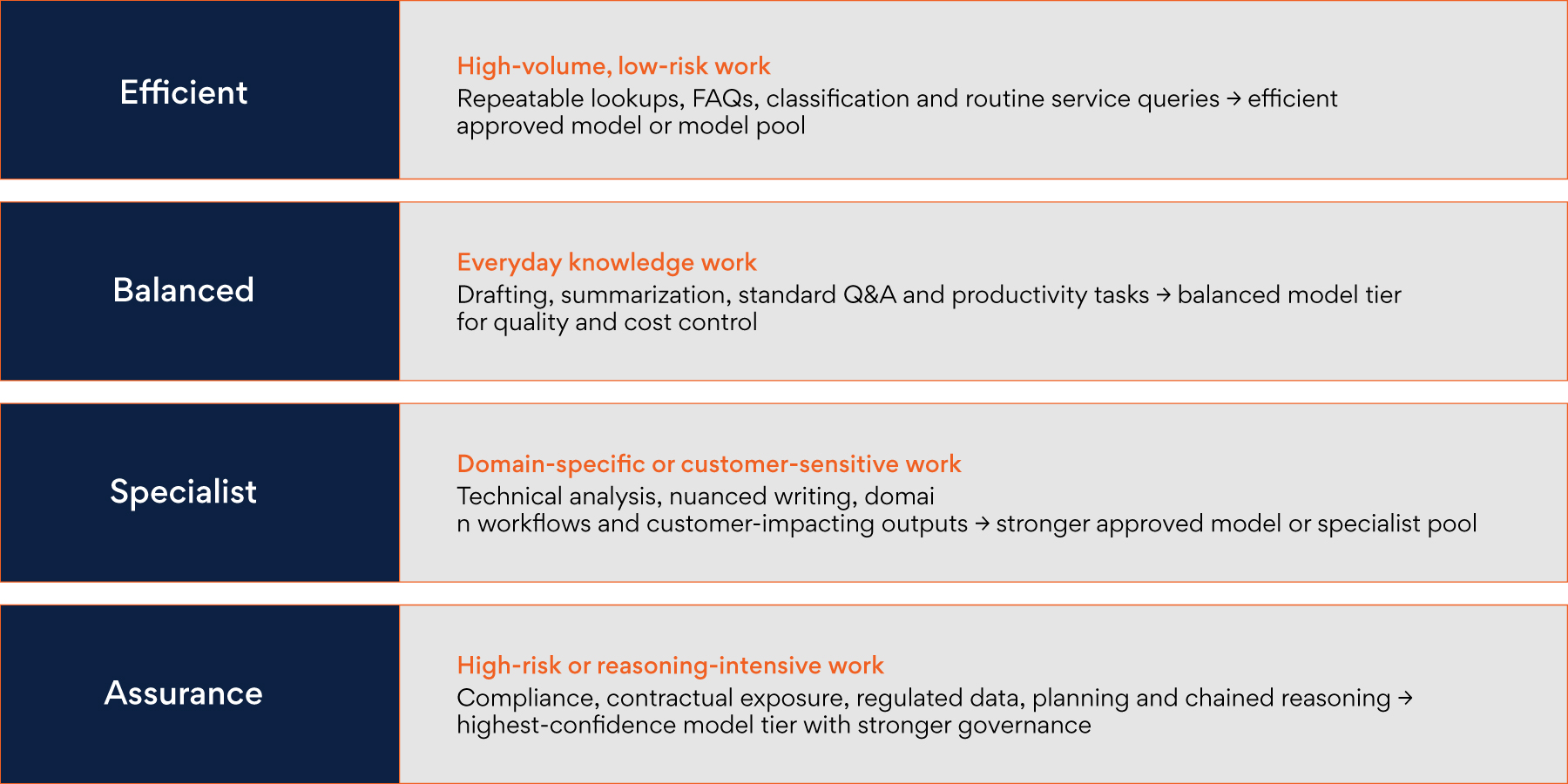
The important shift is that model selection becomes policy, not guesswork. Application teams no longer have to judge request by request when a stronger model is justified; the platform provides a shared decision framework that can be governed, measured and improved over time.
Evaluation and Routing of Prompts
The tiering framework becomes meaningful only when it can be applied at the moment a request comes in. The illustration below shows that flow: one application request enters Autorouter, is classified against policy, tiers and business context, then routes to the appropriate approved model or model pool before a single response is returned.
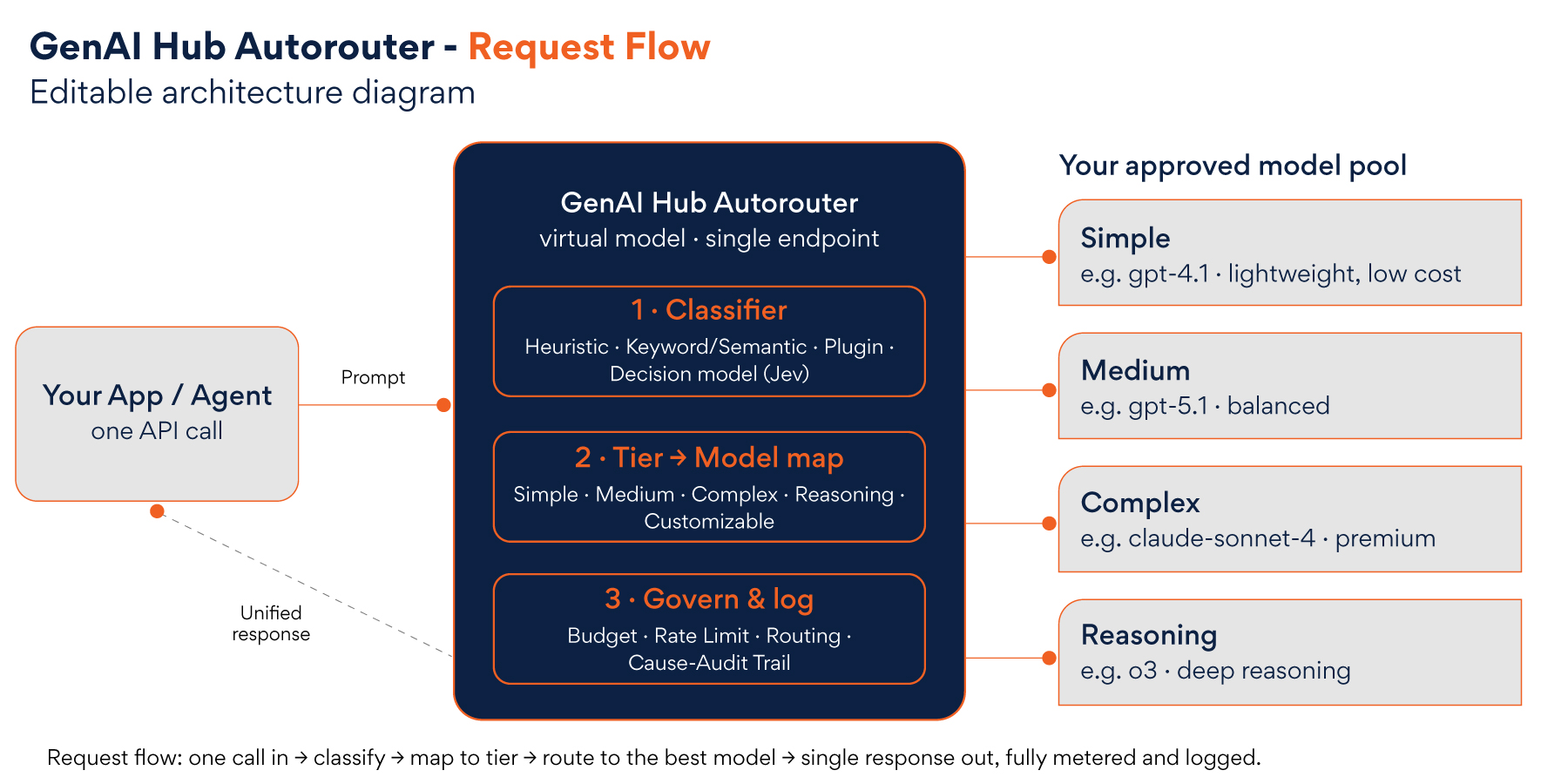
Applied consistently, this routing pattern becomes more than feature configuration. It becomes the operating model for how model capacity is assigned, reviewed and improved across applications.
In GenAI Hub, administrators can control approved models, tier mappings, spend constraints and routing logs from one place, while platform teams adjust policies or model pools as usage patterns change. Developers keep a simple integration path, and the enterprise gets more predictable cost, quality and governance without rebuilding application workflows.
The Next Control Plane for Enterprise GenAI
The next step in enterprise GenAI is not simply adding more models or giving teams more choice. As usage scales, enterprises need a control plane that can make decisions consistently across applications.
Today, that control plane starts with tiers, policies, semantic rules, approved model pools, budgets and logging. Over time, it should become more adaptive, learning from quality signals, cost patterns, latency, user feedback and changing risk posture so routing can move beyond cost optimization and continuously align GenAI performance with business value. Autorouter is a step toward that future because it puts model choice where it belongs: in the platform layer, where it can be governed, optimized and improved as GenAI scales.