
Autonomous networks have become a board-level priority for telecom operators, but the conversation often gets reduced to a technology question: How much more can the network automate? But before we get into the details, let us address the elephant in the room.
Every conversation about “autonomous networks” eventually runs into a jargon wall. So before going further, here is the map. TM Forum defines six levels of network autonomy, running from L0 to L5:
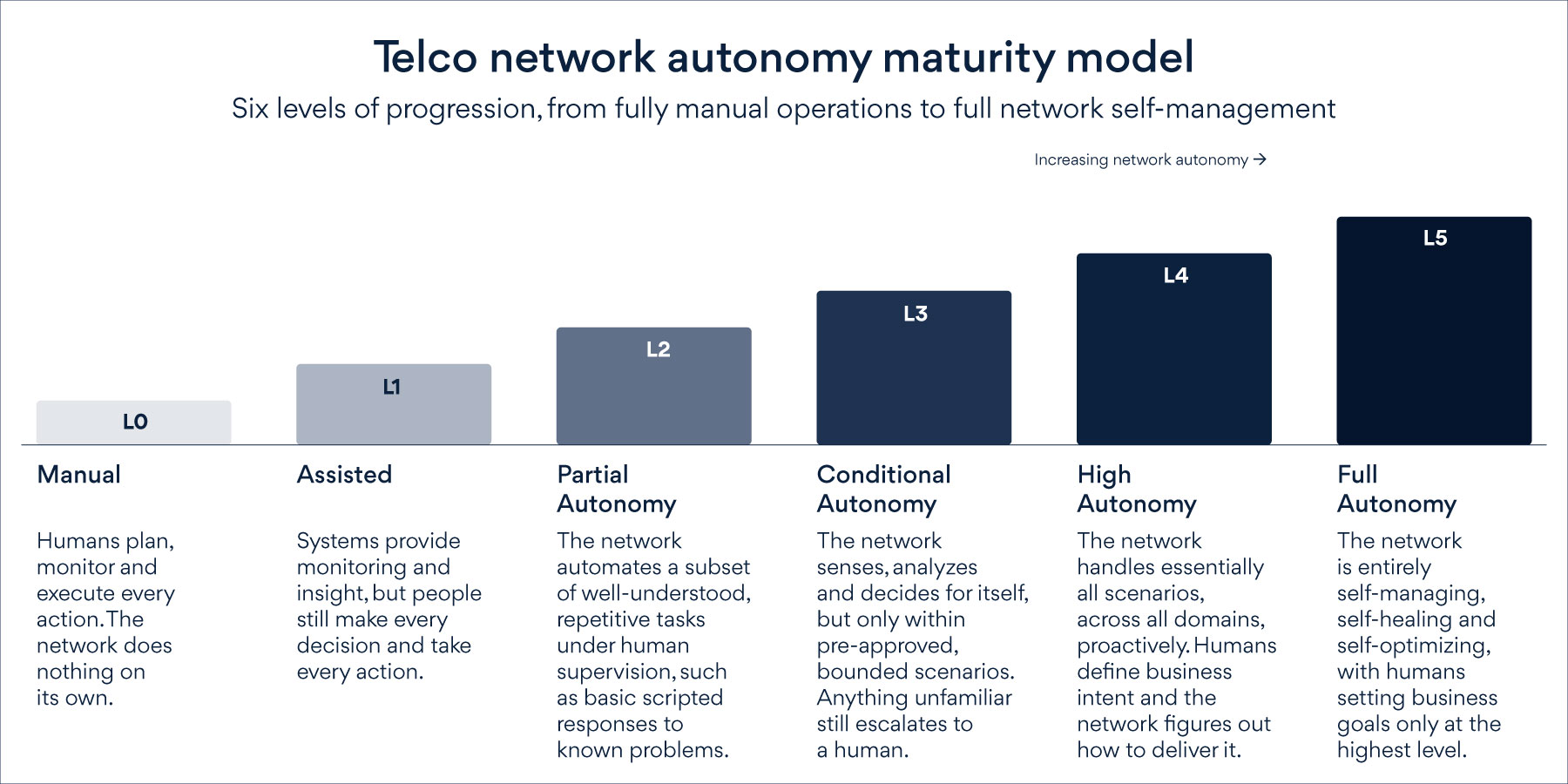
Almost the entire industry today lives between L1 and L3. That is precisely why the L3→L4 transition is the one that matters most right now. It is the boundary between “the network does what we told it to do” and “the network figures out what we want and does it.” Only a handful of operators globally have reached true L4 in even a single domain.
Why L3 to L4 Network is a Different Kind of Transformation?
At L3, the operating model recognizes situations it has been trained to recognize, executes pre-approved playbooks and hands off anything new or complex to a humans. At L4, the system stops being a decision engine executing playbooks and becomes what is best described as an agent — it reasons about a situation, generates a plan, tests that plan in simulation, executes it, watches the outcome and adjusts, thus it requires three architectural capabilities that simply do not exist at L3:
- An agentic AI layer — multi-agent systems (an orchestrator plus specialist agents for assurance, optimization, prediction and operations) that can coordinate autonomous decisions across domains, not just within one.
- A Digital Twin runtime — a live, continuously synchronized simulation of the network that lets the AI validate an action’s impact before it touches production.
- A live intent layer — the interface (TM Forum’s TMF921 Intent Management API, paired with an LLM that translates natural-language business intent into machine-executable policy) through which humans set strategic direction and the network does the rest.
Everything else in the L4 stack, telemetry, RCA models or orchestration, is an evolution of what a mature L3 operator already has.
The TM Forum Scaffolding Operators Forget to Check
Much of the industry’s attention is focused on the visible layers of L4 autonomy, such as agentic AI, digital twins, intent-driven orchestration and autonomous decision-making. But these capabilities only work when they sit on top of a mature operational foundation.
In practice, L4 initiatives stall because operators attempt to introduce autonomous decision-making into environments where processes, data models and system integrations are still fragmented. Before an operator can trust an autonomous network to act independently, four foundational elements need to be in place:
- eTOM automation: Fulfilment, Assurance and Billing must run end-to-end without manual stitching.
- SID conformance: One live, operational data model, that RAN, Core and Transport actually read from and write to in real time.
- Open TMF APIs: A solid L3 base (TMF621, 622, 628, 638–642, 645, 652, 653, 656, 657) with L4 additions, TMF921 (Intent Management) & TMF633 (Service Catalog) to translate and match business intent to executable services.
- ODA Canvas: Resource and Service management deployed, so agentic components plug in without years of custom integration.
8 Gates before Anyone Touches the L4 Architecture
Because L4 is not achievable by upgrading individual components, it requires a fundamentally different operating model, a disciplined transformation treats a small set of prerequisites as hard, binary gates rather than nice-to-haves. In our experience running these assessments, the non-negotiables include:
- Autonomous closed-loop operation sustained across at least two domains for >6 months, with a false positive rate under 3%
- AI-driven root cause analysis achieving above 88% F1 score, sustained over six months of live operation
- A NOC override rate below 3% — the empirical signal that operational trust has been established, not just claimed
- A cross-domain topology graph that is live, more than 98% accurate and real-time synced
- The core assurance and inventory TMF APIs (TMF638, 639, 640, 641, 642, 656, 657) fully live and consumed by the orchestrator, not just implemented on paper
- An explainability layer where every automated decision carries a human-readable audit trail
- Formal CISO and legal sign-off on autonomous changes to core network elements, without a human change authority in the loop.
- The ODA Canvas deployed with at minimum Resource and Service management components in place
What Separates Genuine L4 Program from an Expensive AI Experiment?
At L4, the hardest questions are no longer technical, “Who is responsible when an AI makes a wrong autonomous decision that causes a two-hour outage for half a million subscribers?” is not a hypothetical a program can defer. If the board, the CISO and the regulator cannot answer it clearly before the program starts, L4 will be unwound the first time it happens — not because the technology failed, but because nobody had agreed who owns the failure.
This is also why the smartest operators are calibrating ambition rather than defaulting to a single “big bang” path. Three realistic routes tend to show up in practice:
- A domain-first path (full L4 in RAN first, 18–24 months, favored by first movers building board confidence before going wider)
- A multi-domain path (true TM Forum-certifiable L4 across RAN, Core and Transport simultaneously, 30–36 months, for Tier 1 operators with deep AI maturity and an executive mandate)
- A use-case-first path (L4-grade outcomes in two or three high-value areas like energy optimization and RCA within 12–18 months, for operators under cost pressure who need a board-visible win before committing further)
The Business Case Goes Beyond Costs
A defensible L4 business case has to answer three questions simultaneously and it’s worth being explicit that they are different questions requiring different evidence:
- The cost question: TM Forum benchmarks show 45–55% OpEx reduction vs. L1, 15–21% energy savings and 90%+ fewer SLA breaches vs. L2 — real, auditable once the gates above are cleared.
- The capability question: what can L4 do that L3 structurally can’t? Zero-touch execution, autonomous service/slice lifecycle management (including novel configurations) and predictive intervention before issues occur — not after.
- The competitive question: what if a rival gets there first? No TM Forum benchmark answers this — it takes market intelligence and a clear view of what autonomous unit economics can do that manual supervision can’t match.
How Persistent Helps Operators Cross the L3 to L4 Trust Gap
As a digital engineering company with deep roots in data engineering and a leadership position in agentic AI for autonomous networks, Persistent works across the gaps this transition exposes:
- Building the cross-domain data platforms and enriched knowledge graphs that make a Digital Twin trustworthy
- Engineering the multi-agent orchestration (assurance, optimization, prediction, operations agents working under a governed orchestrator) that turns AI from a decision engine into a reasoning system
- Implementing the TMF-and-CAMARA-aligned APIs that let intent flow cleanly from a business executive’s natural-language request down to network-level execution.
L3 to L4 will be won by operators who pair automation ambition with operational trust. The network’s job isn’t just to execute anymore — it must understand intent, act within governed boundaries and prove why. That’s the last mile of trust and it will define the future of autonomous networks.
Interested in benchmarking your network against the TM Forum AN maturity framework or scoping an L3→L4 roadmap for your operations? Get in touch with our Telecom & Media practice.
Author Profile

Prateek Agnihotri
Principal Solutions Consultant – Pre-Sales Communications, Media, Technology and Industrial