
Research reveals where GraphRAG adds value and where traditional RAG still works.
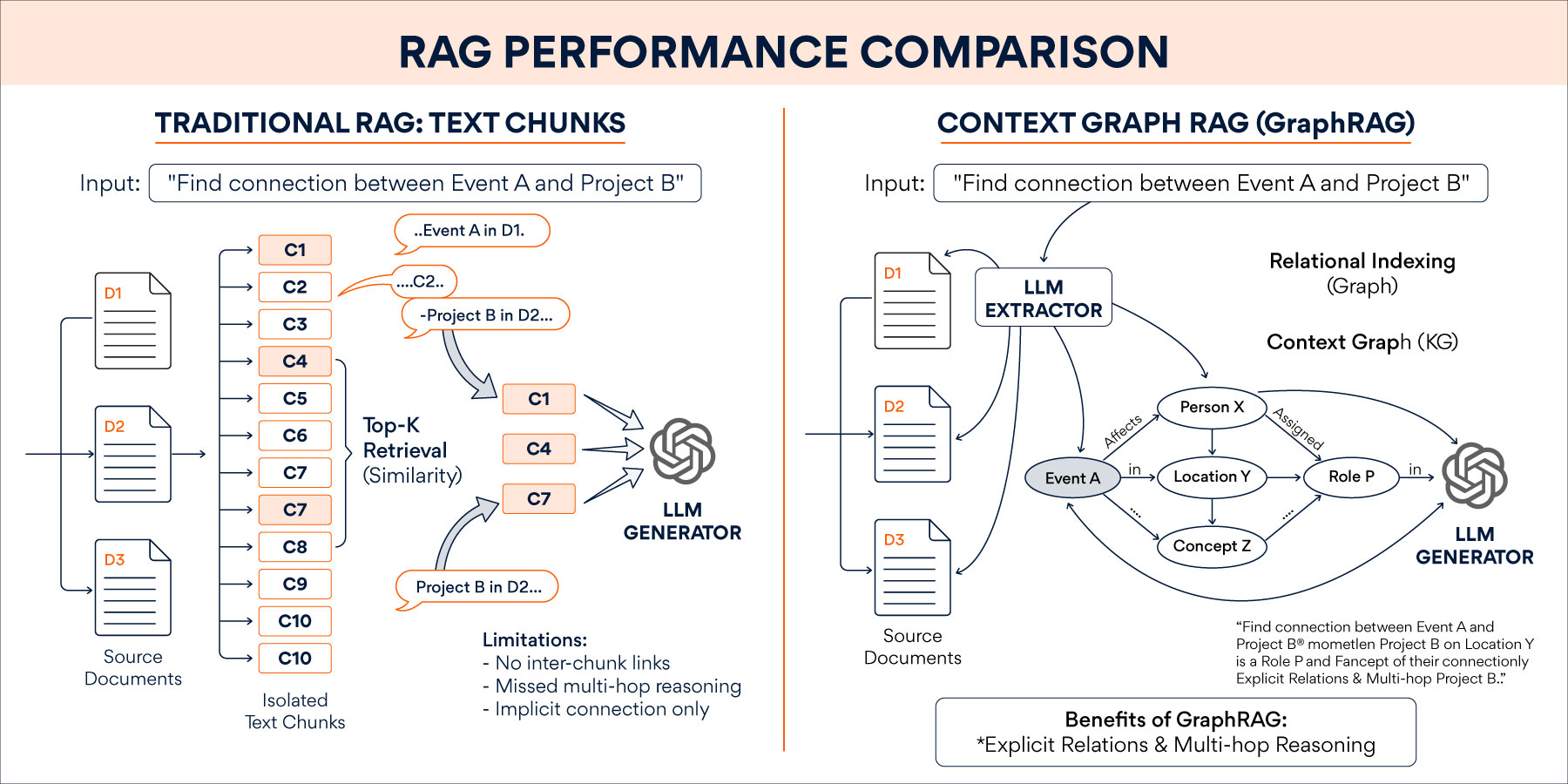
Everyone is bolting knowledge graphs onto their RAG pipelines. Here is what published research actually says about when GraphRAG helps—and when it doesn’t.
If you have built anything with retrieval-augmented generation (RAG) in the last two years, you have lived its central frustration. You chop your documents into chunks, embed them, retrieve the top few that look similar to the question and hand them to the model. For a question that asks, “What was our Q3 refund policy?,” this works beautifully. But for “What are the recurring themes across two years of customer complaints?,” it falls flat, because no single chunk contains the answer.
One answer gaining traction is GraphRAG. Instead of feeding the model isolated snippets, you first build a knowledge graph of the entities and relationships in your corpus and use that structure as context.
The promise is compelling, but does it hold up under scrutiny?
I reviewed the original Microsoft paper and four independent benchmark studies to answer a simple question: does GraphRAG deliver better answers?
The short version? Yes, substantially.
But the story is more nuanced than benchmark headlines suggest. GraphRAG delivers the greatest benefits on the right kinds of questions, but extracting that value requires additional work, infrastructure and trade-offs. Here’s what the research says.
Why text chunks hit a wall
Standard “vector RAG” retrieves the k passages most similar to your query. That design has three structural blind spots:
- It can’t connect the dots. When an answer requires joining facts that live in different passages through a shared entity, chunks embedded in isolation never reveal the link.
- It’s blind to global questions. “What are the main themes?” needs the whole corpus, but similarity search only returns the handful of chunks that superficially resemble the question.
- It severs context at chunk boundaries. The relationships and hierarchy that complex reasoning depends on are exactly what chunking throws away.
Microsoft Research framed this crisply when they introduced GraphRAG: baseline RAG “struggles to connect the dots” and performs poorly when asked to “holistically understand summarized semantic concepts over large data collections.”
What changes when context becomes connected
GraphRAG addresses the problem before any question is asked. During indexing, an LLM reads every chunk and extracts entities, relationships and claims, assembling them into a weighted knowledge graph. It then runs community detection (the Leiden algorithm) to cluster the graph into a hierarchy of related topics and pre-writes a natural-language summary for each community.
At query time, those summaries do the heavy lifting. Each relevant community drafts a partial answer (the “map” step), the partials are ranked and merged (the “reduce” step) and the model synthesizes a final response grounded in structure rather than in a few cherry-picked snippets. Variants like HippoRAG take a different route, using the graph plus a Personalized PageRank walk to find the right passages. However, the core idea remains the same: let relationships, not just cosine similarity, decide what context the model sees.
Viewed this way, GraphRAG is not simply a retrieval technique. It is an attempt to make organizational knowledge more explicit, connected and navigable for AI systems. In many enterprises, the data already exists.
The challenge is that business context is fragmented across documents, systems and teams. The growing interest in graph-based approaches reflects a broader realization: AI effectiveness increasingly depends not just on model quality, but on the quality and connectedness of the context provided to the model.
Four studies, one evident pattern
- When the whole corpus matters: In the original GraphRAG study, Microsoft pitted it head-to-head against naïve RAG on global, “make sense of the whole corpus” questions over million-token datasets, with an LLM acting as judge across three axes: comprehensiveness, diversity and empowerment. GraphRAG won 72–83% of comprehensiveness comparisons and 62–82% of diversity comparisons against vector RAG, while its highest-level summaries used up to 97% fewer tokens than processing the source text directly. That is not a rounding-error improvement. On exactly the kind of question that breaks text-chunk RAG, the graph wins two out of three times or better.
- When answers require connecting multiple facts: The second piece of evidence is about retrieval quality: does the right supporting passage even make it into the top results? On the standard multi-hop QA benchmarks (MuSiQue, HotpotQA, 2WikiMultiHopQA), graph-guided retrieval lifts Recall@5 dramatically:
- Average Recall@5 climbs from 73.4% (naïve RAG) to 87.8% (graph-guided) – a +19.6 point gain.
- The biggest jumps come on the hardest, cross-document sets: +31 points on MuSiQue and +28 points on 2Wiki.
- HippoRAG reports up to a 20% accuracy improvement on multi-hop QA – at 10–20× lower cost and 6–13× faster than iterative retrieval methods.
- When traditional RAG still wins: Here is where the story gains nuance. A 2025 study from Michigan State and Meta ran RAG against four GraphRAG families under one unified protocol —identical chunking, embeddings and generation —and found no single winner. The two approaches are complementary:
- On single-hop, factual lookup (Natural Questions), plain RAG edged ahead (F1 64.8 vs. 63.0 for the best graph method).
- On multi-hop reasoning (MultiHop-RAG), graph-guided retrieval pulled in front (70.3 vs. 67.0 overall accuracy).
- Matching retrieval strategy to the question: The most recent benchmark, GraphRAG-Bench (ICLR 2026), set out to answer “in which scenarios do graph structures provide measurable benefits?” Its accuracy-by-task numbers map the boundary cleanly:
- Simple fact retrieval: text chunks 60.9 vs. graph 60.1, effectively a tie. The graph’s structure is overhead the query doesn’t need.
- Complex reasoning: graph 53.4 vs. chunks 42.9, a +10 point graph win.
- Contextual summarization: graph 64.4 vs. chunks 51.3, a +13 point graph win.
The scorecard
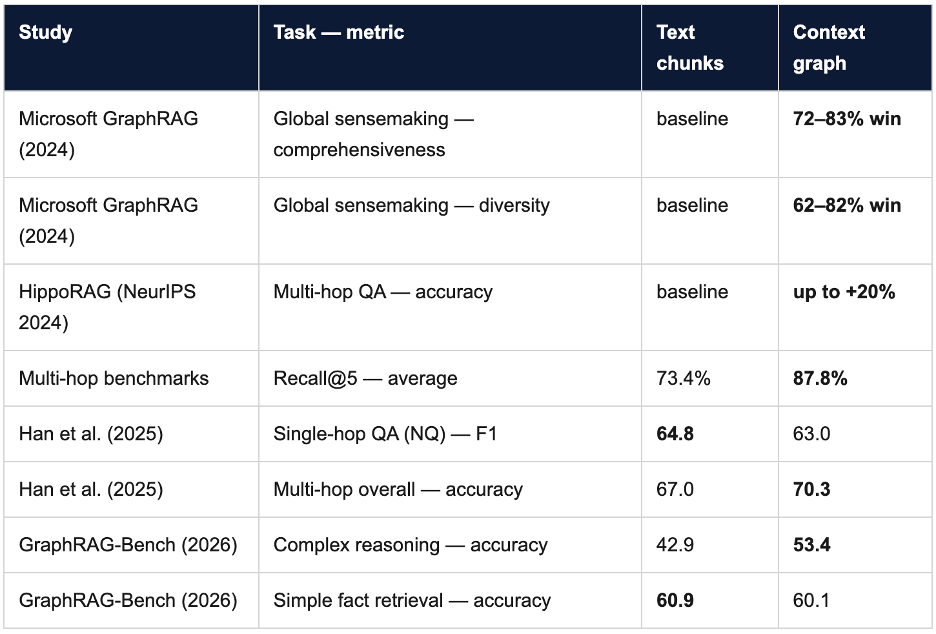
Read top to bottom, the pattern is unmistakable.The graph’s advantage grows with the reasoning depth of the question, while text chunks hold their ground on isolated facts.
The trade-off: cost and the LLM-judge problem
The results are impressive, but they do not tell the whole story. Two caveats are critical to understanding when GraphRAG is the right approach.
Building the graph is expensive. Having an LLM extract entities and relationships from an entire corpus isn’t cheap. One analysis put index construction at roughly $48 against GPT-4o for a moderate corpus, far above a vanilla vector index. Microsoft’s own follow-up, LazyGraphRAG, defers extraction to query time and cuts that to around 0.1% of the cost, a tacit admission that the original budget is impractical for many deployments.
Many of the wins are judged by another LLM and LLM judges are biased. An independent audit found systematic flaws in this evaluation style: position bias (swapping which answer appears first can swing the win-rate by more than 30 points), length bias and trial bias (identical comparisons disagree across runs). After correction, one popular method’s reported 66.7% win rate fell to about 39%, below the 50% break-even line.
The takeaway is not “the research is wrong.” It is that the large gains —the +20% multi-hop accuracy, the +15-to-30-point recall jumps —are robust, while narrow comprehensiveness margins deserve a skeptical second look with reference-based metrics.
Perhaps the most important lesson emerging from these studies is that the industry may be asking the wrong question. The goal is not to identify a universal winner between RAG and GraphRAG. Different questions require different forms of context. The real challenge is deciding which retrieval strategy best matches the reasoning demands of the task at hand.
So, when should you reach for a context graph?
Strip away the hype and the decision is refreshingly practical.
Use a context graph when your questions are multi-hop, global or sensemaking in nature, you need comprehensive, multi-perspective answers and your corpus is richly interconnected (research libraries, case files, incident histories, knowledge bases).
Stick with text chunks when your queries are mostly single-fact lookups, your corpus is small or flat and indexing cost, latency and operational simplicity outweigh a marginal quality bump.
Best of all, go hybrid. The systematic studies converge on the same recommendation: route each query to the right method or fuse evidence from both. Combining graph and chunk retrieval consistently beats either one alone. This is not an either-or decision. The most effective systems route different queries to different retrieval approaches based on the nature of the question.
The bottom line
A context graph is not magic and it is not snake oil. It is one of the earliest manifestations of a broader shift in enterprise AI: from searching for information to constructing context. The evidence suggests that when reasoning depends on relationships, patterns and connections spread across a corpus, graph-based approaches can provide a meaningful advantage. When the task is straightforward retrieval, simpler approaches often remain sufficient.
The larger implication extends beyond GraphRAG itself. As enterprises move from isolated copilots to increasingly autonomous AI systems, the question of context becomes central. Models continue to improve, but their ability to generate useful outcomes will depend on how effectively organizations organize, connect and govern the knowledge surrounding them. In that sense, the future may not belong to the retrieval method with the best benchmark score, but to the architectures that provide the right context at the right moment.
Sources & further reading
- Edge, Trinh, Cheng et al. (Microsoft Research, 2024). From Local to Global: A Graph RAG Approach to Query-Focused Summarization (arXiv:2404.16130). See also the Microsoft Research blog post.
- Gutiérrez, Shu, Gu, Yasunaga, Su (2024). HippoRAG: Neurobiologically Inspired Long-Term Memory for Large Language Models (NeurIPS 2024, arXiv:2405.14831).
- Han, Ma, Wang et al. (2025). RAG vs. GraphRAG: A Systematic Evaluation and Key Insights (arXiv:2502.11371).
- Xiang, Wu, Zhang et al. (2025/26). When to Use Graphs in RAG: A Comprehensive Analysis (GraphRAG-Bench) (ICLR 2026, arXiv:2506.05690).
- Independent LLM-as-judge bias audit (2025), arXiv:2506.06331.
Author’s Profile

Dattaraj Rao
Chief Data Scientist, AI Research Lab