
Enterprises no longer need only a clean record. They need trusted, connected, governed and explainable entity context that both people and AI agents can act on at the point of decision.
The entities that matter most are still fragmented
Business teams want sharper customer insight, data teams want cleaner foundations and AI initiatives need reliable context to reason, recommend and act. One foundational issue keeps slowing all three down.
Customer information sits in CRM, core banking, ERP, service, marketing, product and third-party platforms. Organizational hierarchies are stored differently across regions. Account and product data is duplicated or inconsistently defined. Relationship data is buried in flat tables, so it is hard to see how people, organizations, accounts, events and products actually connect. This is not only a data quality issue. It is a business confidence issue: when master records are inconsistent, teams cannot fully trust the insights, recommendations or AI-driven actions built on them.
The question every enterprise now faces is what happens when AI agents act on our behalf. Not answering questions or drafting summaries, but approving a transaction, recommending a product, deciding who a customer really is. Most organizations have not solved this, because their data was never built to be acted on by something that does not know when to ask a human for help.
Entity 360 was built for reporting. Agents need more.
Classic Entity 360 solved a real problem: the same customer or organization appearing differently across a dozen systems. Matching rules, stewardship workflows and golden records made the dashboard consistent. That was enough when the consumer was a human analyst who could apply judgement and route around bad data. It is not enough when the consumer is an autonomous agent deciding in milliseconds, with nobody in the loop.
- Slow to change. Hard-coded matching logic means a data engineering cycle for every new source or adjusted threshold.
- A record store, not a relationship store. It confirms a golden record exists but rarely shows how it connects to everything around it.
- Opaque. Most legacy tooling cannot explain why two records merged. Tolerable for a report. Not tolerable for an agent that must justify and possibly reverse, a decision.
Context, not more data, is what an agent needs
A capable model can still decide badly if it sees only a flat, ungoverned dump of records. It does not know that E. Smith and Erika Smith are the same person, that one company is a subsidiary of a group it already deals with or which of three conflicting phone numbers to trust. Without context an agent can only guess or stop and ask a human and at enterprise scale neither is good enough. The bottleneck was never model capability. It is context and context must be engineered, governed and kept current.
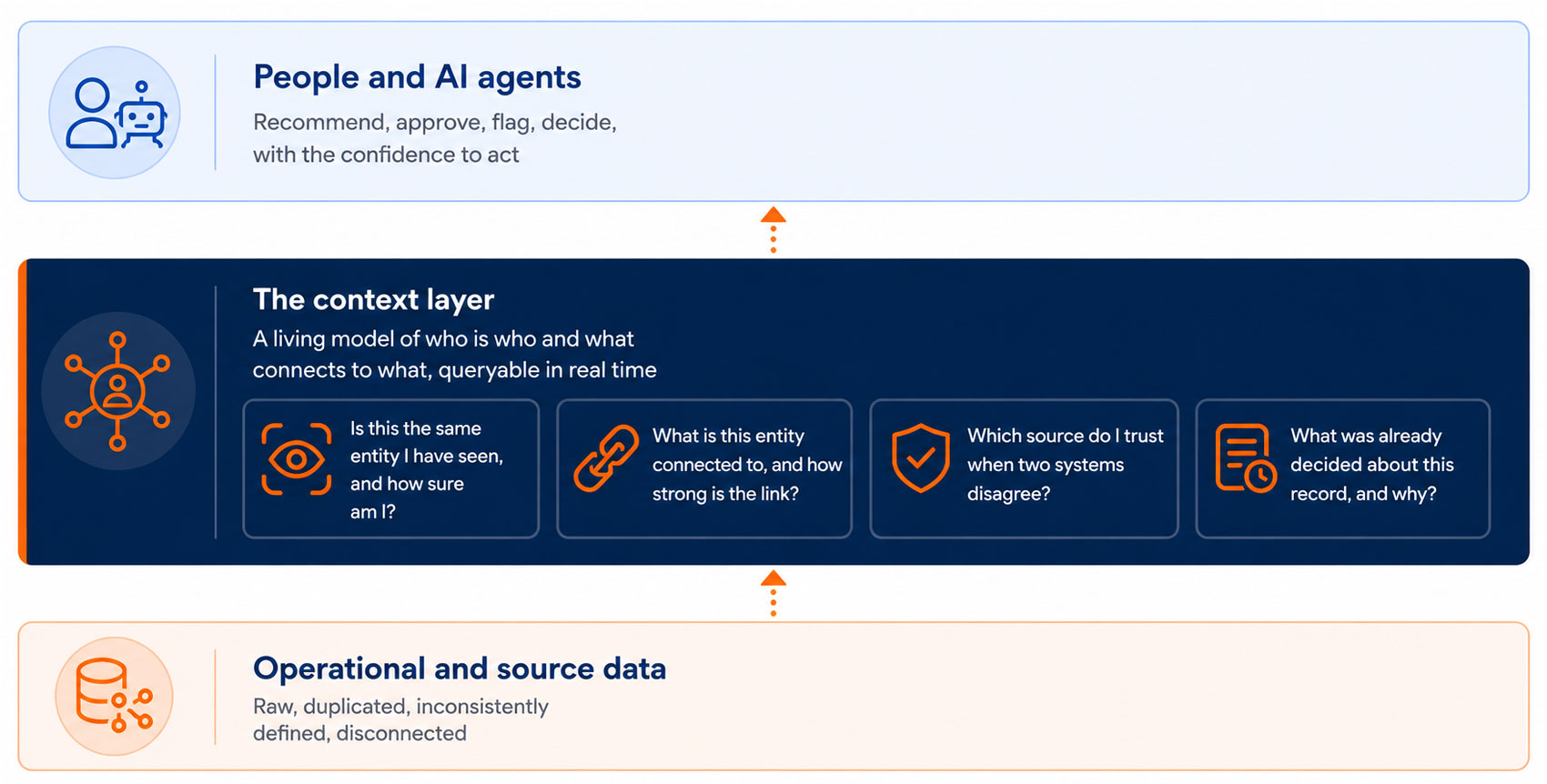
Context is the accumulated answer to four questions, held in a governed layer an agent can query in real time.
Mastering becomes a layer, not a hub
For two decades, mastering meant a separate system beside the data platform. Records were copied into a proprietary match-and-merge hub and shipped back on a batch cadence. Two copies of the data, two governance perimeters and master data that was always slightly behind reality. Tolerable for a report. A liability for an agent acting on what it sees.
Entity 360 removes that middle tier. Mastering runs as one more governed step inside the pipeline you already operate, with the logic held in configuration rather than welded into a vendor engine. The result is one governance perimeter, no egress and no round trip, a lower cost to own, portability across platforms and an audit trail that sits beside the data the agent acted on.
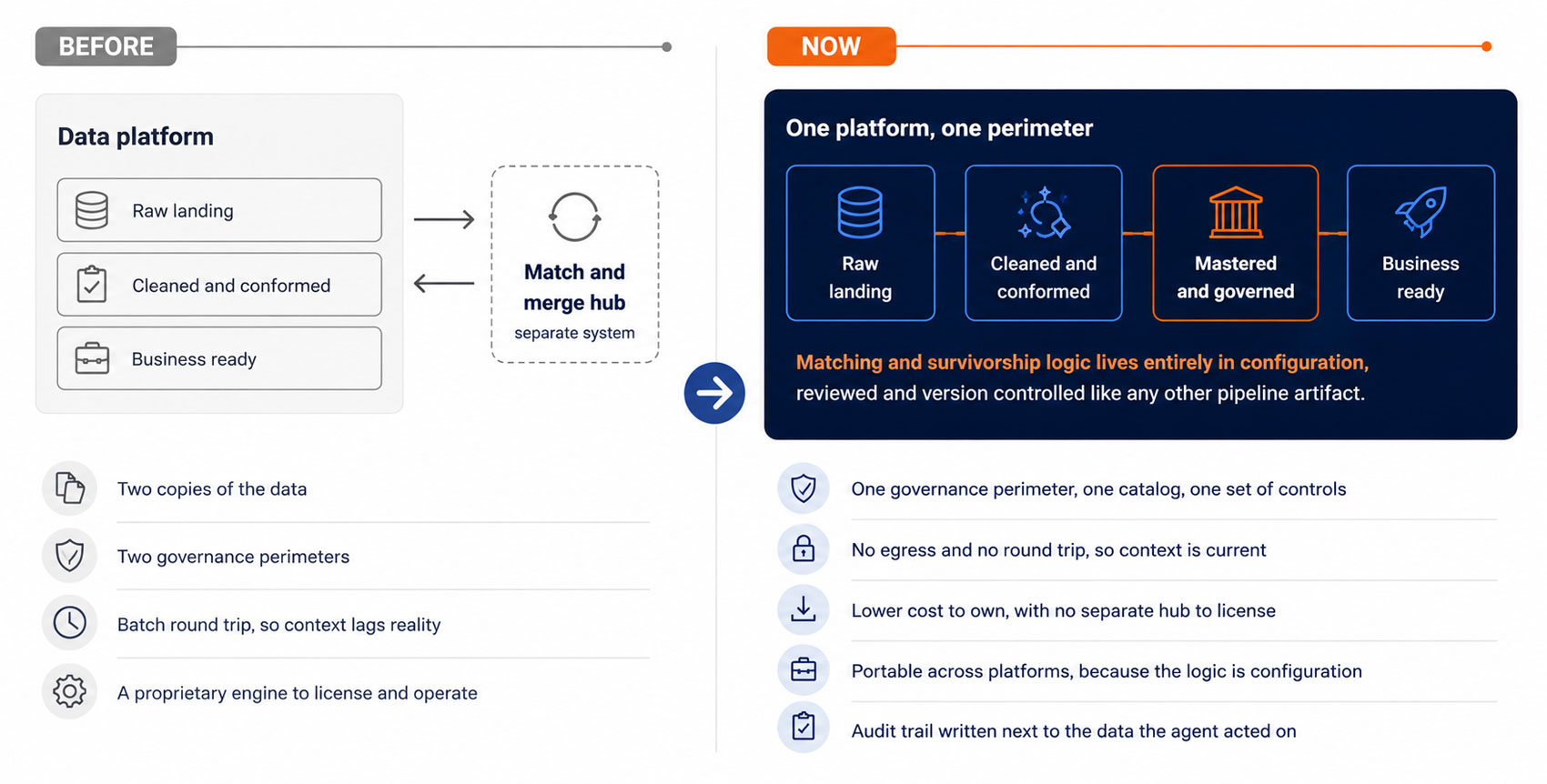
The same pattern runs on your selected Data Platform and Hyperscalar.
Introducing Persistent iAURA Entity 360
Part of the Persistent iAURA suite, Entity 360 resolves identity, consolidates relationships and delivers a governed golden record across Individual, Organization, Account and Product. It gives business users one profile they can rely on and AI agents one they can act on, without a rip and replace of the platform already in place.
- Configuration-driven identity resolution. Matching, standardization and enrichment rules adjusted without a custom engineering cycle, including AI-suggested rules a steward reviews and approves.
- Multi-domain mastering. Individuals, organizations, products, accounts and other connected business entities mastered within a single engine.
- Graph-native relationships. Every entity carries a living map of its connections, explorable as a knowledge graph rather than buried in joins.
- Explainable AI assistance. Merges proposed with a plain-language rationale and a confidence score, while matching itself stays deterministic and auditable.
- Dual-mode processing. High-volume batch mastering and real-time resolution, so the golden record is never stale.
- Search Before Create. New records checked against the mastered graph in real time, stopping duplicates at the point of entry rather than cleaning them up later.
- Entity 360 Knowledge Bot. A conversational layer that lets business users and downstream agents ask natural-language questions and receive grounded, explainable answers.
- Agentic project setup. One completed business requirement template becomes a fully configured project through an eight-agent onboarding pipeline, with no per-project code.
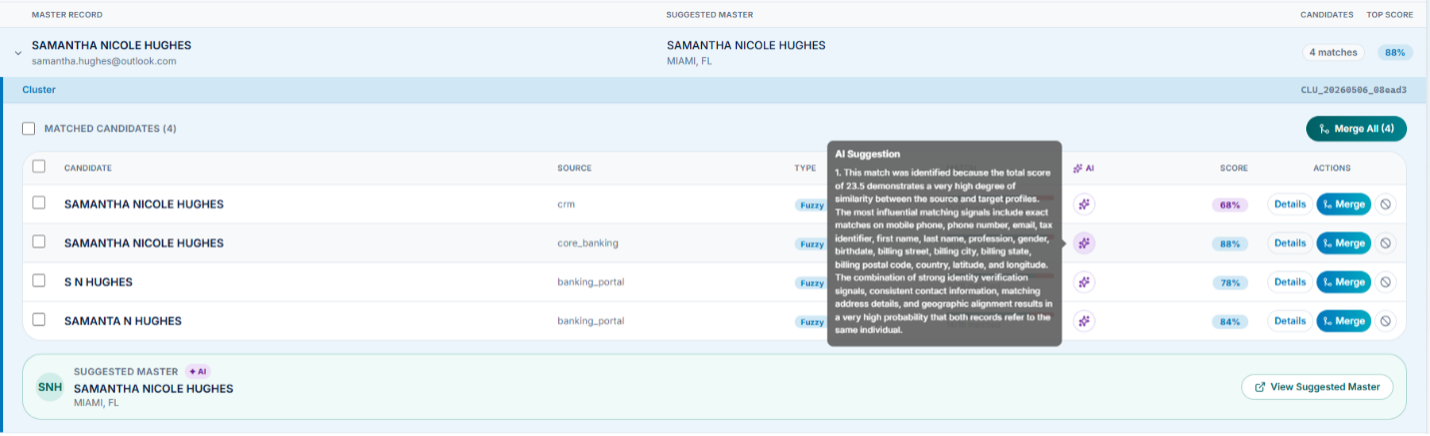
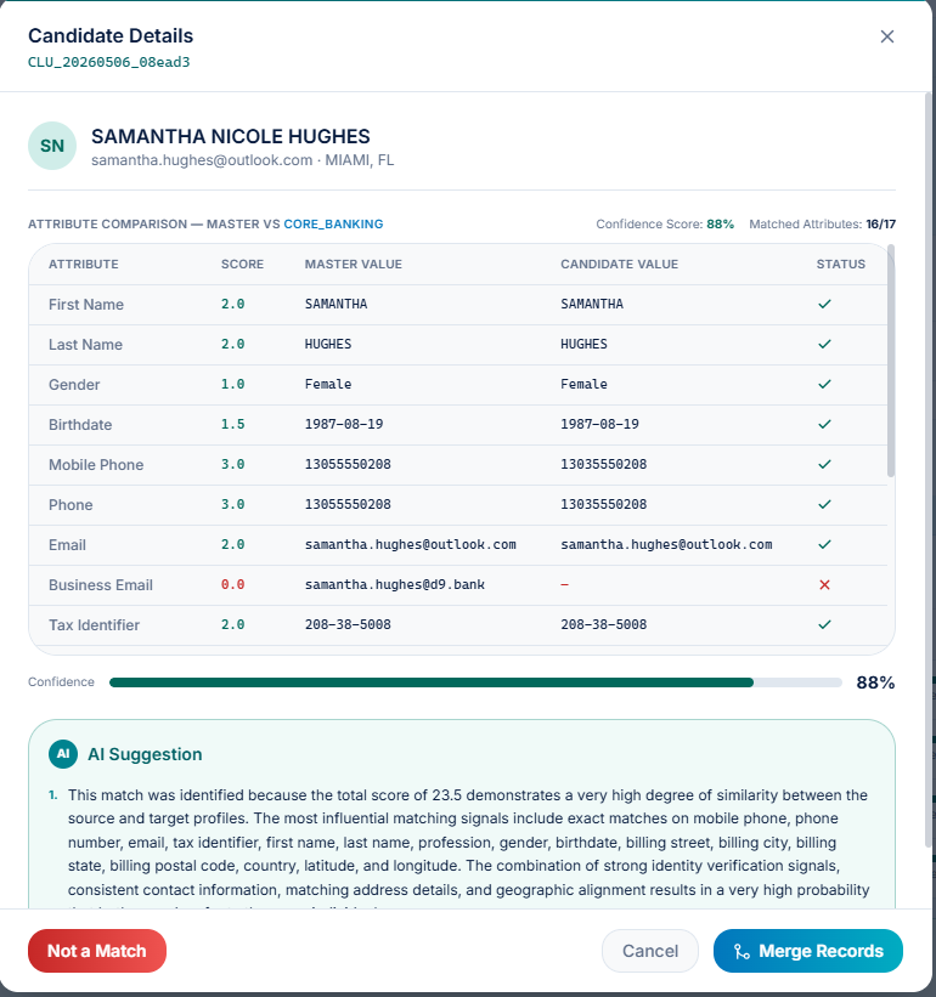
Stewards see the evidence, the confidence and the recommendation before approving, so automation stays governed rather than opaque.
Five places this earns its place
- Customer and member 360. One connected view of every customer, member or subscriber, with household and relationship context, powering personalised engagement, service and retention.
- Organization, supplier and partner 360. Legal hierarchy, ownership and related-party links that speed onboarding, due diligence and exposure assessment.
- Regulated and compliance-heavy industries. Full audit logs, versioned golden records and lineage supporting reporting obligations in financial services, insurance, energy and the public sector.
- Data platform modernization. Migrating off commercial MDM platforms onto a configuration-driven, lakehouse-native identity resolution engine.
- Governance and AI readiness. The identity resolution, relationship graph and golden-record layer that governance and AI teams need to trust and connect master data across domains.
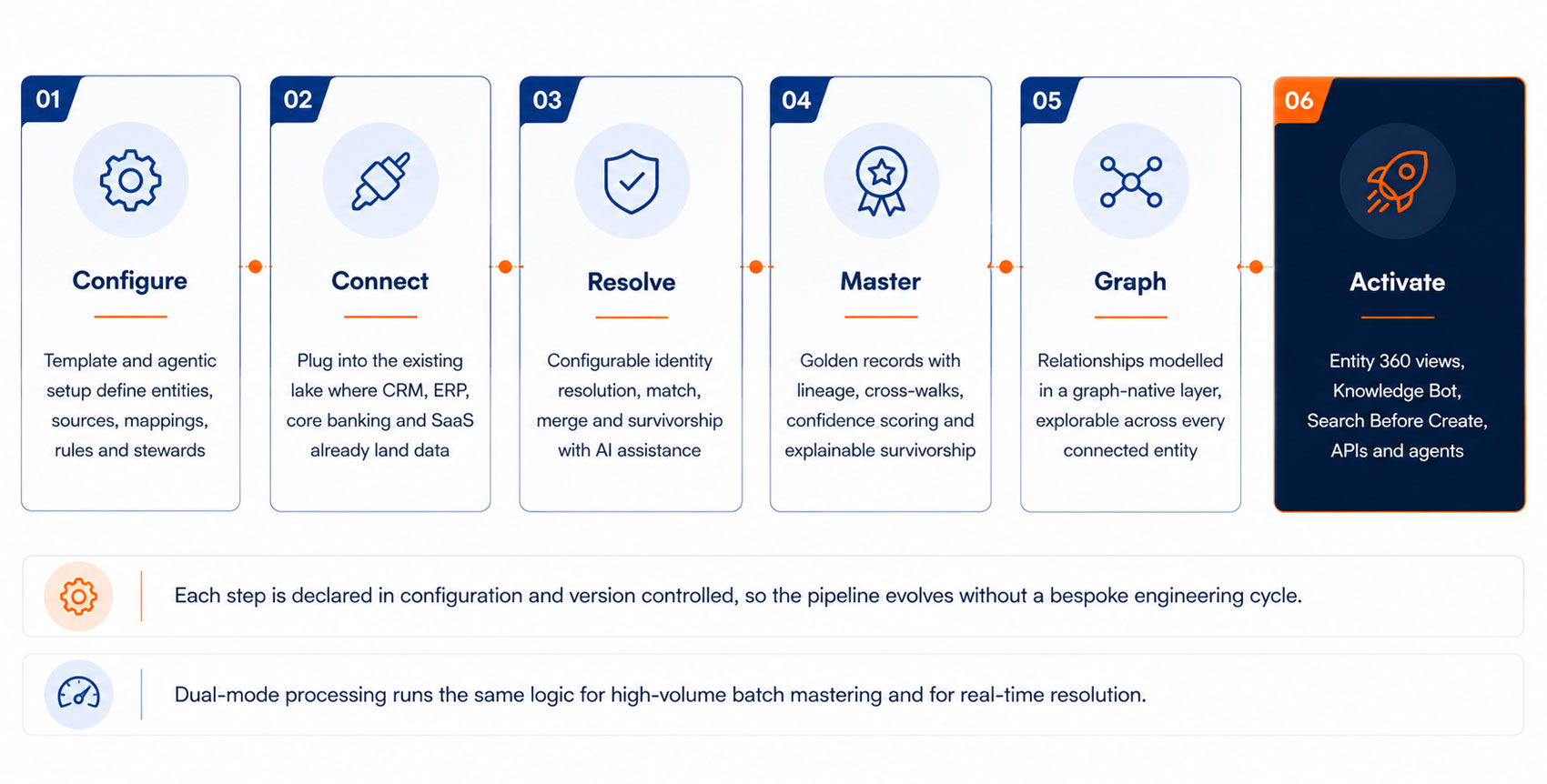
Configure, connect, resolve, master, connect the graph, activate. Each step is declared in configuration and version controlled.
The cost of ungoverned context has changed
A dashboard with a duplicate customer record is an inconvenience. An agent acting on that duplicate, sending a conflicting offer, approving against the wrong risk profile or missing a related-party exposure, is a governance incident. As enterprises move from AI that assists to AI that acts, ungoverned context stops being a data quality metric and becomes a business risk.
Entity 360, then knowledge graph, then trusted agentic AI. It is an architectural chain and the first two steps cannot be skipped.
See it on your own data.
A first project starts with one domain and a small set of sources and proves match quality before any commitment to scale
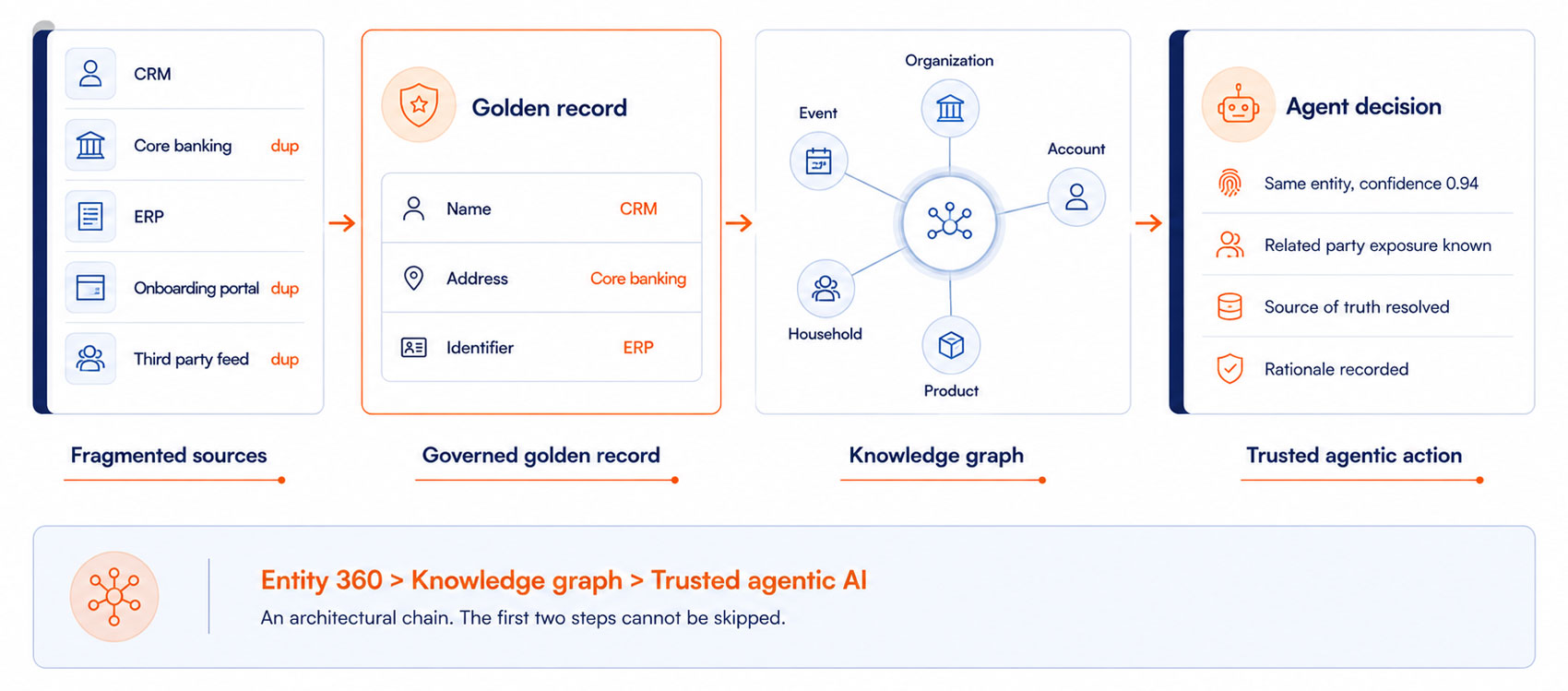
Entity 360, then knowledge graph, then trusted agentic AI. An architectural chain in which the first two steps cannot be skipped.
Author’s Profile

Chetan Pandey
Associate Vice President , Technology

Subhradeep Das
Senior MDM Architect