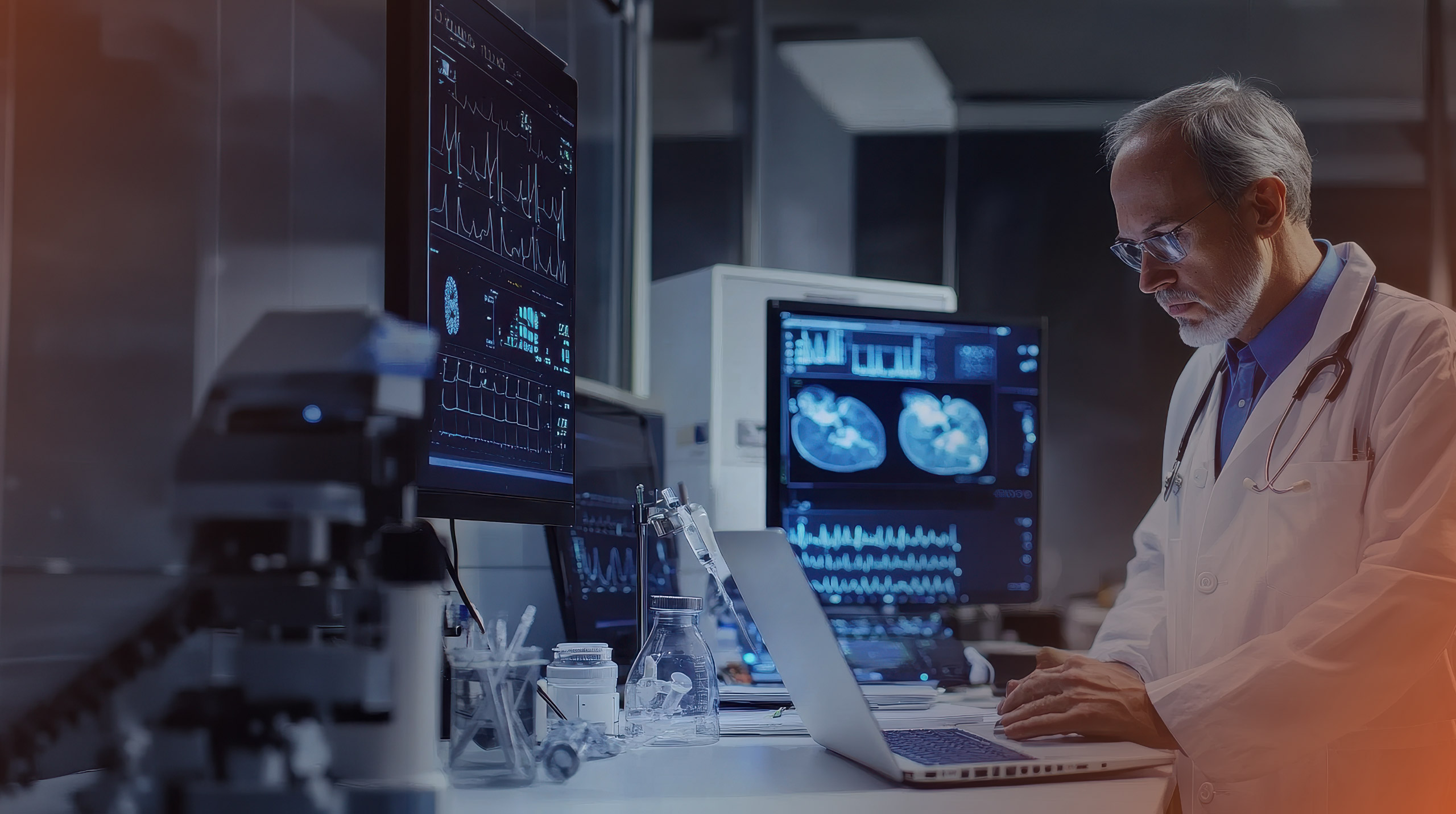

For a global leader in scientific instrumentation, support quality had become central to operational performance. Its instruments are used across pharmaceuticals, food testing, environmental labs, speciality chemicals and industrial quality workflows. They were deployed in more than 35 countries and used by over 90,000 customers. These systems supported critical decisions and had to run with high accuracy and minimal downtime because they validated purity, detected contaminants and helped ensure regulatory and quality compliance.
The challenge lay inside the instrument environment itself. Each system continuously monitored 150 to 200 operational parameters, with values updating every second. When an anomaly appeared, technicians had to determine which parameter had drifted, why it had drifted and what action to take next. The only source of truth was a set of manuals, often spread across multiple PDFs and HTM documents.
In practice, that created five points of drag:
- Technicians often opened 10 to 20 PDFs and searched through hundreds of pages to find the right procedure.
- Everyday tasks such as licence activation or parameter calibration took hours, while complex issues could take two to three days.
- Troubleshooting quality depended heavily on individual technician expertise, leading to inconsistent interpretation and repeated misdiagnoses.
- Manuals contained proprietary design and IP, which meant they could not be shared with public LLMs or external GenAI services.
- The client had hundreds of instruments deployed globally, which meant support demand kept rising with every new installation.
The result was slow resolution cycles, inconsistent support quality, prolonged investigation time and growing pressure on engineering teams. With no automation and no unified knowledge layer, every answer still depended on a human interpreting the manuals. The need was clear: a secure, AI-enabled support model that could move faster without compromising control.
Support began as a search problem. It needed to become an intelligence problem.
Designing A Secure Copilot for Complex Instruments
Persistent partnered with the client to build a secure, GenAI-powered virtual assistant integrated directly into the client’s instrument platform. The goal was to give technicians instant answers from manuals, automate anomaly interpretation and provide conversational access to instrument data. The work followed the client’s innovation and execution framework, with features first validated through small proof-of-concept stages and then promoted into full product development. A dedicated GenAI pod delivered the system in close collaboration with product managers and engineering leads and the assistant was embedded into the larger modernized platform Persistent had already built for the client.
The solution came together through four connected layers:
- A private GenAI assistant trained on proprietary manuals: Persistent ingested manuals into a secure vector database inside the client’s environment and used an AWS Bedrock-hosted LLM to build a private assistant. The assistant also supports multilingual queries for China, Europe and LATAM, helping create a more uniform global support experience.
- An anomaly-insight layer for live telemetry: The system analyzed spikes, drops and abnormal patterns across 150 to 200 parameters streaming every second.
- Direct platform integration: The assistant connected into the environment managing logs, job execution, experiment results and parameter graphs, , enabling contextual responses grounded in live system data.
- A closed-domain AI boundary: Manuals remained inside the client-controlled cloud environment, telemetry stayed protected and AWS Bedrock provided secure LLM access.
Deloitte notes that AI-enabled predictive maintenance can improve quality, safety, workforce productivity and asset uptime. This logic applies here as well: once reasoning is embedded within the operating environment, faster resolution becomes a repeatable capability rather than a one-off improvement.
The breakthrough was not giving technicians another screen. It was giving them a faster path through complexity.
Where Manuals, Telemetry And Action Start Working Together
The assistant was designed around the questions technicians already asked every day. From manuals, it could respond to prompts such as how to activate the license, why detector parameter 12 was out of range or which calibration value to check. From the platform, it could answer operational questions such as which jobs were running, what the last experiment results showed or which parameters had failed yesterday.
When anomalies appeared, the flow worked in a tight loop. An insights banner surfaced inside the platform. Clicking it opened a GenAI generated explanation that connected telemetry patterns with the relevant manuals and answered three questions in sequence: what happened, why it happened and what to do next. This removed guesswork and reduced cognitive load for technicians.
McKinsey has estimated a $4 billion to $7 billion annual opportunity for gen AI in biopharmaceutical operations. The significance is not the number alone, but where the value comes from: less time spent interpreting complexity, faster decisions and improved equipment effectiveness. That is exactly the operating terrain this implementation was built to improve.
The real savings begin when technicians stop searching and start deciding.
Business Impact
From Manual Search to Guided Resolution
Although still early in rollout, the implementation is already delivering strong results in real technician workflows:
- Troubleshooting time has been reduced from two to three days to seconds or minutes for many common and complex tasks.
- License activation guidance is returned immediately.
- Parameter calibration steps are provided in seconds.
- Complex interpretation that previously required extensive manual reading are now automated.
- Up to 90 percent reduction in technician effort is expected as the solution scales across instruments.
- AI-generated responses are improving consistency across regions and reducing misdiagnoses and calibration or configuration errors.
- Customer issues that previously took two to three days can now be resolved the same day.
- With instrument prices between INR 95 lakh to 1.2 crore, the embedded AI layer is emerging as a high-value differentiator across the product line.
- The telemetry-driven AI pipeline is laying the foundation for predictive maintenance, automatic parameter drift detection, auto-calibration and self-healing sequences.
- Six to nine months of telemetry will enable the ML layer to go live.
- The client is building a GenAI team of more than 50 engineers and AI-driven support is being rolled out across more than 1,150 instruments.
The visible gain is faster troubleshooting. The deeper gain is a support model that becomes more consistent, more scalable and more defensible as instrument complexity grows.
Better uptime starts with better interpretation.
Extending From Assistance to Self-Healing Operations
The roadmap already extends beyond today’s assistant. Over the next phases, the client expects to scale the solution across instrument families, mature additional ML models in the innovation track and move toward fully automated calibration and self-healing capabilities as data volumes grow. Leadership is already positioning these capabilities as a differentiator in global sales and marketing.
Why Persistent Was Chosen
- It already leads a large-scale cloud and platform modernization initiative involving more than 150 engineers for this client.
- It demonstrated the ability to design a secure, closed, domain-trained enterprise AI system without exposing proprietary content.
- Its innovation-to-execution model accelerated validation.
- The architecture was modular and scalable enough to support rollout to thousands of instruments globally.
- Strong customer empathy and co-creation culture, with continuous feedback from field technicians, product owners and customer advisory groups.
Through this engagement, Persistent helped the client redefine how lab instruments are supported, maintained and optimized. By combining GenAI, multi-agent reasoning and unified platform engineering, the client is transitioning from manual, expertise-driven workflows to intelligent, automated and scalable lab operations. This marks a new phase of AI-assisted instrumentation, where complex scientific systems can increasingly guide, support and optimize themselves.
Support began as a search problem. It is becoming a system-intelligence advantage.
Assess Your Instrument Support Gaps. Map A Secure AI Roadmap. Talk with Persistent.