
Agentic AI, Telecom RAG, Knowledge graphs and Digital Twins with AIOps & Service Orchestration for faster detection and accurate, self-healing resolution. Moving towards Autonomous Networks Level 4/5.
For a decade, autonomous networks were an aspiration on conference slides. They are now an operating reality with measurable returns. The shift that matters to the business is not better monitoring; it is collapsing the distance between the moment a network detects a fault and the moment it resolves one, accurately and without manual handoffs.
Agentic AI makes this possible. An agent reasons over a knowledge graph, decides on a remediation, scores its own confidence and acts within guardrails after rehearsing the change on a digital twin. The result is less operational noise, faster detection, accurate resolution and lower cost to serve — with an audit trail leaders can defend.
Operational Challenge
Networks were never designed to heal themselves. Events may lead to faults, which surface as alarms, which become tickets and tickets wait for an engineer. Each handoff adds delay and with it, cost and customer impact. At scale, a single physical event, say, a fiber cut or a degraded transceiver, generates an alarm storm across domains, burying the root cause in noise. The operational and financial penalty is concentrated in one metric: mean-time-to-repair.
The strategic question for a telecom operator is therefore simple to state and hard to deliver: how to detect faster, diagnose accurately and resolve before customers are affected — consistently, across a multi-vendor, multi-domain estate?
From Automation to Agentic AI
Conventional automation executes predefined scripts. It is fast but brittle and it was never designed to reason about conditions it has not seen before. Agentic AI changes the operating model. The agent ingests streaming telemetry, detects anomalies and reasons over a knowledge graph to localize the fault. It proposes the next best action, scores its confidence and acts within defined guardrails; rehearsing the change on a digital twin first, with a rollback path always primed. Human oversight concentrates on high-impact decisions, so involvement becomes precise rather than pervasive.
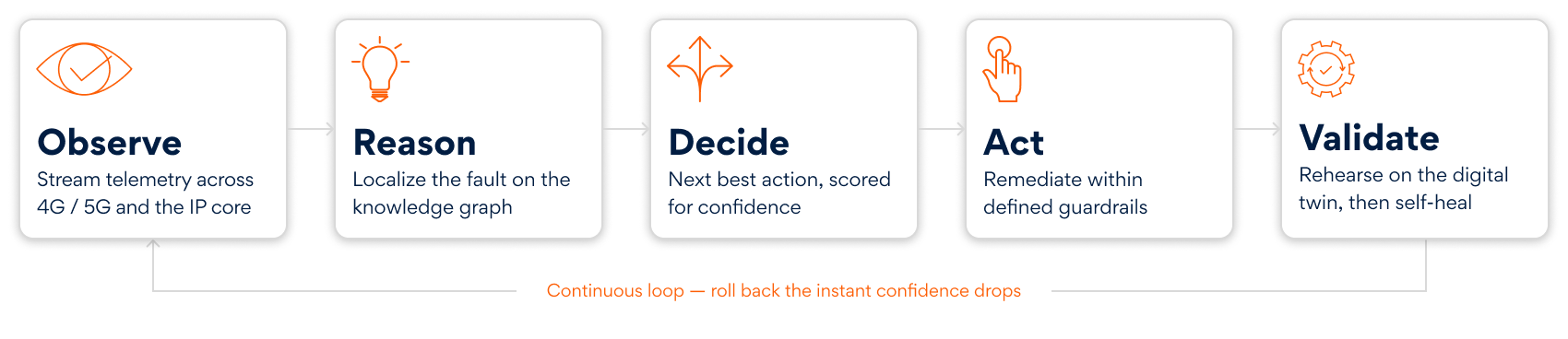
This is also where operational noise reduces. Instead of an alarm storm, the operator is presented with a single root cause and confidence-scored resolution path. The same telemetry that drives detection feeds predictive maintenance, anticipating degradations and acting before they cascade.
Reference Architecture
Autonomous operation is not a single feature; it is a coordination layer assembled from primitives that reinforce one another. A knowledge graph supplies cross-domain context by linking alarms, network elements and probable causes, so the agent can trace a fiber cut through to the transport and IP layers it disrupts. A digital twin rehearses each remediation safely before it touches production. Telecom RAG grounds the model in the operator’s own network, so answers cite evidence rather than hallucinate it. Intent-driven, cross-domain orchestration turns the decision into action across RAN, transport and core; MCP-T and A2A-T protocols let agents communicate; and standards such as TR326A keep the industry honest about what “autonomous” means.
Agentic AI for Autonomous Networks
From streaming telemetry to confidence scored, verified self-healing action
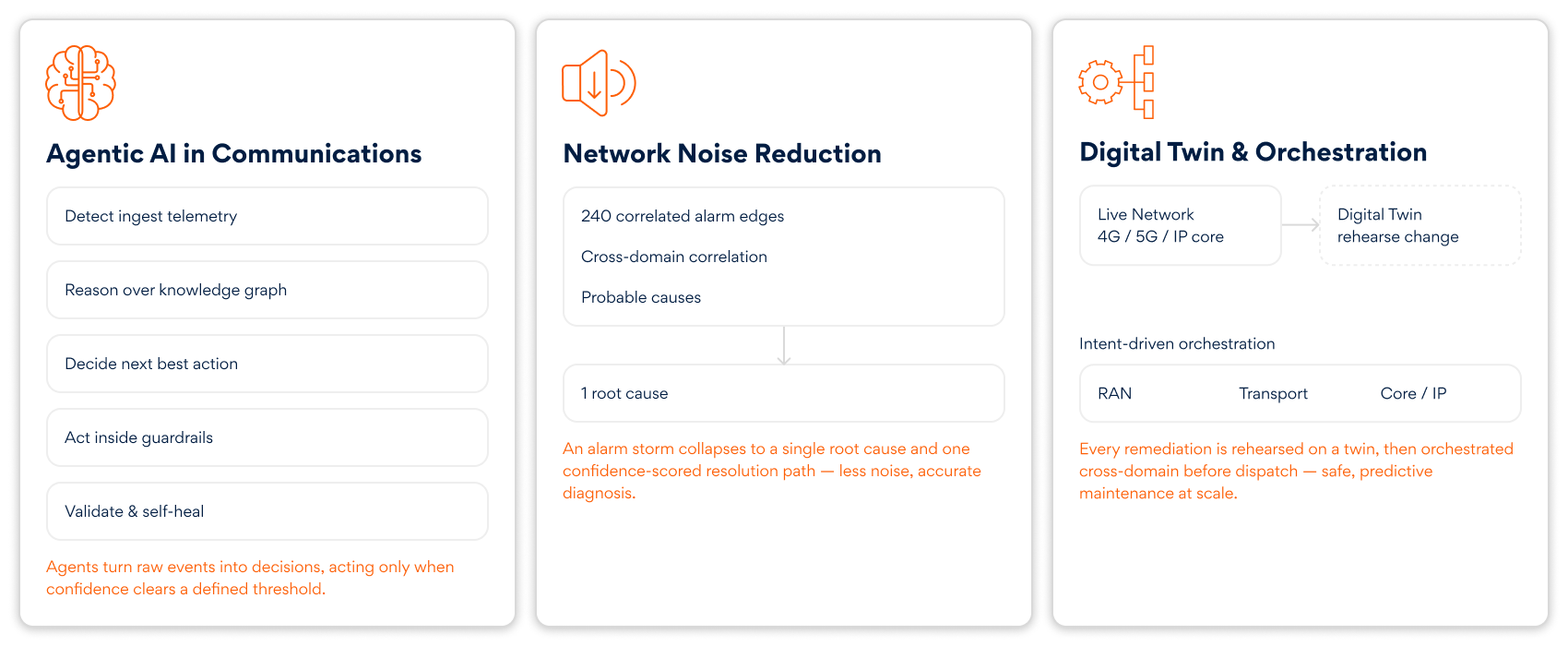
One primitive ties the architecture together more than any other: the confidence score. It is what tells an operator when to let the loop act autonomously and when to escalate to a human. Trust, in other words, is engineered per decision, not asserted per demo.
Operational Outcomes
The value of the model is best understood as a shift in how each stage of operations behaves. The table below contrasts reactive operations with an agentic, autonomous approach.
| Dimension | Reactive operations | Agentic autonomous networks |
| Detection | Threshold alarms, manual triage | Streaming anomaly detection, graph-localized in seconds |
| Diagnosis | Alarm storms, ticket queues | Single root cause, confidence-scored |
| Resolution | Engineer-led, measured in hours | Self-healing in seconds, twin-validated |
| Maintenance | Scheduled or reactive | Predictive and pre-emptive |
| Trust | Assured per demo | Confidence-scored per decision with audit trail |
The net effect is fewer truck rolls, a falling mean-time-to-repair and decisions an operator can defend.
Field Evidence from DTW Ignite
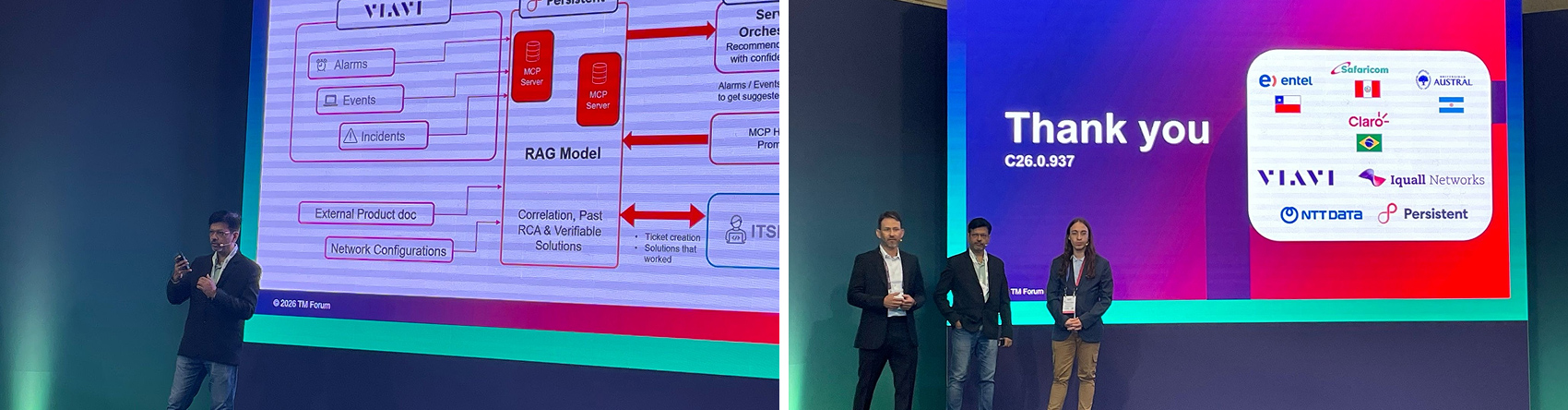
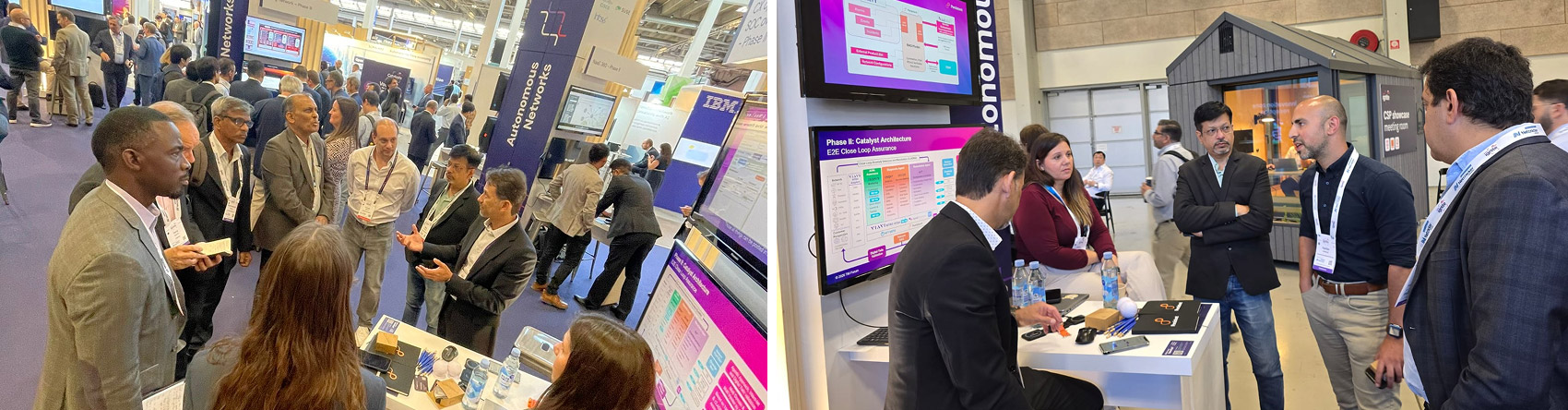
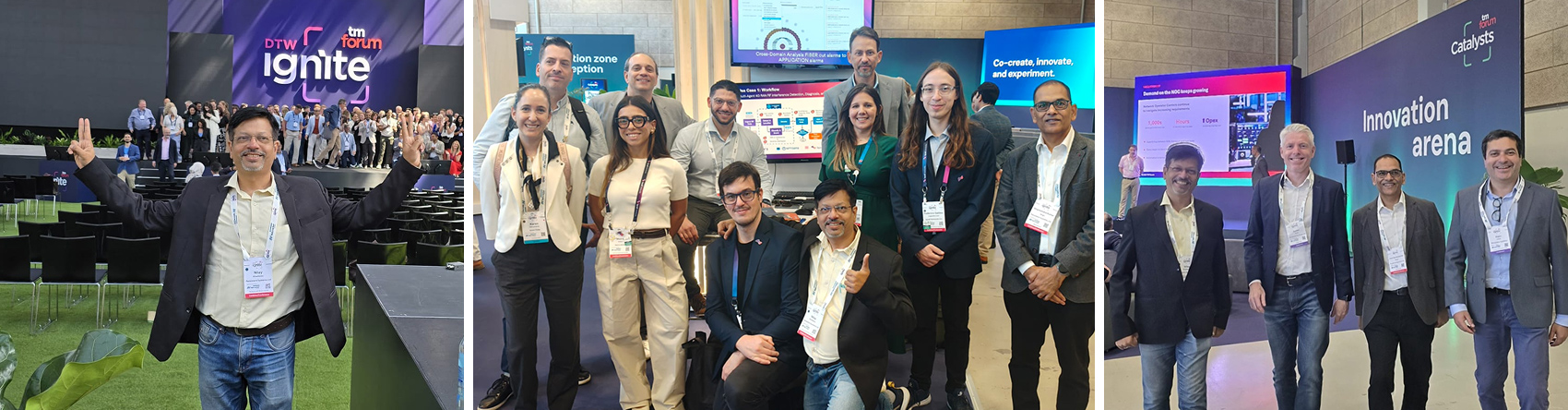
These outcomes were not presented as theory. At DTW Ignite in Copenhagen, Persistent demonstrated a live Catalyst with Viavi and Iquall, validated by CSPs like Entel Chile, Claro, Safaricom — a closed loop stitched across 4G, 5G and the IP core — to operators on the show floor.
Customers responded to proof rather than promise and the conversation among global telco leaders kept returning to the same primitives: closed-loop automation, self-healing, knowledge graphs, digital twins, telecom RAG, predictive maintenance and intent-driven control. The sharpest framing of the event came from a telecom veteran:
“Show me the confidence score or it’s not autonomous — it’s a guess.”
Road to 2030
The direction is clear. Through 2030, autonomous networks move from isolated closed loops to digitally engineered operations, where intent flows directly into execution across domain. This sits inside TM Forum’s wider vision of the autonomous enterprise with composable, autonomous and trustworthy operations that deliver measurable growth, experience and efficiency, with autonomous networks at its core.
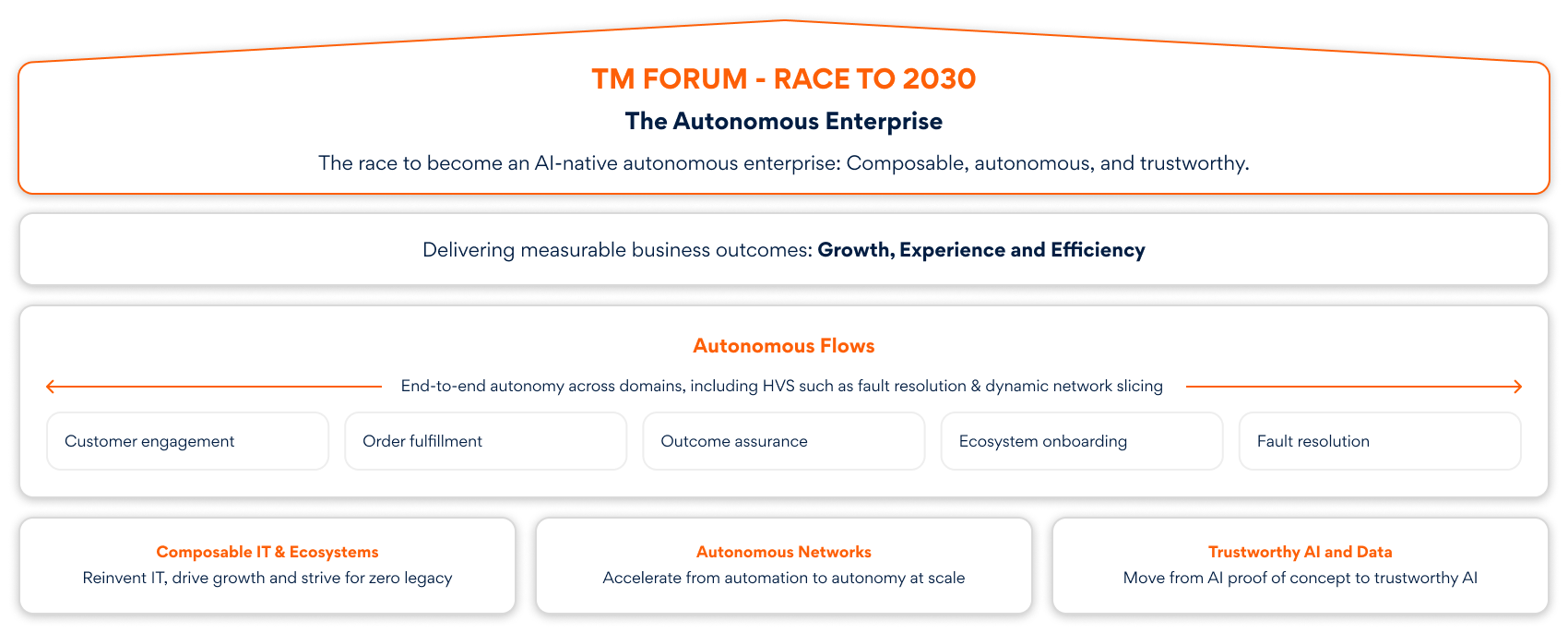
The priorities leaders named are consistent: deepen agentic reasoning across multi-vendor estates; make confidence scoring a first-class operational signal; and engineer trust into every decision, without losing accountability.
Strategic Implications for Telecom Leaders
Autonomous networks change how decisions are made inside the network. For leadership, three implications follow. First, the relevant metric is no longer alarm volume but the speed at which detection becomes resolution. Second, trust must be treated as a product feature — instrumented, scored and auditable. Third, value compounds when autonomy spans domains, so investment should favor the coordination layer over point tools.
The industry has moved away from the most elegant architecture toward measurable outcomes. Operators that accurately shorten the distance between detection and action and with engineered trust will lead the next wave. Theory has become proof and proof now has a number attached.
Ready to close the distance between detection and action?
Explore how Persistent brings agentic AI to autonomous networks digital engineering.
Author Profile

Nilay Khadepau
Solution Head, Domain Consulting – Telecom