
Four days. Moscone Center. Thousands of data and AI practitioners in one place.
One clear conviction emerged from DAIS 2026: enterprise AI is moving from experimentation to operations. For leaders who left the Summit with innovative ideas but familiar execution questions, the issue is no longer whether AI capabilities are advancing. It is whether their data foundations, governance models, cost controls and delivery teams are ready to absorb that change.
The conversation has shifted from “Should we adopt AI?” to “How quickly can we make our enterprise ready for AI and agents?”
The Central Thesis Databricks Laid Out
Databricks framed the summit around four words:
Context. Cost. Control. Choice.
Every significant announcement mapped back to one or more of these pillars and not by accident. It was a deliberate statement about where enterprise AI is heading.
The hardest problems in AI are no longer model quality or access to compute. They are about making AI work inside real enterprises, with real governance requirements, budget constraints, security expectations and highly fragmented data landscapes.
The announcements are better read as three connected platform shifts: a real-time, governed data foundation through Lakehouse//RT, LTAP and Lakeflow; an enterprise context and governance layer through Genie Ontology, Unity Catalog and Unity AI Gateway; and a path to agent operations and business applications through AgentBricks, Omnigent, CustomerLake and LakeWatch.
The message was clear: the future will not be powered by a collection of AI tools. It will be powered by an integrated AI stack.
What Actually Changed at the Platform Level
Several announcements stood out as true platform shifts rather than incremental enhancements.
Lakehouse//RT and LTAP Reimagine Data Architecture
Lakehouse//RT, powered by the Reyden engine, is designed to bring millisecond-latency analytics directly to governed Delta Lake and Apache Iceberg tables, reducing the need for separate serving layers, duplicated data copies and fragmented governance.
LTAP takes the vision further by enabling PostgreSQL-native transactional workloads to be stored in open table formats at the point of write, dramatically reducing the historical separation between operational and analytical systems.
For enterprises maintaining expensive dual-stack architectures, this could fundamentally reshape how data platforms are designed.
Unity AI Gateway Brings Governance to the Runtime Layer
The governance discussion finally moved beyond data access.
Unity AI Gateway introduces runtime controls that govern not only what data AI agents can access, but also what actions they are allowed to perform.
Contextual Service Policies enable approval, denial and enforcement of agent behaviors in real time. Centralized spend controls provide visibility and management across both Databricks-hosted and external models.
This represents one of the most important developments for enterprises pursuing AI at scale.
Genie Ontology Creates Shared Enterprise Understanding
One of the more intriguing announcements was Genie Ontology.
Built on Unity Catalog Glossaries and Domains, it creates a continuously evolving enterprise context layer that captures business meaning, relationships and semantics.
Rather than simply providing access to data, agents gain access to organizational understanding.
This has significant implications for reducing hallucinations, improving decision quality and enabling consistent reasoning across AI applications.
AgentBricks: From Building Agents to Running Them at Scale
A recurring theme across DAIS was that building an agent is relatively easy. Scaling, governing and operating thousands of agents across an enterprise is not.
AgentBricks signals a broader shift from building individual agents to industrializing agent delivery. The focus is moving beyond creation to deployment, evaluation, observability, governance, security, context management and lifecycle operations.
In other words, the conversation is moving from “How do I build an agent?” to “How do I run agents reliably at enterprise scale?”
Where Databricks’ Vision Meets Persistent’s Delivery
What stood out most was how closely these platform priorities align with the challenges enterprises face every day.
Databricks built its vision around Context, Cost, Control and Choice.
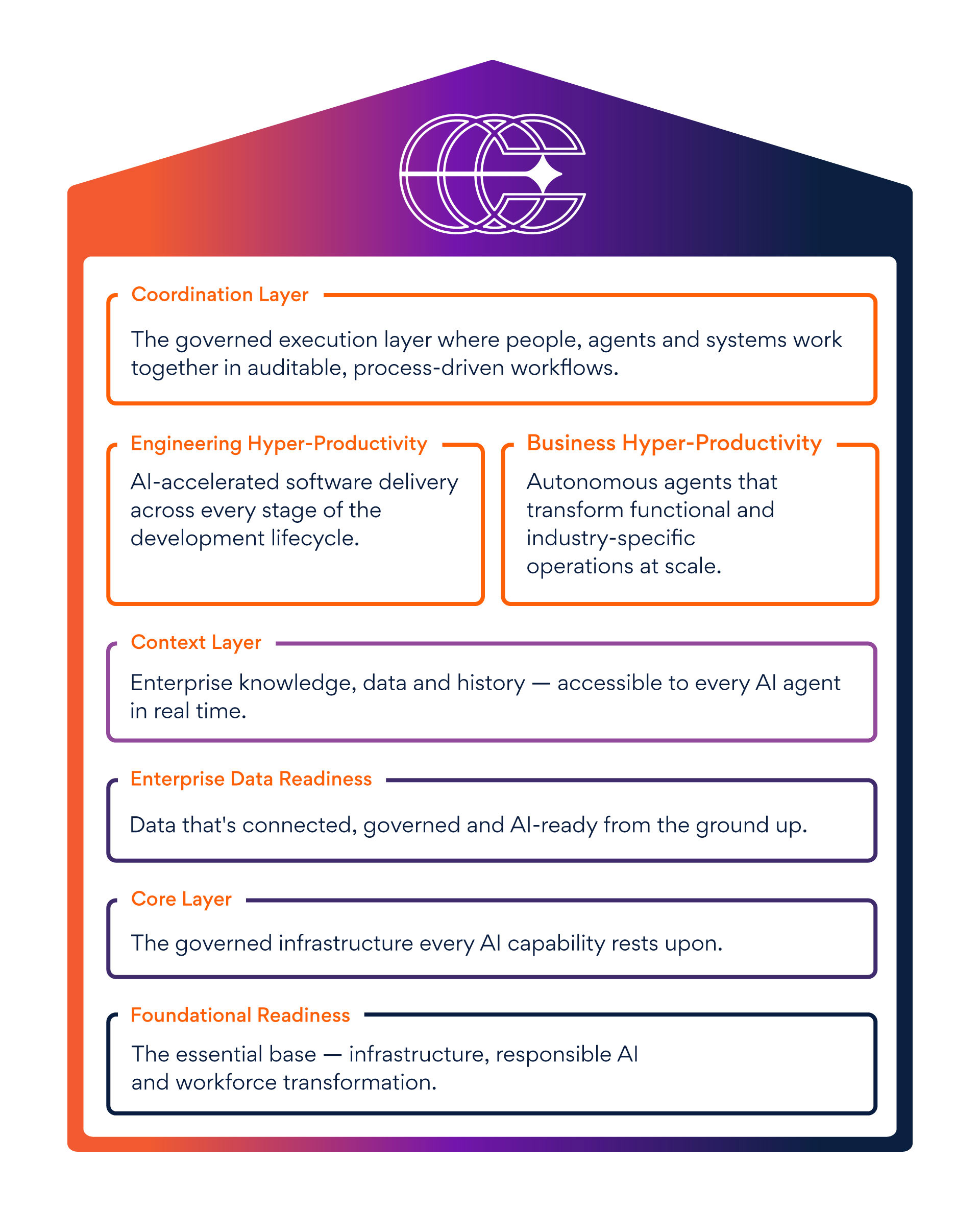
At Persistent, we see strong alignment through our 3C Framework: Core, Context and Coordination.
While the terminology differs, the underlying objective is remarkably similar: helping enterprises build scalable, governed and business-ready AI ecosystems.
Databricks is defining the platform architecture for the agentic enterprise.
Persistent helps enterprises make that architecture real through Enterprise Data Readiness (EDR), iAURA 2.0 and GenAI Hub, connecting data modernization, governed AI operations, reusable agent patterns and managed execution.
Together, they create a pathway from platform capability to funded programs, scalable operating models and measurable business outcomes.
Core: Building the AI-Ready Foundation
Lakehouse//RT, LTAP and Lakeflow establish the real-time, AI-ready data foundation enterprises need.
Persistent’s EDR framework and iAURA 2.0 accelerate the journey through data modernisation, migration automation, observability and governance, helping organizations move faster from legacy estates to production-ready AI platforms.
Context: Turning Data Into Enterprise Intelligence
Genie Ontology introduces a governed enterprise context layer that gives AI systems a shared understanding of business meaning.
Persistent extends this through iAURA Knowledge and Context Management and GenAI Hub, enabling knowledge graphs, semantic grounding, RAG and enterprise-wide AI experiences built on trusted business context.
Coordination: Governing AI at Scale
Unity AI Gateway brings policy, security and cost controls to the runtime layer across models, agents and applications.
Combined with iAURA’s managed AI operations and GenAI Hub’s governance, evaluation and observability capabilities, organizations can move beyond pilots and operate AI responsibly at enterprise scale.
From Agents to Enterprise Outcomes
AgentBricks and Omnigent provide the foundation for building and orchestrating intelligent agents.
Persistent accelerates adoption through iAURA 2.0’s pre-built agent library and GenAI Hub’s reusable AI blueprints, orchestration frameworks and guardrails, enabling organizations to move from experimentation to repeatable business outcomes.
The goal is not simply to deploy more agents. It is to industrialize AI across the enterprise.
New Conversations Emerging from DAIS 2026
Two announcements stood out for opening entirely new business discussions.
CustomerLake
CustomerLake marks Databricks’ entry into the Customer Data Platform space.
By combining identity resolution, governed customer data and autonomous profile agents directly within the Lakehouse, it challenges traditional CDP architectures and opens new possibilities for customer intelligence at scale.
The Security Lakehouse Becomes a Strategic Bet
growing commitment to the Security Lakehouse vision. The announced Panther acquisition and continued investment in agentic security operations signal a broader move toward unifying security, operational and business data on a single governed platform.
For regulated industries, this could become an important conversation around AI-powered security operations, compliance and managed services.
What This Means for Enterprises Now
For enterprises, the immediate takeaway is practical. Modernise the data estate before scaling agents. Treat context as production infrastructure, not a metadata clean-up project. Put runtime governance and cost controls in place before agent sprawl begins and move from isolated pilots to reusable AI operating models that can be governed, measured and scaled.
The Real Divide is Ambition vs Legacy Complexity
DAIS 2026 reinforced a simple reality.
Every enterprise is facing the same challenge:
AI ambition at the boardroom level and legacy data complexity at the operational level.
The platform stack required to bridge that gap is now emerging.
Databricks highlighted that stack through Context, Cost, Control and Choice.
Persistent helps organizations realize that vision through Enterprise Data Readiness (EDR), iAURA 2.0 and GenAI Hub, accelerating the journey from data modernization to production-grade AI, governed agent operations and repeatable business value.
The next phase of enterprise AI will not be defined by access to better models.
It will be defined by how effectively organizations combine trusted data foundations, enterprise context, governed AI operations and scalable agent deployment into a repeatable business capability.
The Agentic Enterprise is no longer a concept. It is now a stack.
The organizations that succeed will not necessarily have the best models. They will be the ones that can operationalize data, context, governance and agents into a sustainable enterprise capability.
Turn Platform Momentum Into Execution Discipline
The enterprises that move fastest after DAIS 2026 will be the ones that turn platform momentum into execution discipline: ready data, trusted context, governed AI operations and agents designed to deliver measurable outcomes. Persistent and Databricks can help you build that discipline, from data modernization to governed agent operations at scale.
Talk to Persistent about your agentic AI roadmap.
Author Profile

Mandar Baxi
Associate Vice President , Technology