
Ask ten technology leaders what the future looks like and most will describe some version of the same idea: increasingly autonomous agents that can plan, reason and execute work with minimal human intervention.
It is a compelling vision, but it is also built on a flawed assumption. Somewhere along the way, we began treating autonomy as independence. And that is why so many enterprise AI initiatives struggle to move from pilots to full-blown transformation. If independence were the highest form of intelligence, enterprises would have organized themselves very differently. The most successful organizations in the world are not collections of independent actors, but networks of specialized expertise operating within shared goals, governance structures and operating models. A product manager does not work in isolation, nor do a software architect, a chief financial officer or a customer service representative. Each understands their role, responsibilities and constraints. More importantly, they understand when they need to engage others.
Their effectiveness comes from autonomy within a system. Not independence from it.
Yet when we imagine the future of agentic AI, we often envision a super-agent that acts as a proxy for a single system, a single decision-maker, a single intelligence capable of navigating an entire workflow from beginning to end without assistance.
Unchecked Independence Creates Intelligent Silos
Enterprises have spent decades attempting to eliminate silos because they are among the most persistent obstacles to performance. Independent applications created fragmented technology estates. Independent databases created conflicting versions of truth. Independent business units produced competing priorities. Independent teams slowed execution because information could not flow efficiently across the organization.
Every major wave of enterprise technology has ultimately been about reducing fragmentation.
- ERP systems connected fragmented processes.
- CRM systems connected siloed customer interactions.
- Cloud platforms connected distributed infrastructure.
AI now faces the same challenge. Only this time, the fragmentation is cognitive.
New Fragmentation Is Cognitive
Across the enterprise, teams are deploying copilots, assistants and agents at speed. Developers are writing code faster. Analysts are producing reports more quickly. Sales teams are generating proposals within minutes. Adoption is accelerating rapidly. Deloitte reports that workforce access to sanctioned AI tools grew by 50% in just one year. Yet only 34% of organizations reported using AI to deeply transform their business. Most are seeing productivity gains. Far fewer are fundamentally reinventing how work gets done.
The gap between adoption and transformation reveals that the challenge is no longer access to intelligence. It is what happens to intelligence once it is democratized. Today, every function can acquire its own AI capabilities. Every team can build its own agents. Every department can optimize its own workflow. The result is not necessarily an intelligent enterprise. It is often siloed intelligence.
BCG’s latest report says the current stage of AI evolution shifts the unit of change from individual tasks to end-to-end processes where multi-agent systems orchestrate tools and decisions within defined governance, controls and accountability. That is precisely why interoperability matters. Without it, intelligence remains trapped inside functional boundaries.
Turning Autonomy into Participation: 3C Framework
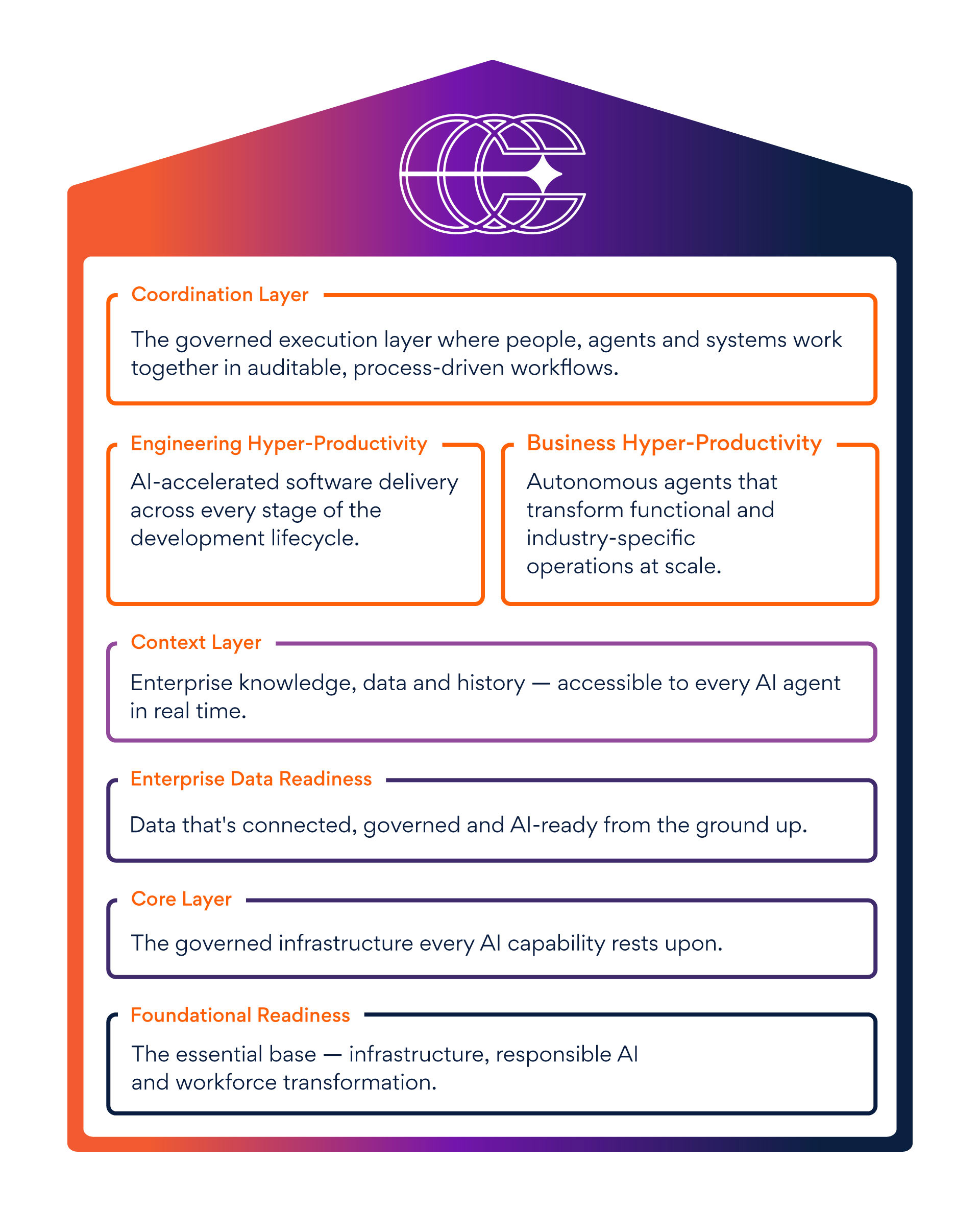
The 3C framework (Core, Context and Coordination) prevents autonomy from becoming fragmentation by ensuring that intelligence operates within a coherent enterprise system. The framework combines governed AI infrastructure, enterprise knowledge grounding and coordinated execution across agents, systems and humans.
This helps organizations move from tasks to outcomes and from individual efficiency to the redesign of entire processes for multistep AI autonomy. In that context, the 3C framework evolves from an AI architecture to an operating discipline that ensures autonomous agents do not drift into disconnected decision systems.
Core: Preventing Governance Silos
An agent cannot be genuinely autonomous if it lacks awareness of its enterprise boundaries. Core establishes governance, lifecycle management, transparent cost control and compliant operations. Without those guardrails, every agent effectively becomes its own isolated decision-making system with its own interpretation of acceptable behavior. Core ensures that intelligence operates within a common operating model rather than creating islands of islands.
Context: Preventing Knowledge Silos
An agent cannot act intelligently if it lacks a shared understanding of enterprise reality. Context provides access to business memory, trusted knowledge and organizational understanding. It grounds agents in the same version of truth and prevents them from operating as isolated knowledge repositories. Context transforms intelligence from generic reasoning into business-aware decision-making.
Coordination: Preventing Execution Silos
This is where the conversation around agentic AI becomes most interesting.
Most discussions focus on what a single agent can accomplish. Coordination focuses on how intelligence moves. It determines how agents collaborate, how decisions are validated, how knowledge flows across systems and how humans remain part of the process. Coordination turns isolated intelligence into collective execution. Without it, even highly capable agents risk becoming disconnected centers of optimization.
This shift in perspective fundamentally changes what it means to be agentic.
From Super-Agent to Team of Specialist Agents
Consider a sales executive preparing for a strategic customer meeting. The popular vision of agentic AI assumes a single assistant gathers information, analyzes findings and produces recommendations.
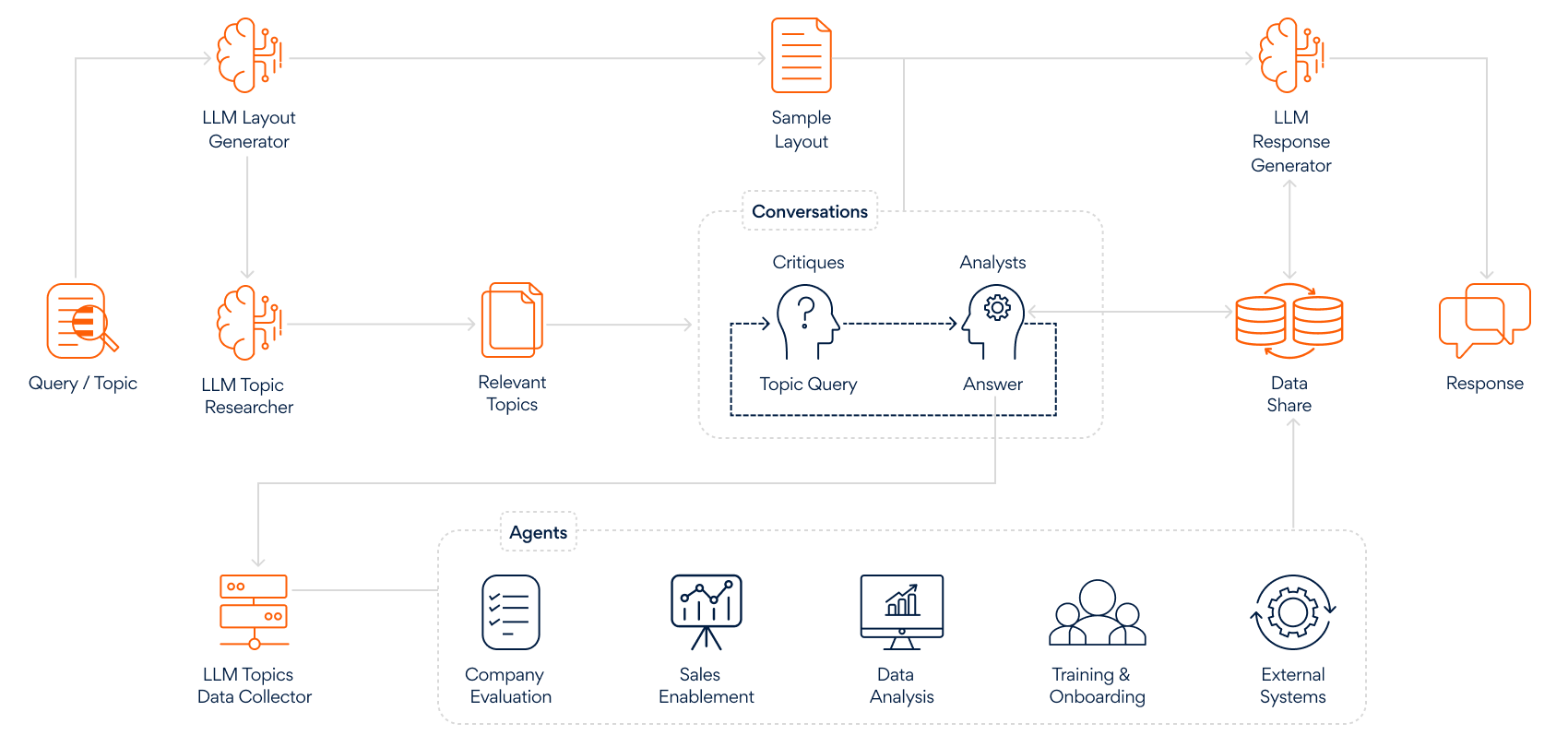
A more mature system behaves differently. One agent identifies the topics for investigation. Another gathers customer intelligence. A third analyzes market development. A critic agent challenges assumptions and identifies gaps. An analyst agent synthesizes evidence. A response agent structures the final narrative. Human judgment remains part of the workflow throughout the process.
True autonomy lies not with agents, but in the process, where specialized agents collaborate through structured execution.
No participant possesses complete intelligence. The intelligence emerges through interaction. The system behaves less like a tool and more like a team.
Anthropic’s 2026 State of AI Agents report found that 57% of organizations already deploy agents across multi-stage workflows and 16% have expanded into cross-functional processes spanning multiple teams. The center of gravity is shifting from isolated task execution toward coordinated systems of specialized intelligence.
Toward Coordinated Cognition
The future of agentic AI is not a super-agent capable of doing everything. It will be defined by a system of systems that understands how to participate effectively within a broader ecosystem of people, policies, tools and specialized agents.
Autonomy, in other words, is not independence. It is informed participation.
The organizations that scale AI successfully will have agents that understand context, respect enterprise guardrails, collaborate effectively with other specialist agents and contribute to a shared objective.
Because the greatest challenge facing enterprise AI is no longer intelligence. It is fragmentation. And the path beyond fragmentation is not greater independence. It is coordinated cognition.