
Modernization is usually scoped as an engineering problem. Its value depends on recovering, governing and applying domain meaning.
Five Systems, Five Definitions of a Dividend
Ask five systems in the same institution to define a dividend and you may receive five different answers. Each can be technically correct. The tax engine classifies the payment by income character. The ledger records a posted credit. Cost-basis distinguishes income from return of capital. No system holds the complete meaning, or explains how the interpretations relate.
People bridge the gaps through manual reconciliation and institutional knowledge. As estates are modernized and supervisory scrutiny tightens, that becomes harder to sustain. The challenge is not fragmented technology. It is fragmented meaning.
A pipeline can recover an estate at scale, but extracting information does not make it authoritative. Recovered knowledge has to be connected to a governed business framework and ruled on by specialists who can say what it means here.
The Case in Numbers
| What It Is | Source | |
| USD 58bn | What corporate-actions processing costs the industry each year, on automation below 40% | DTCC; Citi Asset Servicing 2025 |
| USD 5.3m | What unclear event terms cost the average firm each year and the largest single cause of losses above USD 1m | ISSA / ValueExchange 2024 |
| 16% to 54% | Accuracy of the same model on the same data, without and then with an ontology. 72.6% with ontology-based checking | Sequeda et al. 2023; Allemang & Sequeda 2024 |
How the Pieces Fit Together
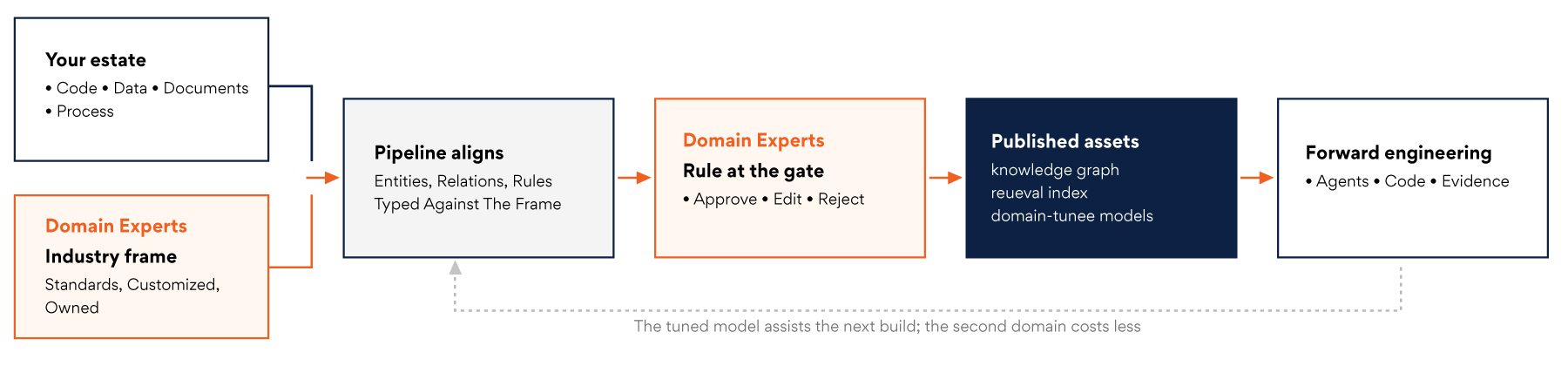
- Modernization Must Recover Meaning, Not Only Logic. The most valuable output is a governed statement of business meaning that survives the systems it came from.
- Automation Scales Discovery, Experts Establish Authority. AI identifies entities, relationships and rules at volume. It cannot decide what should be accepted as business truth. That is judgment, not data entry.
- Start With One Domain and Prove It End to End, ending in a specialist ruling on what the pipeline found, before scaling to the next.
Why Domain Meaning Has Become a Modernization Priority
Rules can run correctly without being explainable and two regulatory dates are now fixed.
| Why It Matters Now | |
| Rules That Run but Cannot Be Stated | A rule in code fuses several decisions, hides a regulatory constraint in a comment and depends on definitions held elsewhere. It executes. Nobody can state the set, so nobody can prove a replacement enforces it. |
| Ambiguity Creates Measurable Risk | Without a common definition, different systems produce different answers. Unclear event terms sit at the top of the loss table, ahead of manual error and system failure. |
| Two Dates Remove the Option to Wait | From 2 August 2026, EU AI Act obligations require traceable systems and evidence, not policy. On 11 October 2027, UK, EU and Swiss T+1 compresses interpretation to hours. |
Excavation alone yields a vocabulary unique to the estate, reconciling with no standard or regulator. A standard alone describes the market. Connected, every concept traces to a published authority or becomes an explicit, owned extension.
Exhibit 1 · A Representation of the Corporate-Actions Ontology: Seven Modules and Their Edges
| Module | Module | Module |
| Event | Security and Reference Data | Party and Role |
| Dates and Terms | Election and Entitlement | Processing and Settlement |
| Tax and Regulatory | The Edges: affects, hasClassification, hasKeyDate, hasOption, entitles, resultsIn, supersedes, sourcedFrom |
Every class sits in one module. Events, dates, options and elections are objects rather than fields, so each is citable and every fact carries its source and validity. supersedes is the edge a document index cannot see.
Industry Standards Provide the Frame, Not the Firm’s Meaning
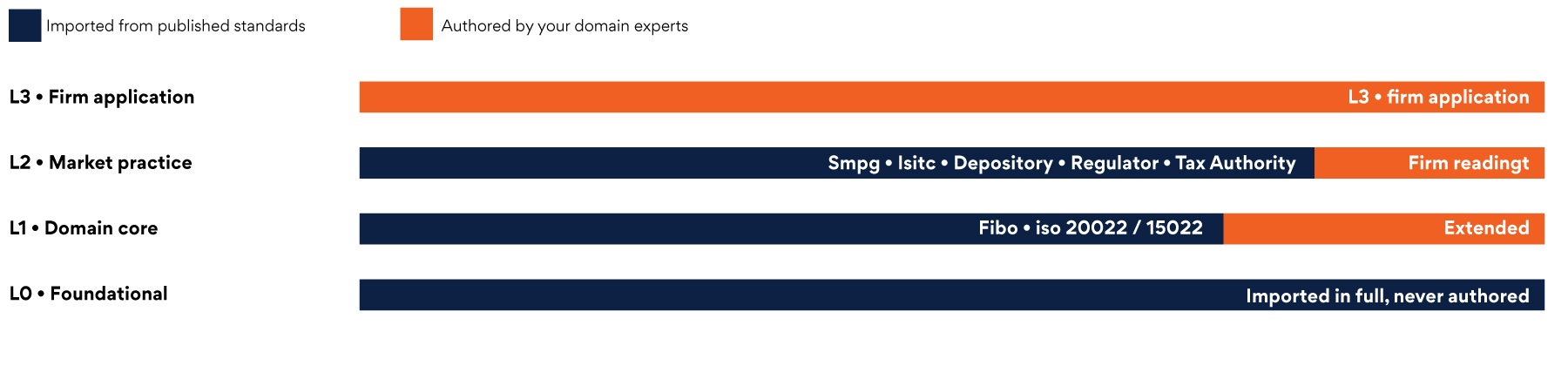
Standards define how the market understands concepts, not how one institution implements them. Frameworks supply the definitions, taxonomies and relationships. The estate supplies the implementation detail and operational context. The frame is borrowed. The mapping is yours.
Exhibit 2 · Imported Versus Authored, by Layer
The Two Domain Checkpoints That Matter
Everything between them can be accelerated by automation. Authority stays with the domain expert.
Exhibit 3 · Seven Stages From Source to Published Context. The Domain Owns Two
| Stage | What Happens | Who |
| 01 Source and Sanitize | The estate, plus the knowledge and governance sources around it. Only a curated package crosses. | No raw code egresses |
| 02 Checkpoint 1: Define the Frame | The concepts that matter, the standards applied, how recovered entities are classified and which version is in force. | Domain Experts |
| 03 Parse, Classify, Extract | Entities resolved and relations derived from parse trees. Rule extraction is the one probabilistic step. | Citations checked |
| 04 Ontology Alignment | Entities typed against the supplied vocabulary, with rules grouped into capabilities. | Against the checkpoint-1 frame |
| 05 Make Every Fact Accountable | Source, tool and citation status per item. Arithmetic proven by execution. | Provenance is not proof |
| 06 Checkpoint 2: Rule at the Gate | Approve, edit or reject each proposal, with the reasoning recorded. This turns recovered knowledge into authoritative knowledge. | Domain Experts |
| 07 Publish | Approved content only. The knowledge graph, the index derived from it, the tuning corpus. | Index derives from the graph |
Turning Technical Records Into Business Knowledge
Without context a recovered entity is little more than structured data. Mapped to a governed framework, relationships become visible and decisions become explainable.
Exhibit 4 · One Recovered Entity, Before and After the Frame Is Applied
| Recovered, Inside-Out | Aligned, Against the Supplied Frame |
| Position — primary key POS-ACCT-SEC — fields 22 — assembled from 3 record layouts — business entity (score +9) — state proposed. A structure. No meaning yet. | ex:Position a owl:NamedIndividual, ca:SettledPosition ; ca:heldIn ex:Account ; ca:entitles ex:Entitlement ; ca:measuredAsOf ex:RecordDate ; ca:sourcedFrom ex:DTCFeed ; dct:valid “2026-04-12/..” . ca:SettledPosition rdfs:subClassOf ca:SecuritiesPosition . Verdict: reuse-standard, module Election and Entitlement. |
The Domain Expert’s Contribution
Domain expertise is often treated as an input to modernization. In reality it is one of its most valuable outputs.
Exhibit 5 · Four Dimensions. On Each, the Difference Is a Domain Expert’s Ruling
| Estate Only, No Frame | Frame Only, No Estate | Connected and Adjudicated | |
| Authority | Self-asserted. Every definition contestable. | Borrowed, but describes a market. | Traces to an accepted standard, or a clearly documented firm extension. |
| Extraction Quality | Invents its target as it goes. | No content to extract. | Validated against an agreed business framework as it is recovered. |
| Reuse | Per application. Each domain restarts. | Reusable in principle, with nothing to reuse. | A semantic foundation the next program builds on. |
| Defensibility | “This is how our system works.” | “This is how the industry works.” | “Where ours follows industry practice and where deliberate differences exist.” |
What the layer publishes is the point. A knowledge graph with provenance, a retrieval index from approved content and domain-tuned models inside your boundary. Forward engineering runs on those and the tuned model assists the next build. Modernization becomes more than system transformation. It becomes knowledge creation.
| Limit | What It Means |
| The Bottleneck Is Organizational | If two functions cannot agree what a term means, no platform resolves it. A named owner per class of fact is a gating decision. |
| Extraction Is Not Self-Sufficient | Recovered rules need validation and parity testing. Grounding proves a citation exists, not that the rule is right. |
| Not All Logic Belongs Here | Performance-critical paths stay in code. The candidates are declarative rules and definitions. |
Own the Meaning Layer. Re(AI)magine What Modernization Can Be.
- Engineering Pedigree: More than 35 years in financial services, 125+ BFSI clients, 23 Fortune 500 institutions and multiple G-SIBs.
- Domain Depth: Retail and commercial banking, payments, lending, capital markets and post-trade, with depth in corporate actions.
- AI-Led Accelerators: A working recovery and curation pipeline, a citation on each fact and a specialist review gate. More than 35 AI patents.
- Talent, Independently Assessed: A Leader in the 2025 ISG Provider Lens for Generative AI Services and Everest Group’s Talent Readiness assessment.
Start With One Domain and Prove It End to End. Identify an area where fragmented meaning creates friction or regulatory risk. Define the questions that matter, customize the frame with your specialists, then take a representative set of concepts through recovery, alignment and review. The test is simple. Can a domain specialist understand what the pipeline found, verify the source and rule on its meaning? If so, you have created more than a modernization artifact. That asset is the domain dividend.
Author Profile

Anuj Kohli
Principal Solutions Consultant, Persistent Systems