Every enterprise now has access to the same frontier models. The weights are open, the APIs are cheap and the benchmarks are public. So, if the model is no longer the moat, what is?
The answer sits inside an organization. It is the context or the meaning behind enterprise data, the rules that govern it and the decisions that teams have made for years.
Models have become commodities. The context has not.
From Lakehouses to Data Fabric to Agents
For a decade, enterprises centralized everything into data lakes and lakehouses. That model is giving way to federated architectures like data fabric, with distributed ownership and data treated as a product. In parallel, AI shifted from siloed machine learning models to large language models and agents. These two curves are now colliding. The question is whether enterprise data platforms are ready for the agents that will consume them.
Why Agents Break Traditional Data Fabric
Traditional data fabric was built for people. It compiles structured data into virtual tables, dashboards and reports that a human can read. Agents work differently. An agent perceives multi-modal inputs, reasons over them, plans a path, calls tools and composes many small responses into one useful answer. To do this well, an agent must make sense of enterprise data on its own. It needs to find missing knowledge, follow relationships and probe a human only when required. A fabric designed for dashboards cannot supply that. The agent is left guessing at meaning the enterprise never wrote down.
Consider a simple question. Which support issues are hurting the most valuable accounts? Human analysts join two worlds in their head. They know a ticket priority maps to business risk. They know an account in one system is the same customer in another. That knowledge lives in people, not in tables. When an agent hits the fabric, none of it is present. The agent can read rows, but it cannot read intent. Value stalls at exactly the point where reasoning should begin.
Layer for Meaning, Not More Copies of Data
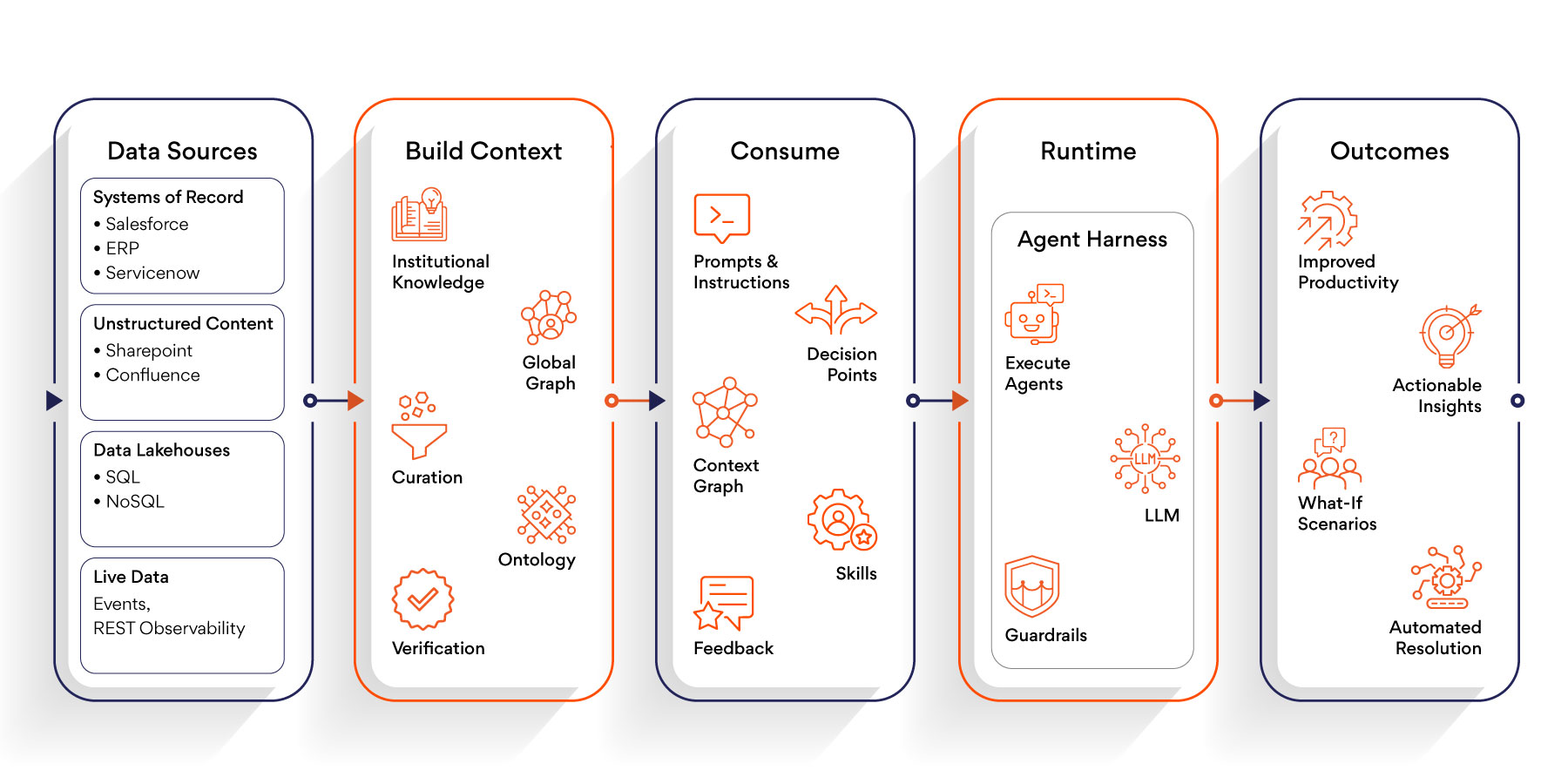
We propose an enterprise context layer that sits above the data fabric. It captures semantics, ontology, domain skills, process intelligence, decision history and institutional rules. Its guiding principle is simple. Do not duplicate the data, rather unify the metadata, the meaning and the connections in one place. When an agent needs the actual records, it reads connection details from the context layer and queries the source through the agent harness using MCP or API connectivity. The context layer holds knowledge. The harness handles access.
This connected intelligence layer is agent-readable, agent-writable and human-verifiable. An agent can read it to reason, write back what it learns and a human can inspect and correct it. Enterprises can start simply with an LLM-backed wiki and grow into a scalable knowledge graph as the domain matures. The point is not the storage engine, but that meaning lives somewhere the agent can reach and someone can trust.
This separation of concerns matters. Data stays where it is, governed by its owners. The context layer describes what that data means and how it connects. The agent harness carries out access under existing controls. Each layer does one job well. This helps avoid a giant copy of the enterprise and handing agents raw data with no map to read it by.
Standard to Build On
Google recently released the Open Knowledge Format (OKF), an open standard that helps define exactly this kind of context layer. OKF gives teams a portable, vendor-neutral way to describe entities, relationships and rules that both agents and humans can share. Standards matter here. Without one, every context layer becomes another silo and we recreate the problem we set out to solve.
Seeing It Work
To make this concrete, we build an OKF-based context layer that unifies two very different systems. BigQuery holds financial data, while ServiceNow holds support data. On their own, neither can answer a question that spans both. With the context layer in place, ontology-driven agents reason across the two and answer cross-domain questions such as how support incidents relate to revenue for a given account. No data is copied. The meaning is unified once and the agents do the rest.
Takeaway
Better models will keep arriving and competitors will have them too. A durable advantage comes from a portable layer of meaning that turns enterprise data into something agents can reason over safely. Capture semantics, ontology and institutional knowledge in a layer that is agent-readable and human-verifiable.
The model is the commodity, context is the equation only the enterprise can solve.
We carry the discussion on at VLDB Conference in Boston, MA from August 31 to September 4, 2026.
Author’s Profile

Dattaraj Rao
Chief Data Scientist, AI Research Lab