
For decades, enterprise software has been built around destinations. Employees logged into CRM systems to manage customer relationships, ERP platforms to access operational data, service applications to resolve issues and countless other systems to get work done. Business capabilities lived inside applications and users had to go where those applications were.
Salesforce’s AIforce announcement at Dreamforce 2026 suggests that this model is beginning to change. By making Salesforce capabilities accessible through experiences such as Claude, Microsoft Teams, Slack, Copilot and other AI interfaces, AIforce reflects a broader industry shift in which enterprise applications are moving into the background and AI is becoming the primary interaction layer.
This shift extends far beyond Salesforce. Employees increasingly expect business capabilities to be available wherever work is already happening. Rather than switching between applications, navigating multiple systems or learning new interfaces simply to access information or complete tasks, they expect answers, recommendations and actions to be delivered directly within the flow of work.
The Future Is Not About Access. It’s About Capability
AIforce is important not simply because it makes Salesforce available in more places. Its significance lies in what it reveals about the next phase of enterprise AI: access through assistants will become common, but the real value will come from the governed business capabilities those assistants can discover, invoke and execute.
That changes the enterprise AI question. The issue is no longer only whether an employee can reach a system through Copilot, Claude, Teams, Slack or another interface. The more important question is whether AI can act on approved enterprise capabilities in a way that reflects the organization’s data, rules, workflows, permissions and controls.
For example, can AI retrieve the right information, understand the business context, execute only approved actions, respect governance boundaries and participate in enterprise workflows without forcing users back into the underlying application?
Organizations that answer those questions well will not just add more AI assistants. They will turn business knowledge, operational expertise, governance models and workflows into reusable capabilities that AI can apply consistently across the enterprise.
Enterprise Skills Become the New Differentiator
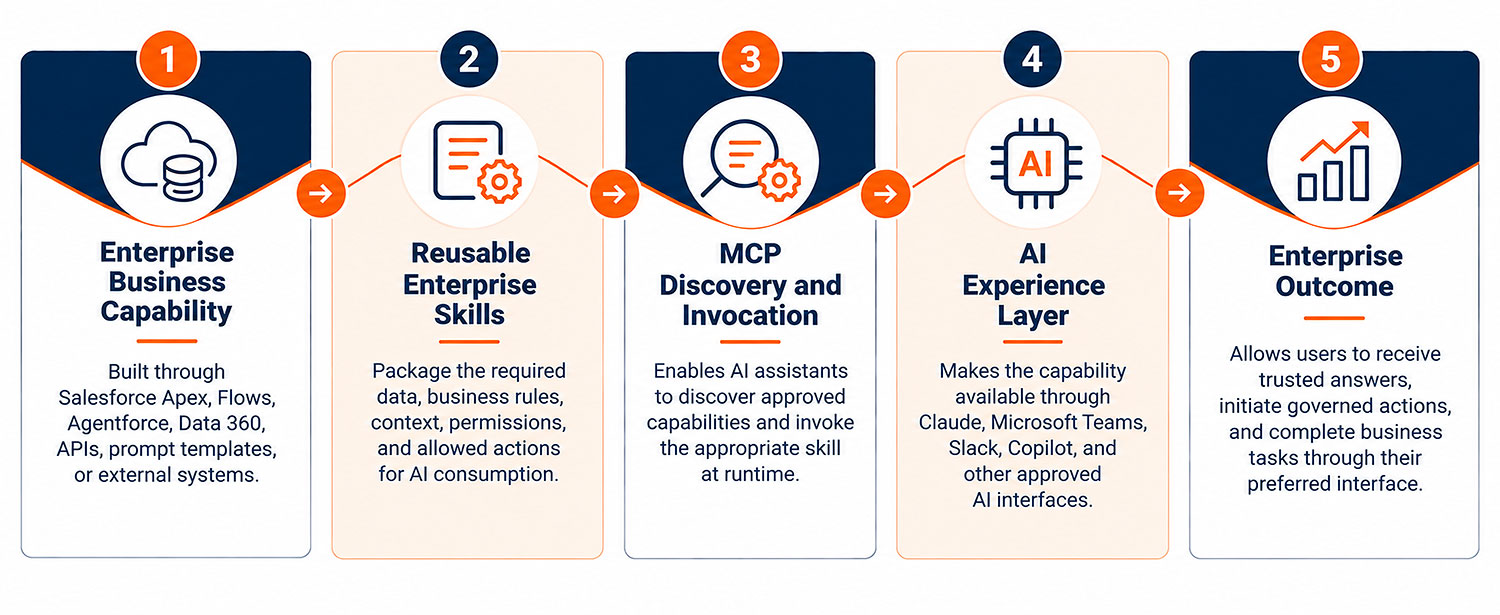
Enterprise skills are the mechanism for packaging those capabilities. A skill is more than a connector or API: it brings together business logic, workflow orchestration, permissions, enterprise data, integrations, context and approved actions into a reusable capability that AI can invoke on demand.
This is why the same AI platform can create very different outcomes across industries. A bank, healthcare provider, manufacturer and software company may all use similar models and interfaces, but the workflows they execute, the approvals they require, the governance models they follow and the business rules they operate under are fundamentally different.
A sales organization may need skills that identify renewal risks, summarize account health and recommend next-best actions. A healthcare provider may require skills that coordinate patient-service workflows while maintaining strict governance and compliance requirements. In each case, the differentiator is not the assistant itself, but the enterprise-specific capability available behind it.
The most useful way to think about this shift is as a capability chain: business capabilities are packaged as reusable enterprise skills, made discoverable and invokable through mechanisms such as MCP, surfaced through approved AI experiences and translated into trusted enterprise outcomes.
Building for an AI-First Enterprise
Building for this model requires more than exposing existing systems to AI. Organizations need to decide which capabilities should be made available, how they should be governed, who can invoke them, what actions they are allowed to perform and how they should evolve as business needs change.
That makes enterprise skills a matter of architecture, not just integration. Business rules, approval paths, compliance requirements, security controls and operational guardrails must be built into the capability itself so AI can act without creating new risk or ambiguity.
As enterprises move from experimentation to production-scale adoption, they will need to manage these skills as living assets by monitoring performance, updating logic, strengthening controls and retiring capabilities that no longer align with business needs.
The strategic question, then, is not which AI interface employees will prefer. It is whether the enterprise has a reusable, governed capability layer that allows any approved AI experience to deliver trusted outcomes.
AIforce points to that future. As AI interfaces become more interchangeable, competitive advantage will come from the enterprise skills that make AI useful, accountable and deeply aligned to how the business actually works.
Now is the time to move from AI experimentation to enterprise execution. Build the skills, governance and capability layer that allow AI to work where your business works securely, intelligently and at scale. Build for an AI-powered enterprise with AIforce.
Speak to our experts to learn how AIforce can help you build a governed, enterprise-ready AI capability layer.
Author Profile

Vijayaraghavendra R
Senior Manager, Persistent Systems