
Salesforce Connections 2026 revealed how AI is reshaping enterprise marketing. Learn what organizations should prepare for across data, governance and operating models.
Most Salesforce events focus on introducing new products, updating roadmaps and sharing customer success stories. Salesforce Connections 2026 did all of that. But something felt different this year. Not because of a single headline announcement, but because of what the event, taken as a whole is signaling about how marketing teams will actually work three to five years from now.
Salesforce is not simply adding AI features to existing products. It is proposing and, increasingly, demonstrating a fundamentally different operating model for marketing. One where AI agents own execution and human marketers own strategy. One where business outcomes replace campaign activity as the primary measure of success. One where data is not just an input to reports but the intelligence layer that powers autonomous decisions.
“The future marketer is not being replaced. The future marketer is being repositioned.”
-The clearest message from Connections 2026
For enterprise leaders, that distinction matters. The conversation is no longer limited to better automation, smarter segmentation, or faster content production. The real change is structural. Marketing is evolving from a function that manages campaigns to one that directs intelligent systems across channels, touchpoints and customer moments.
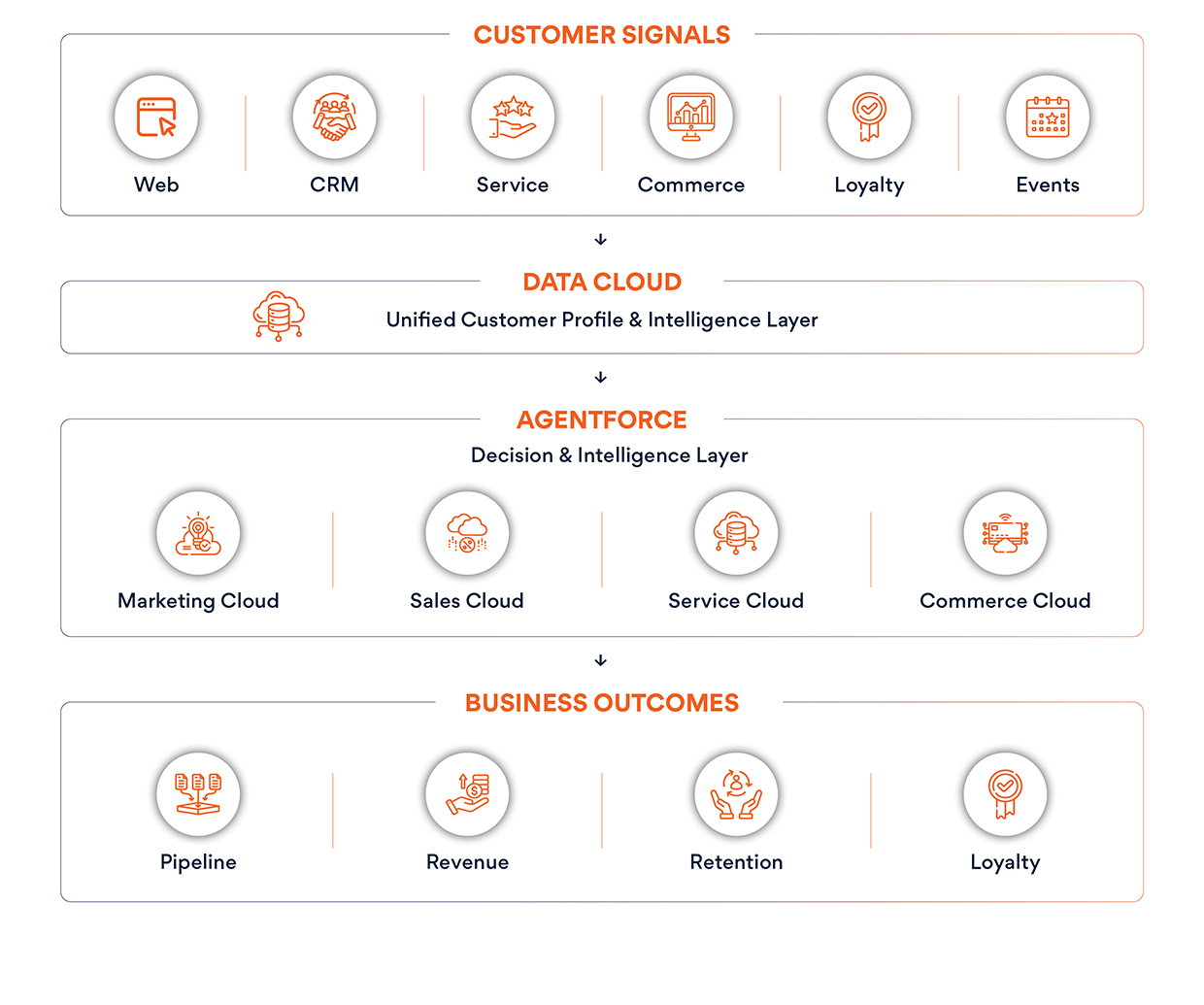
Salesforce has also recognized this change and has positioned Marketing Cloud Next as the engagement layer of the broader agentic architecture. Rather than operating as a standalone campaign platform, Marketing Cloud Next was repeatedly demonstrated as the execution engine receiving decisions from Agentforce and customer intelligence from Data Cloud.
Here is a look at how these changes will play out in the larger scheme of things.
Key Theme of 2026 & Beyond: The Rise of the Marketing Maker
The central concept introduced at Connections 2026 is what Salesforce calls the “Marketing Maker” — a marketer who spends less time executing and more time directing.
For the last two decades, marketing transformation conversations have been about channels, automation and personalization. The underlying operating model barely changed. Teams still built audiences manually, created content asset by asset, launched campaigns on schedules and optimized based on dashboards they had to pull and interpret themselves.
Connections 2026 has proposed something radically different. In every major demonstration — whether for B2C campaigns, B2B pipeline, loyalty programs, or commerce — the marketer no longer started with a campaign brief. They started with a business objective. An AI agent then determined the audience, the content, the channel mix, the journey logic and the optimization strategy. The marketer reviewed, approved and directed. The agent executed.
This changes the marketer’s role in a meaningful way. Human teams are not stepping away from marketing. They are stepping into a higher-order role, like setting goals, defining guardrails, shaping experiences, validating outputs and ensuring alignment with brand, compliance and business priorities. That is why the biggest takeaway from this year’s event is not simply that AI is becoming more capable. It is that marketing itself is being redesigned around orchestration rather than manual execution.
The Announcement: What Salesforce Has Actually Built
The keynote, led by Eric Zenz, SVP of Agentforce Marketing, presented six areas where Agentforce is acting as an AI multiplier for marketing teams. These are not future roadmap items; most are available today to existing Marketing Cloud customers at no additional cost through like-for-like additions.
- Campaign Creation and Optimization: The Marketing Goals Agent takes a business objective, target audience and budget, then generates audience recommendations, campaign structure, journey logic, content assets and forecasting. After launch, it continues monitoring and proposes optimizations automatically.
- Content at Scale: The Content Agent generates channel-ready assets like email, SMS, WhatsApp ans landing pages from a single brief, grounded in a Unified Brand Centre that stores voice, tone and visual identity.
- Two-Way Conversational Marketing: Every channel becomes bidirectional. Agents engage, respond, qualify and escalate, maintaining full customer context across marketing, service and commerce interactions.
- Unified Data and Intelligence: Data Cloud (also referred to as Data 360) serves as the context layer for all agents. Without unified data, agents cannot act intelligently.
- Real-Time Segmentation and Personalization: Moving beyond static segments to behavioral signals, AI-driven audience recommendations and household identity resolution.
- Marketing Planning and Ops via Slack: Agentforce Co-Worker surfaces campaign performance, root-cause analysis and recommendations directly in Slack, eliminating the need to open multiple dashboards to understand what is happening and why.
Enterprise Agentic Marketing Architecture
Beyond the Keynote: Three Announcements Worth Knowing
Several announcements at Connections 2026 received less attention than Agentforce but may have significant long-term impact.
- Qualified (Now Part of Salesforce) Historically, B2B websites relied on forms and delayed follow-up. Qualified puts AI agents directly on the website to engage visitors through chat, voice and guided experiences — qualifying leads, booking meetings and creating pipeline in real time. For enterprise B2B clients where the website is a primary demand generation surface, lead leakage reduction through Qualified is directly measurable.
- Real-Time Offer Management Moving away from static offers and manual targeting logic toward dynamic offer selection based on customer context and behavior. For loyalty programs and commerce teams, this means the right offer at the right moment — not the right offer at the next campaign deployment.
- Headless 360 — The Architecture Change Most Teams Are Missing This is the concept that will matter most over the next two to three years. Salesforce acknowledged something fundamental: agents do not consume user interfaces. They consume data from APIs and MCP servers. Headless 360 means Marketing Cloud Next capabilities — campaign creation, journey orchestration, content generation, segment activation — can now be triggered entirely by agents, without a human ever opening the application screen.
What This Means for Enterprise Clients?
The biggest mistake organizations can make is trying to implement everything simultaneously. A sequenced approach reduces risk and builds on each layer:
- Phase 1 — Data Foundation: Unify customer data. Resolve identity. Establish consent management. Without this, AI delivers no value.
- Phase 2 — Intelligence Agents: Introduce reporting and performance agents. Give teams the ability to ask natural-language questions of campaign and pipeline data.
- Phase 3 — Content and Campaign Agents: Activate Content Agent and Marketing Goals Agent for a specific campaign type. Measure time saved and quality delta.
- Phase 4 — Website Engagement and Lead Qualification: Deploy Qualified or equivalent. For B2B teams, pipeline leakage reduction is immediately measurable.
- Phase 5 — Autonomous Optimization: Self-optimizing campaigns, Headless 360 orchestration, multi-agent workflows across marketing, sales and service.
Organizations that skip directly to Phase 5 without the data and governance foundation will likely struggle to see meaningful ROI. Those that sequence correctly will find that each phase compounds the value of the next.
Final Thought
Salesforce Connections 2026 was not primarily about AI. It was about a shift in how marketing teams will work. The organizations that benefit most will not necessarily be the ones with the largest AI budgets. They will be the ones with the strongest customer data foundation, the clearest business objectives and the cultural willingness to let agents own execution while humans own strategy.
The operating model behind marketing teams is beginning to change. The platform is ready. The question for every marketing organization and every implementation partner is, “Are you ready to embrace this change?”
To explore how this plays out in your Salesforce environment, write to us today.
Author Profile

Vijay Jaiswal
Senior Engineering Lead, Persistent Systems