
Across telecom, media, manufacturing and enterprise technology, one pattern is becoming impossible to ignore: organizations are investing heavily in copilots, automation and AI-driven experiences, yet enterprise-wide outcomes remain underwhelming. This is not a lack of AI capability; this is an enterprise AI-readiness gap.
AI success is no longer determined by models or pilots; it is determined by whether enterprises can operationalize AI at scale. Today, most organizations are building AI-driven businesses on top of legacy foundations that were never designed for intelligence, speed or scale. As a result, AI does not transform the business; it exposes its limitations.
Modernization is the decisive factor that determines whether AI delivers real business value or simply scales inefficiency.
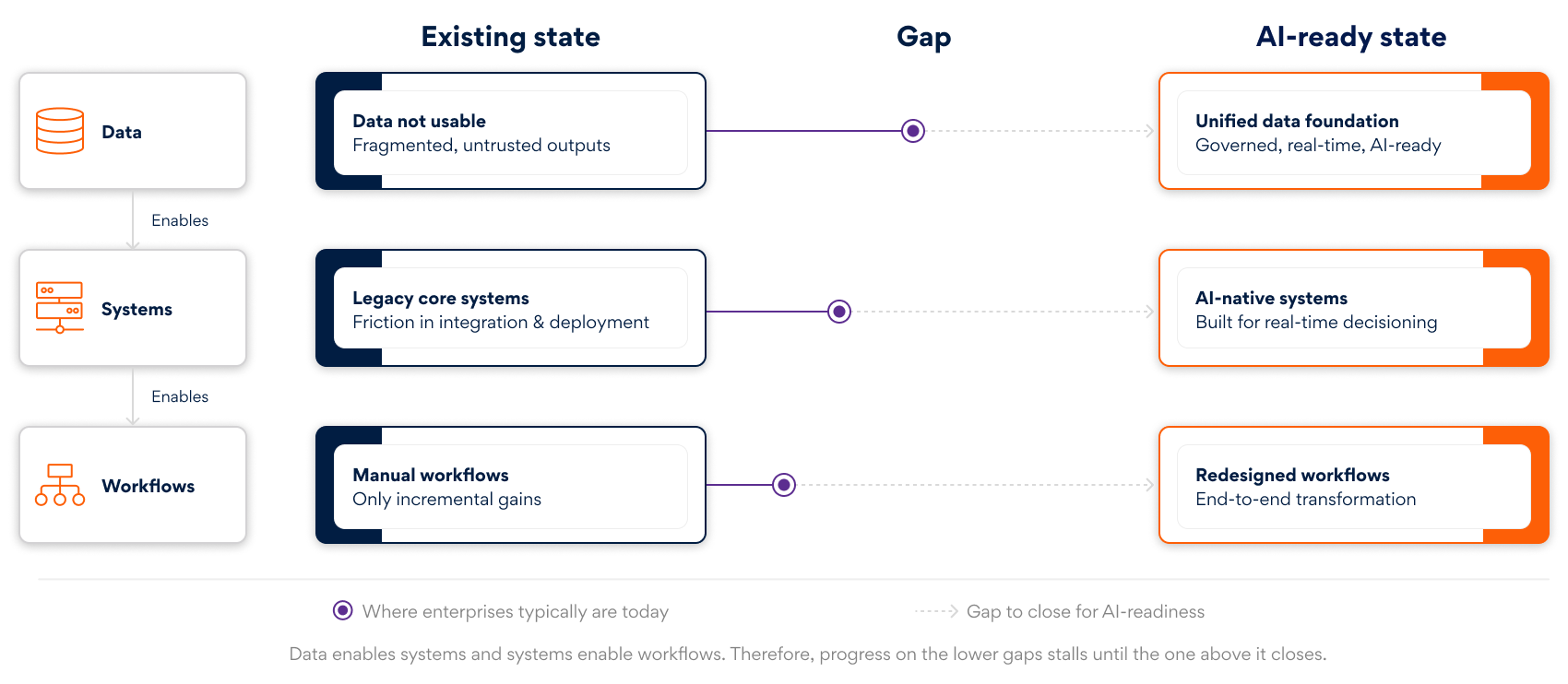
Same Gap, Playing Out Differently
- Telecom & Networks: Growth Without Monetization Operators are handling unprecedented data volumes, yet revenue growth remains under pressure. AI is expected to improve efficiency and unlock new revenue streams, but legacy OSS/BSS systems and fragmented data architectures continue to slow progress.
- Media & Entertainment: Attention Without Loyalty Content consumption is expanding across platforms, while monetization models are being disrupted. AI promises deeper personalization and engagement, but without unified audience and content data, impact remains muted.
- Industrial & Manufacturing: Automation Without Intelligence Operational systems are increasingly connected and data-rich, yet organizations struggle to translate this into enterprise-level intelligence. Fragmented OT/IT landscapes and legacy systems prevent AI from delivering scalable value.
From Legacy Constraints to AI-Ready Enterprises
The pressure is evident across boardroom discussions. AI budgets are rising, but the outcomes and value delivered to the enterprise are well below expectations. It is clear that AI is not another technology upgrade cycle; it is a structural shift in the business operating layer, be it autonomous networks in telecom or an intelligent supply chain in manufacturing.
In that context, modernization is not limited to cloud migration, application rationalization or cost optimization. Modernization today is the missing link in enterprise AI, required to Re(AI)magine the enterprise core to make AI possible at scale.
Across industries, five modernization imperatives define the AI Era
- From Fragmented to Intelligent Data: Unify data across customers, assets, operations and ecosystems to create trusted, real-time intelligence. Without a strong data foundation, AI amplifies noise instead of generating insight.
- From Legacy to Composable Platforms: Monolithic architecture slows innovation. AI-ready enterprises are adopting API-driven, cloud-native, modular platforms that embed intelligence directly into products, services and workflows.
- From Automated to Autonomous Workflows: AI is not about speeding up existing processes; it is about reinventing them. Organizations that redesign workflows end-to-end unlock transformational productivity, agility and growth.
- From Operational to Strategic Infrastructure: AI requires scalable computing, real-time processing and hybrid cloud architecture. Infrastructure is no longer a back-office function; it is the foundation for innovation and competitive advantage.
- From Governance to Differentiated Trust: As AI adoption accelerates, trust becomes a critical business asset. Security, privacy, resilience and responsible AI are shifting from compliance requirements to sources of market leadership
Modernization is no longer what happens before AI; rather, it is what determines whether enterprise AI delivers at its full potential and promise.
New Strategic Divide
The next phase of enterprise competition will not be defined solely by AI adoption. It will be defined by who can operationalize AI at scale and that will depend on who can modernize the core to gain a disproportionate share of business.
- Telecom operators will compete on network intelligence, not just coverage
- Media companies will compete on personalization, not just content
- Manufacturers will compete on autonomous operations, not just efficiency
- Software vendors will compete on AI-driven outcomes, not just features
And in every case, the difference will come down to one question: Is the enterprise core ready for AI or is AI exposing its limits?
The bottom line is: AI is not a silver bullet but a force multiplier.
On a modern, integrated, intelligent foundation, it creates exponential value, while on a fragmented, legacy foundation, it amplifies inefficiency, risk and cost.
Re(AI)magining Enterprise Core
At Persistent, we see modernization not as a prerequisite to AI, but as the pathway to unlocking its full value. Our approach is anchored in three interconnected layers:
- The Core: Build an AI-ready digital foundation where organizations move beyond technical debt and fragmented systems to create a connected, composable and intelligence-driven digital backbone
- The Business: Create AI-infused intelligent and autonomous operations for a business that continuously learns, adapts and optimizes itself through redesigned workflows, augmented decision-making and intelligent operations
- The Experience: Deliver human-centric engagement that is AI-native by design and is based on hyper-personalization, proactive interactions and conversational intelligence that anticipate needs, simplify complexity and strengthen relationships
Our 3C Architecture (Core, Context and Co-ordination) is designed for purpose-built enterprise AI solutions that address the widening value gap across AI pilots and production-grade solutions. It helps enterprises with a systemic approach to engineering AI solutions from the ground up by ensuring the right foundations are in place across enterprise readiness, awareness and operational dimensions.
- Core is the enterprise backbone and foundation for AI readiness
- Context is the engine for enterprise intelligence that makes AI enterprise aware
- Coordination is the human-machine orchestrated experience that makes AI operational
Based on our experience working with clients, we have identified three prominent recurring patterns and signals for organizations that have been successful in unlocking the true value of AI.
- Invest in building the intelligent foundation that makes AI possible
- Infuse AI into operations to create adaptive, autonomous enterprises
- Deliver AI-native experiences that anticipate, personalize and delight
The AI Aha moment has come. The question is no longer whether to modernize, but how quickly one can modernize the core and become AI-ready to capture the next value pool.
Talk to our experts to unlock value from your AI investments.
Author Profile

Subhankar Ghosh
Vice President and Pre Sales Lead for Communications, Media, Technology and Industrial