
Why Drug Discovery Needs a New Operating Model
AI has transformed individual stages of drug discovery, yet most discovery programs still operate as disconnected workflows. The next frontier is coordinating these capabilities into connected workflows Progressing from target identification to a focused set of therapeutic candidates requires significant investment, specialized expertise and years of iterative experimentation. Although AI supports individual drug discovery tasks – such as literature review, structure prediction, molecule optimization, biomolecular simulation, interpretation and reporting – workflows often remain fragmented. This fragmentation makes it difficult to operationalize AI Drug Discovery at scale.
Preclinical research still depends heavily on wet-lab validation, while prebuilt workflows can be too rigid for dynamic scientific questions. Discovery teams need flexible workflows that can be launched, adapted and governed on demand—connecting specialized models, tools and human expertise into traceable, decision-ready processes. The challenge is no longer whether AI can perform individual scientific tasks, but how organizations orchestrate specialized capabilities into governed, repeatable discovery workflows.
DrugStudio:A Coordinated Multi-Agent Framework for Early Drug Discovery
DrugStudio is a multi-agent solution for small-molecule drug discovery that transforms fragmented early discovery tasks into a coordinated, evidence-grounded workflow. Rather than treating biomedical search, database retrieval, molecule design, protein structure prediction, virtual screening, ranking and reporting as disconnected activities, DrugStudio orchestrates the right specialist agent, model, database API or tool based on the scientist’s intent. This modular approach connects scientific context, computational execution, human-in-the-loop decision-making and traceable outputs to support evidence synthesis, candidate prioritization, R&D productivity and more informed therapeutic decision-making.
At the center of this framework is an Orchestrator Agent, supported by an NVIDIA Nemotron open source model. It interprets the user’s domain query, identifies the appropriate scientific path and orchestrates specialized agents for external evidence access through web search and scientific databases, molecule generation, protein structure prediction, virtual screening and smart reporting.
By building on NVIDIA BioNeMo Agent Toolkit technologies, DrugStudio gains a scalable foundation for building multi-agent drug discovery workflows. The toolkit currently brings together NVIDIA BioNeMo NIM microservices for biomolecular and structural biology tasks, NVIDIA NeMo Agent Toolkit Phoenix for observability, traceability and reproducibility. As next steps, DrugStudio is expected to incorporate NVIDIA NeMo Retriever for scientific knowledge access from literature and NVIDIA NeMo Guardrails for governed, review-ready report generation.
DrugStudio: High-level Architecture Diagram
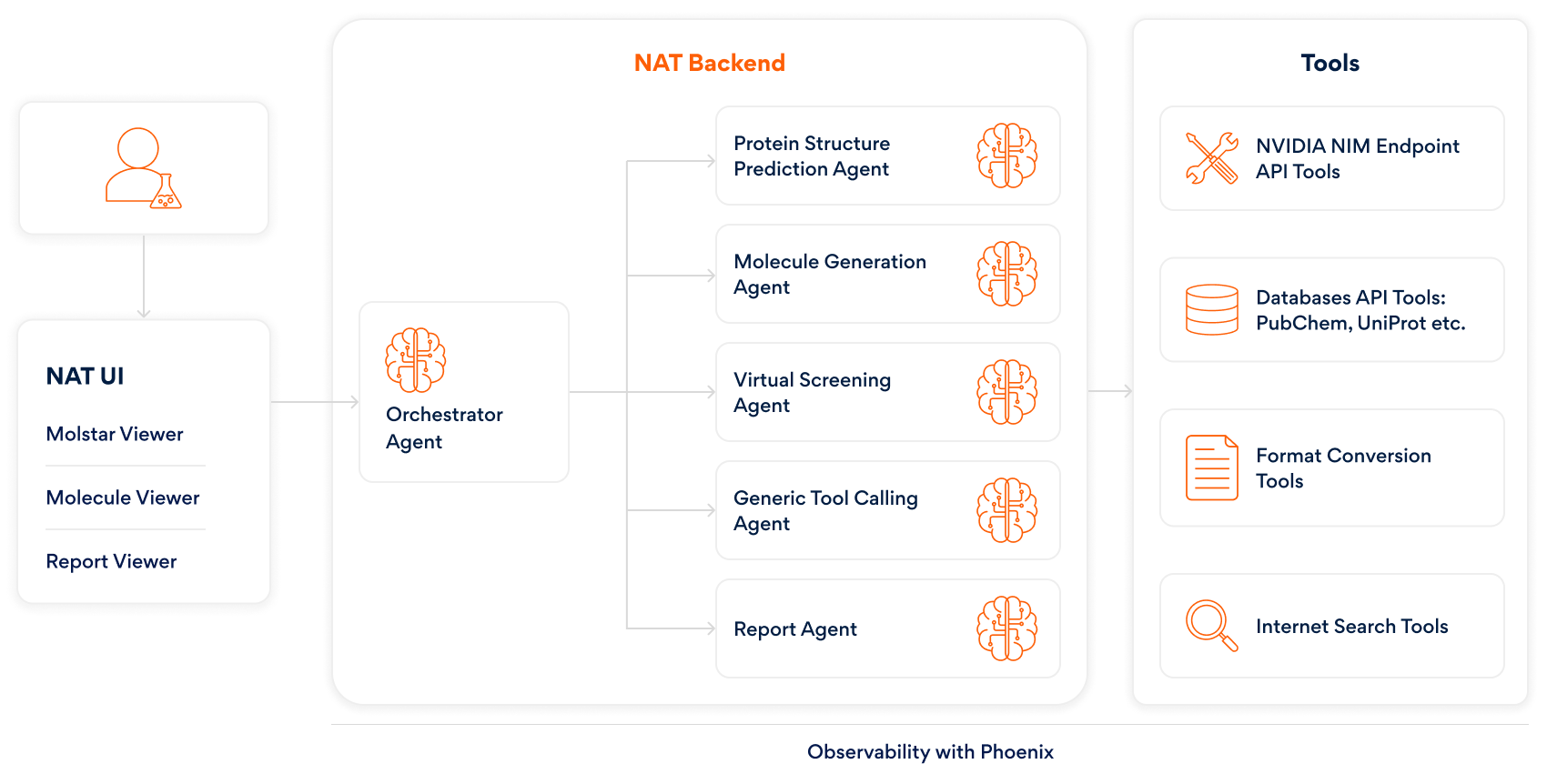
How DrugStudio Coordinates Five Specialized Capabilities
DrugStudio brings its specialist agents and tool-calling capabilities together through an orchestration layer that routes each scientific query to the right model, scientific databases, web search tool or computational agent. The revised architecture separates evidence access, molecule generation, protein structure prediction, virtual screening and report generation so each capability can evolve independently while remaining part of a connected discovery workflow.
1. Generic Tool Calling Agent: Connecting Web Search and Scientific Databases
Evidence gathering is handled through a web search agent combined with scientific databases and tool-calling workflows. This layer can retrieve and contextualize information from sources such as UniProt, PubChem and PDB, helping the system move from a broad disease, target or mechanism question toward a structured evidence base that includes protein sequences, known ligands, molecular identifiers, structural context and prior scientific findings.
2. Protein Structure Prediction Agent: Building Target-Ready Structural Context
The Protein Structure Prediction Agent focuses specifically on translating target sequences into 3D structures of proteins for downstream discovery. It can use biology-specific NVIDIA BioNeMo NIM microservices and structure prediction models such as AlphaFold2 and ESMFold.
By establishing a reliable structural foundation early in the workflow, downstream ligand design and virtual screening become more evidence-driven and transparent. Scientists can review and build on these outputs rather than treating candidate evaluation as a black-box docking step.
3. Molecule Generation Agent: Designing and Optimizing Candidates
The Molecule Generation Agent uses upstream evidence to propose novel molecules, scaffolds and SMILES representations for exploration. This layer is supported by NVIDIA BioNeMo NIM microservices such as GenMol and MolMIM, with RDKit supporting cheminformatics operations and property-level analysis. The value lies not in generating more molecules, but in producing higher-quality candidates that can move more confidently into computational evaluation and laboratory validation.
Because this agent is part of a coordinated multi-agent system, generated molecules do not remain isolated model outputs. They are passed forward for structure-aware analysis, target-binding assessment and ranking, enabling a more continuous path from design hypothesis to computational prioritization.
4. Virtual Screening Agent: Ranking Candidates Through Binding and Interaction Evidence
The Virtual Screening Agent evaluates how generated molecules may interact with prepared target structures. It can support protein–ligand complex prediction, binding interaction analysis and candidate ranking using models and tools such as DiffDock, Boltz-2 and OpenFold-3. By combining structural context with binding predictions, this stage helps narrow the search space so researchers can focus computational and experimental resources on the most promising candidates.
5. Smart Report Agent: Converting Results into Review-Ready Reports
The Smart Report Agent closes the loop by transforming web search outputs, database-derived evidence, model outputs, structures, screening results, rankings and user interactions into a structured scientific report. It supports section planning, drafting, analysis, ranking summaries and structured report generation.
This is where DrugStudio moves beyond automation into scientific communication. The report agent helps document assumptions, methods, evidence sources, candidate rankings and recommendations so that computational outputs can be reviewed by scientists, shared with decision-makers and reused across discovery cycles.
Business Impact: Accelerating Drug Discovery with Connected AI Workflows
DrugStudio strengthens the business case for multi-agent AI by turning fragmented discovery steps into a connected, governed workflow. By coordinating web search, biomedical databases, model execution, protein structure prediction, virtual screening, analysis, ranking and report generation, it can help teams shorten discovery cycles, improve candidate prioritization, strengthen reproducibility and retain human oversight across early-stage R&D.
For biopharma organizations, the opportunity is not simply to automate isolated steps, but to build intelligent discovery systems that connect real-time scientific search, trusted scientific databases, domain models, human expertise and enterprise governance. DrugStudio is a step toward that future, where specialized AI agents work together in trusted, transparent and decision-ready scientific workflows.
Author’s Profile

Dr. Som Dutt
Principal Domain Expert, HLS, Persistent Systems

Leena Bahulekar
Senior Technical Consultant, Persistent Systems