
Every telecom software vendor carries products it rarely talks about anymore. These include network assurance platforms, orchestration systems, performance management tools and IoT stacks that were built for a different era still sit at the center of customer operations. These products are mature, but they are still far from irrelevant.
Today, Product Lifecycle Management (PLM) is faced with a strategic dilemma with no simple exit: retire a product too early and revenue, customer trust and contractual commitments are put at risk. Keep running it without transformation and costs climb, innovation slows and competitiveness erodes.
The ideal way forward is to stop treating maturity as a synonym for decline. With the right ownership model, selective modernization and lifecycle intelligence, mature products can become durable revenue platforms and, in many cases, engines for renewed growth.
Why Mature Foundations are Falling Behind Modern Expectations?
The constraints around mature telecom products are well understood: monolithic architectures, accumulated technical debt, slow release cycles, fragmented tooling, expensive support structures and legacy overheads such as SS7 and circuit-switched dependencies. What has changed is the expectation curve. Customers now treat cloud-native deployment, SaaS consumption, open APIs, real-time analytics, agentic AI-enabled operations and 5G readiness as baseline capabilities.
That gap cannot be closed through support alone. It requires connecting decisions that many organizations still make in isolation: portfolio strategy, product ownership, engineering modernization, intelligent operations and commercial growth.
Protect The Base: Transform With Discipline And Reopen Growth
For executives, the mature product agenda has three connected priorities and the sequence matters.

Why Outcome-Led Ownership is the Operating Model Mature Products Need
The strongest lifecycle model is not staff augmentation. It is outcome-led ownership, where a partner is accountable for lifecycle results across product management, architecture, engineering, quality, DevSecOps, site reliability, customer operations and innovation, not merely for engineering capacity.
The reason is structural. Accountability for roadmap, engineering, support and customer outcomes in one place creates the feedback loop that sustained value depends on. Production telemetry shapes roadmap priorities. Roadmaps shape engineering investment. Engineering quality shapes reliability. Customer adoption closes the loop. When those functions sit in separate contracts or separate teams, the loop breaks and each function optimizes locally while the product decays globally.
Ownership also frees the vendor to redirect scarce internal talent toward strategic growth platforms while experienced teams stabilize, modernize and evolve the established portfolio.
Decide Where to Invest, Transform, Sustain or Exit
A balanced portfolio strategy avoids two common mistakes: overfunding mature assets with limited strategic upside or abandoning valuable products before a credible transition path exists. The right call depends on both current business impact and future growth potential.
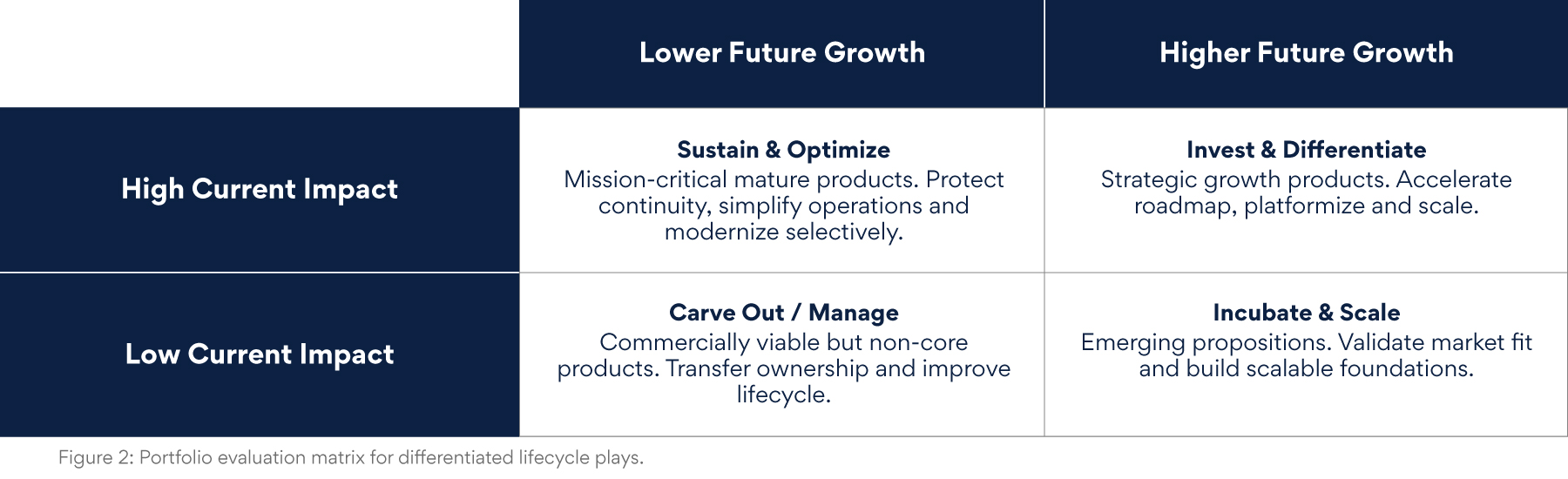
High-impact products with strong growth prospects deserve continued investment and differentiation. High-impact products with limited growth potential call for sustain-and-optimize: protect continuity, simplify operations and modernize selectively. Low-impact products with growth potential should be incubated and scaled. Commercially viable but non-core products are candidates for carve-out or managed ownership, where transferring the lifecycle to a partner improves economics without destroying value.
The matrix is simple. The discipline lies in applying it honestly to products that still have internal champions.
Scale Agentic AI with Governed Autonomy
AI makes product transformation more evidence-based, automated and responsive through capabilities such as knowledge extraction, requirements refinement, code generation, test automation, release-risk prediction, anomaly detection and root-cause analysis. Agentic AI extends this by coordinating specialized agents across product, engineering, quality, release, reliability and customer experience. Each agent observes signals, recommends actions and triggers governed workflows on a shared product knowledge foundation.
The design principle that matters most is restraint. Autonomy should increase only as evidence quality, control maturity and operational trust improve. Human accountability must remain explicit for high-impact decisions.
Measure Lifecycle Value in Business Terms
The business case for lifecycle management fails when it narrows to engineering cost. The lifecycle value equation is broader: avoided run cost, plus protected revenue and margin, plus released capacity, plus option value from modernization and growth, minus transition investment.
That translates into four executive questions.
- Are customer and revenue commitments safer?
- Have lifecycle cost and complexity improved?
- Is the product changing faster and more safely?
- Is it creating new commercial options?
A program that cannot answer all four is just a support contract with a better name.
Mature products should be managed as value streams with choices, not as assets to be kept alive. Our point of view, Telecom Product Lifecycle Management: From Product Sustenance to AI-Native Digital Growth, explores the ownership model, portfolio matrix, six-stage playbook and agentic architecture in greater depth. Download the full paper to see how telecom software vendors can protect legacy value, modernize with discipline and create new paths for AI-native growth.
Author Profile

Nilay Khadepau
Solution Head, Domain Consulting – Telecom