
Your AI-infused solution is intelligent. But does it appeal to the senses?
How does your AI-powered workflow make your users feel?
Do they believe, “This AI has my back”?
And when they have a choice, does your AI application become the trusted go-to for employees and customers?
These are not just questions of usability. They are questions of adoption, trust and experience.
In an enterprise AI context, a “binge-worthy” experience is one users willingly return to, not because they have to, but because it consistently feels useful, intuitive, relevant and dependable. It understands their context, helps them accomplish what matters and gets the job done accurately.
Every time.
That is the real opportunity with enterprise AI: moving beyond intelligent technology to create experiences people genuinely want to use.
Enter the 3C Architecture
Persistent Systems has developed the 3C framework, to build the Orchestrated Enterprise. It has an architecture built on 3 pillars.
Core: The Foundation.
This is the integrated infrastructure that connects data and workflows, governs models and agents, enforces identity and access, delivers full observability and keeps performance and cost under control. Every downstream AI agent inherits its strength or its fragility from this layer.
Context: The Intelligence.
This is the enterprise brain that transforms raw data into actionable knowledge: an ontology of entities and relationships, a graph that captures connections, a memory of what happened before and the semantics that define what words mean in this specific business.
Coordination: The Execution.
This is the unified execution layer where people, agents, applications and systems collaborate with clear controls and accountability. Because we know that siloed agents without coordination are only set up to collide.
The 3C architecture establishes the enterprise foundation for AI at scale. Core provides governance and operational integrity. Context delivers institutional intelligence. Coordination enables execution across people, systems and agents. Together, these capabilities create the conditions for trusted AI.
But enterprise-scale AI infrastructure alone does not necessarily guarantee instant adoption of AI experiences. The next challenge is translating these AI capabilities into experiences at the user level, where users are convinced these experiences are valuable, trustworthy, intuitive and worth returning to. This is where APEX comes in.
The Need for an AI experience framework
The aim of every experience designer has always been to truly understand the user’s hopes, dreams, fears, frustrations, preferences, dive deep into the user’s thoughts, feelings, historical behavior patterns and then create an experience to empower the users. We have now reached a point in digital evolution that an intelligent ecosystem can finally help contribute toward that mission. Establishing a strong foundation and rich context is necessary and is the first step to ensure adoption. The real measure of success is when the AI experience starts feeling personal.
If you want your AI experience to demonstrate empathy and feel genuinely useful, it must build upon Context. The Context layer grounds all AI experiences, with true integrity to user goals and user outcomes. Rich enterprise and user context allows AI experiences to deliver greater relevance, reduce cognitive effort, provide meaningful explanations and give users confidence and control over outcomes. This creates a trusted and effective experience.
The APEX AI-UX framework builds on the 3C architecture
Persistent has built the APEX framework to outline our AI powered experience guidelines. We’ve translated abstract ethics and usability theories into concrete practices that, when integrated into AI experience design, deliver trust, relevance, usability and impact. While 3C enables enterprise AI capability, APEX enables enterprise AI adoption. It translates the power of governance, context and coordination into experiences that drive outcomes.
APEX leverages the context layer to build an authentic mental model of how decision making happens in the mind of the user and enables designing UX that is grounded in context, is appealing and is easy to consume. It meets the users where they are.
These 8 guidelines help assess if your existing or new AI experience is optimized for both user and business impact. These guidelines help inform user research, UX strategy, UX design and user testing.
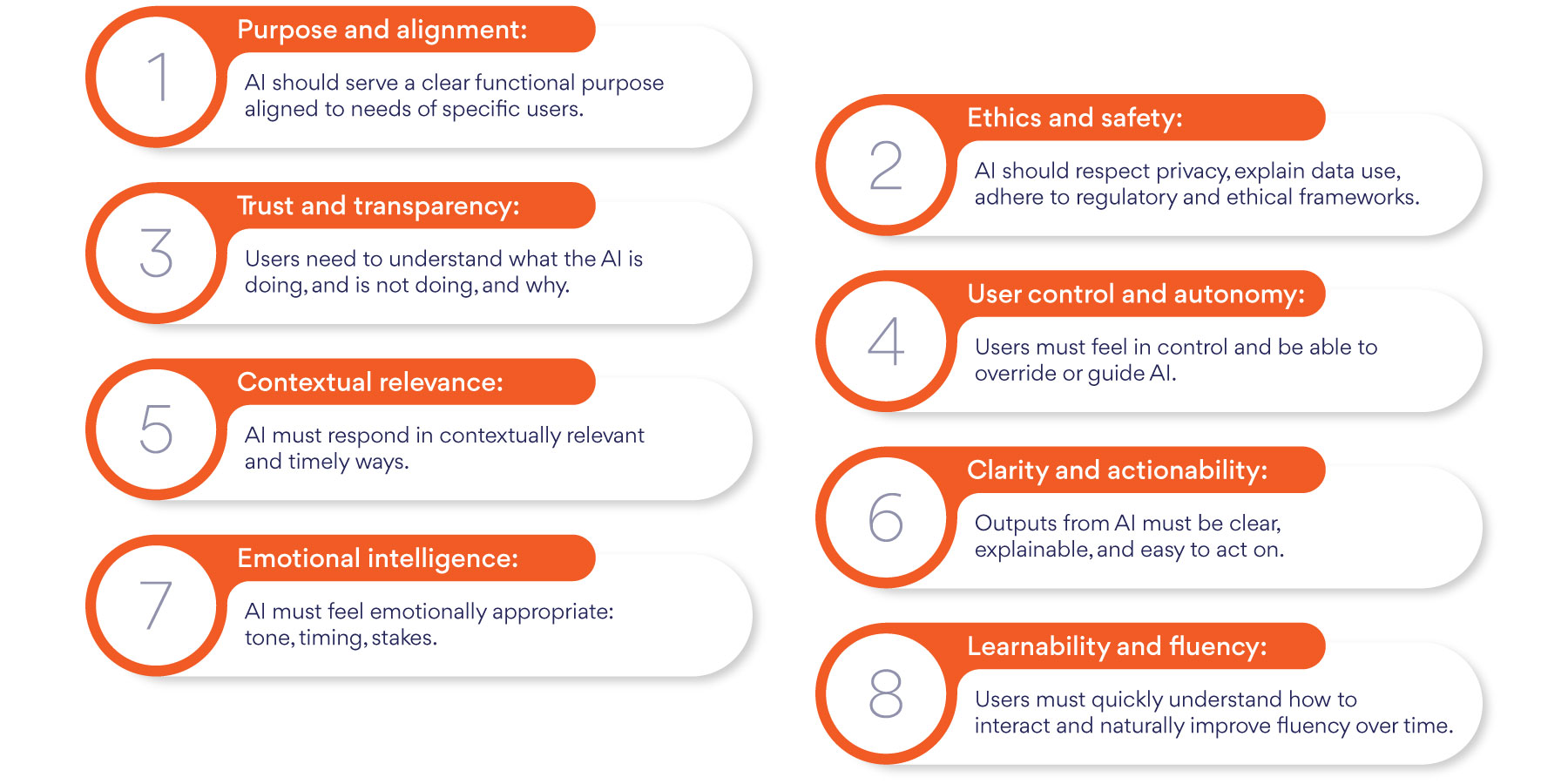
APEX is designed to build confidence and trust in the AI experience, encouraging the behaviors that lead to desired business outcomes. Its underlying Context layer keeps AI grounded, traceable, permissioned and human-governed, creating experiences that feel credible, relevant and intuitive. That’s AI that is trustworthy and appeals to your senses.
The toolkit is designed for faster AI adoption. While applying the 8 APEX guidelines in UX design, we also leverage the OOUX (Object-Oriented UX) design methodology. The Context graph helps power the OOUX, to build digital systems and AI experiences around the core objects or entities that users care about, before designing screens, steps or actions. The UX therefore mimics how users naturally think, creating effortless Human centered AI.
While the 3C architecture helps deliver enterprise AI value at scale, APEX ensures that the individual WIIFM (What’s In It For Me) value is high. It is personalization served with deep context and with clarity and humility, setting up your AI ready for consumption and adoption.
Talk to Persistent XT (eXperience Transformation consulting practice) about your AI initiatives and we can help evaluate if you are setting up your AI initiatives for both user success and enterprise success.
It’s time to make your AI experiences addictive-by-design and truly binge-worthy.
Author Profile

Gajanan Kasbekar
Chief Principal, Experience Transformation Consulting