
Across the enterprise software, SaaS, ISV and platform landscape, a clear pattern is emerging. AI ambition is accelerating faster than product readiness. Vendors are rapidly launching copilots, AI assistants, intelligent workflows and personalized experiences, yet many struggle to convert these capabilities into sustainable business value.
The reason is simple: most products were designed for the SaaS era, not the AI era. AI is being layered onto architectures, data models, workflows, user experiences and business models that were never built for autonomous execution, contextual intelligence or outcome-driven delivery.
This challenge spans every software category. Horizontal SaaS vendors must evolve from feature-rich applications to platforms that deliver business outcomes. Vertical SaaS providers have deep domain expertise but often lack the agility, contextual data and automation required to scale AI. Infrastructure, data, developer and industry platforms face similar pressures as customers increasingly expect self-healing operations, intelligent automation, predictive insights and autonomous decision-making rather than better tools and dashboards.
The root causes are consistent.
- First, software vendors possess vast amounts of products, customer, workflow, telemetry and transaction data, but much of it remains fragmented and difficult for AI to use effectively.
- Second, legacy architectures built around forms, records and human-led workflows limit the ability to embed intelligence and scale autonomous execution.
- Third, most software still assumes users will interpret information, navigate workflows and make decisions manually, while AI is shifting expectations toward software that understands context, recommends actions, executes tasks and continuously learns from outcomes.
This is why modernization can no longer be viewed as a technology refresh exercise focused on cloud migration, technical debt reduction or UI modernization. Modernization has become the reinvention of the software core to support AI, autonomy, trust and measurable business outcomes at scale.
Our Perspective – The Modernization Flywheel
Many software vendors still treat modernization and AI as separate initiatives: modernizing platforms on one track while launching AI capabilities on another. That thinking is rapidly becoming obsolete.
AI is increasingly helping organizations accelerate modernization through code generation, testing automation, migration acceleration, intelligent operations and engineering productivity gains. At the same time, modernization creates the foundation AI requires: unified data, composable architecture, agent-ready platforms, governance, observability and trusted workflows. Together they create a self-reinforcing flywheel where modernization enables AI and AI accelerates modernization.
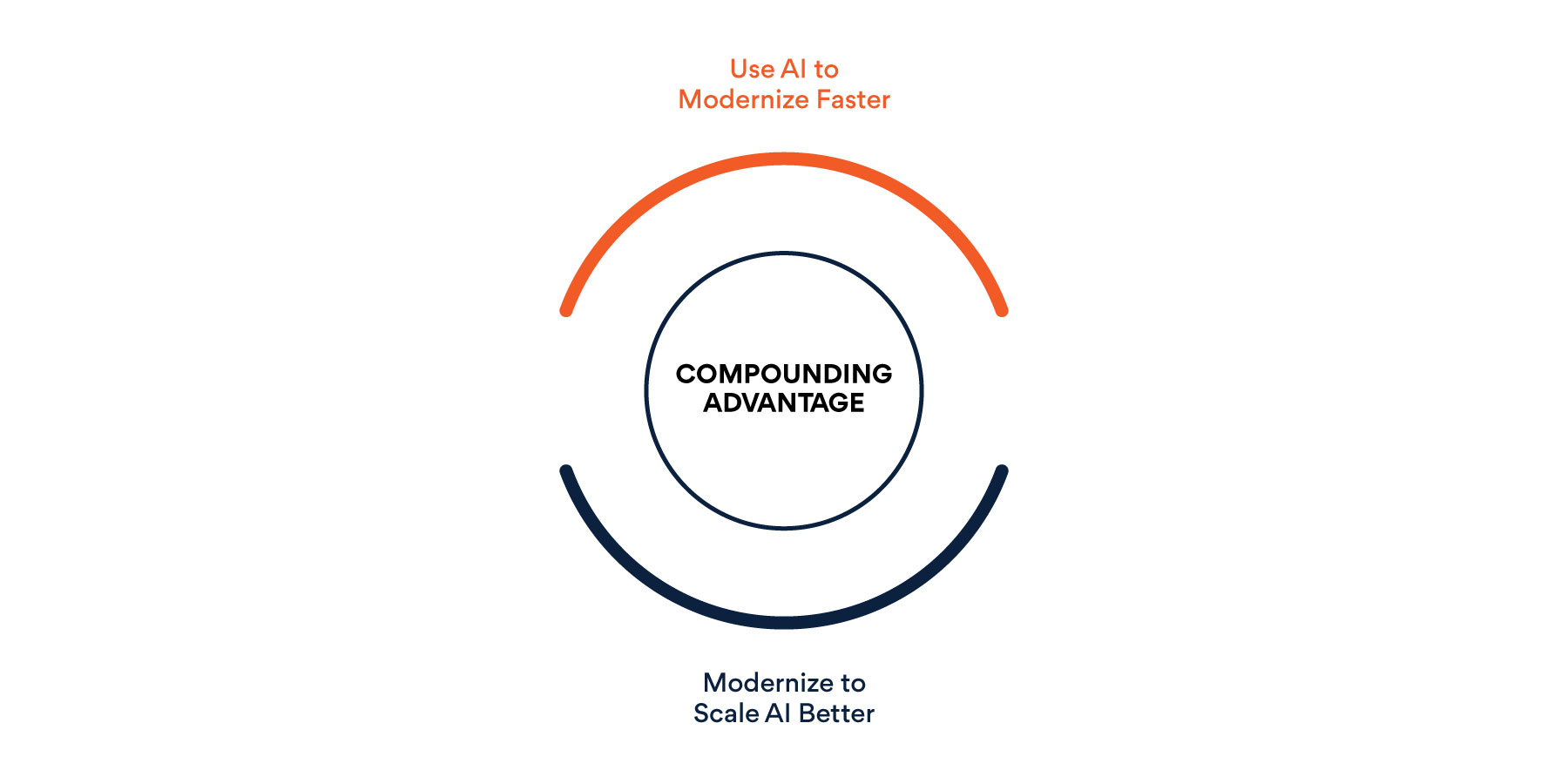
Organizations that combine both motions gain a compounding advantage. They move faster than traditional SaaS competitors burdened by legacy platforms while building deeper trust, domain context and enterprise readiness than many AI-native disruptors.
To create this flywheel, software vendors must modernize across five dimensions:
- Data: Transform product and operational data into a trusted Product Intelligence layer that powers personalization, automation and AI-driven decisions.
- Platforms: Evolve from monolithic SaaS architectures to composable, cloud-native, API-first and agent-ready platforms.
- Workflows: Redesign experiences around autonomous execution, moving from forms and dashboards to recommendations, orchestration and outcomes.
- Infrastructure: Build AI-scale foundations that support model orchestration, retrieval, observability, governance, performance and cost optimization.
- Trust: Make security, privacy, explainability, governance, compliance and responsible AI core product differentiators.
The next competitive divide will not be defined by who adds the most AI features. It will be defined by who can operationalize AI into trusted, measurable, autonomous product value. Across CRM, ERP, HCM, ITSM, developer platforms, cybersecurity, data platforms and vertical SaaS solutions, success will increasingly be measured by outcomes delivered rather than features deployed.
At Persistent, we believe software vendors must modernize across three dimensions:
- Renovate the Core with AI-ready product foundations
- Reinvent the Business through AI-infused operating and monetization models
- Reimagine the Experience around intelligent, proactive and human-agent interactions.
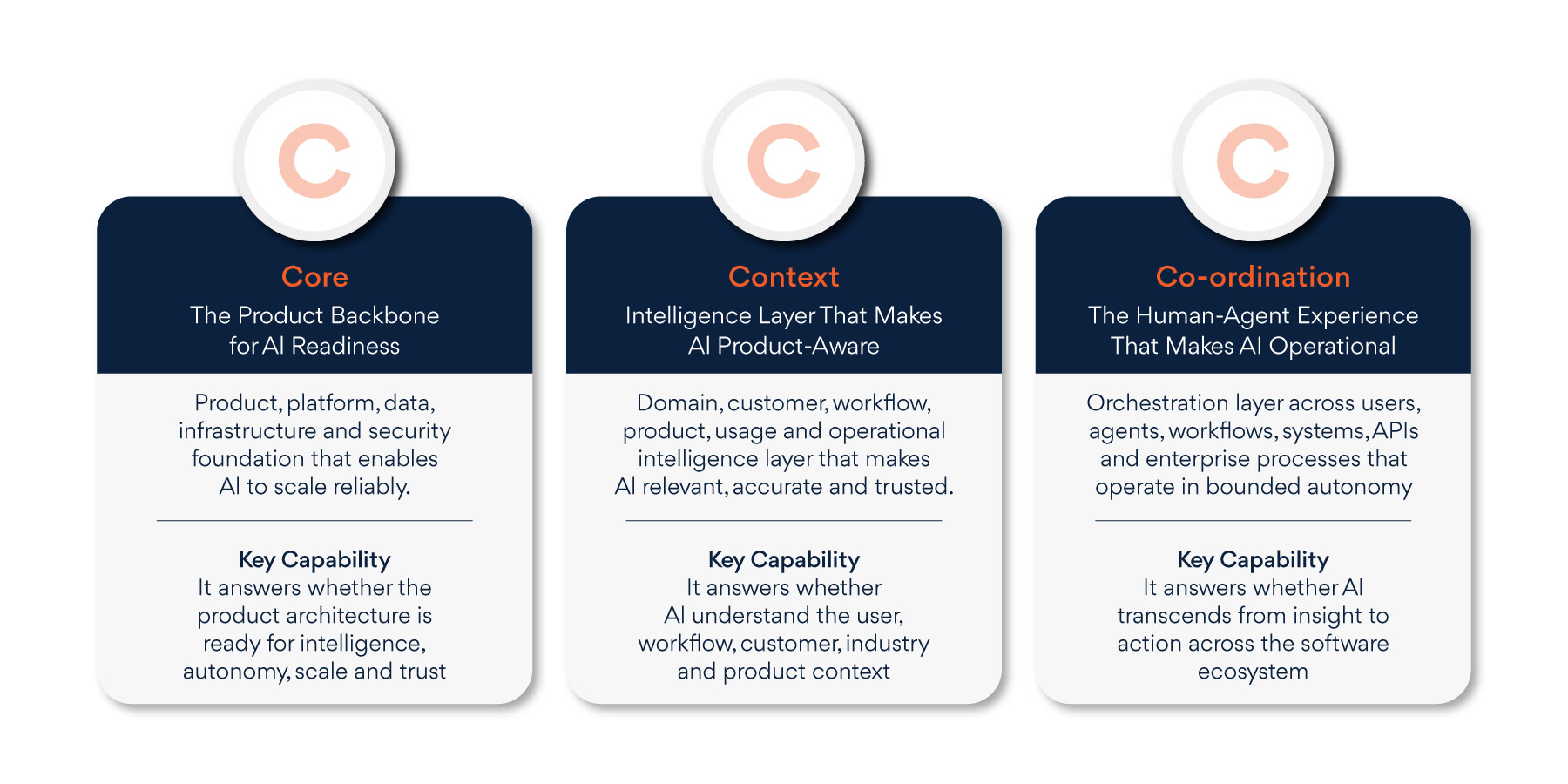
Our 3C Architecture – Core, Context and Coordination helps bridge the gap between AI pilots and production-scale AI-native products.
- Core establishes the fit for purpose AI technology foundation
- Context creates product-aware intelligence
- Coordination enables AI to move from insight to action across users, workflows and ecosystems
The vendors creating real AI value are following a common playbook: modernizing the product core before scaling AI, embedding intelligence into workflows rather than interfaces and redesigning value and trust together.
AI is rewriting the rules of software; The next software battleground is not SaaS versus SaaS. It is software that supports work versus software that delivers work.
The winners will be those that modernize their products to evolve from systems of record into intelligent platforms that learn, decide and act on behalf of their customers.
The AI era has created a defining moment for software companies. Products will no longer be judged solely by the features they provide, but by the work they perform, the outcomes they deliver and the trust they earn.
Modernization is no longer a precursor to innovation. It is the engine that powers AI-native leadership.
Ready to turn modernization into a competitive advantage? Whether you are evaluating legacy applications, modernizing software products, migrating to cloud-native architectures or preparing your technology estate for AI adoption, the first step is understanding where modernization can create the greatest business impact.
Download our Enterprise Technology Modernization POV to explore the frameworks, strategies and modernization approaches that are needed to build an AI-ready enterprise.
Author Profile

Subhankar Ghosh
Vice President and Pre Sales Lead for Communications, Media, Technology and Industrial