
Chipsets get the headlines. The real cost of modernizing a device program is hiding in the BSP, the certification pipeline, the lab you rent or own and the RTOS fleet nobody’s touched in years.
The myth: “We’re modernizing — we switched to the new chip”
Ask most product leaders what “modernizing” a device program means and you’ll get some version of: newer chipset, newer OS version, maybe a jump to 5G. It’s a clean story. It fits in a board slide. And it’s maybe ten percent of the real work.
The other ninety percent is debt — quietly accumulating in four layers that nobody line-items in a budget until a launch date slips and everyone starts asking why a “simple chip swap” turned into a nine-month program. Modernization doesn’t fail at the chip. It fails in the layers built around the chip that nobody was watching.
Here’s what those four layers are, why each one is invisible until it’s expensive and how to tell which one is actually your bottleneck.
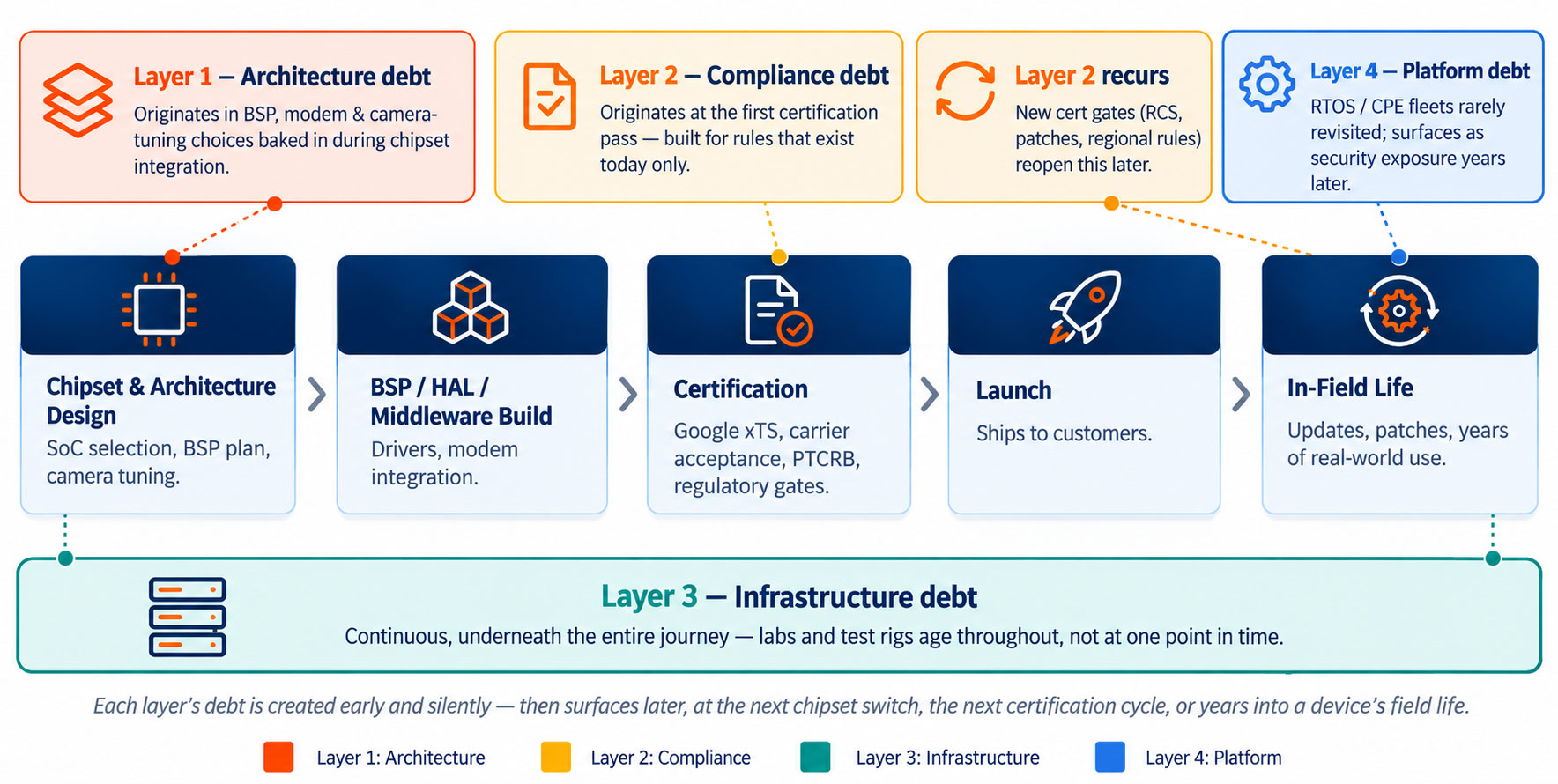
Layer 1: Architecture debt — the HAL promise that only half-delivered
Android’s Hardware Abstraction Layer (HAL) was supposed to solve this problem once and for all. The idea was elegant: define a fixed contract — a Camera HAL, an Audio HAL, a Wi-Fi HAL — that any chipset vendor implements, so the OS and every app above it never need to know or care which silicon is underneath.
It worked. Partially. HAL genuinely decoupled the application and framework layers from the hardware — that part of the stack barely changes when you switch chipsets. But HAL was never designed to eliminate the work below it. The board support package, the modem integration, the camera ISP tuning — all of that still has to be rebuilt, largely from scratch, for every new chipset. The “translator” between generic OS requests and this specific chip’s electrical reality doesn’t write itself.
This is the most dangerous kind of debt because it hides behind a half-truth. Teams see “we support HAL” and assume chipset flexibility is solved. Then a chipset switch shows up and the BSP, RF and camera-tuning teams discover they’re doing eighty percent of the work they did last time — because HAL only ever fixed the top of the stack.
The scale of this problem is well documented outside the smartphone world too. As per McKinsey’s research on automotive software and electronics, the software running inside a modern vehicle exploded from roughly ten million lines of code in 2010 to around 150 million by 2016 — while the industry’s ability to actually develop and maintain that software grew at nowhere near the same pace, creating what McKinsey calls a widening “complexity-productivity gap.” Devices don’t need to be cars to hit this wall: any product line stacking new chipsets, new middleware and new certification requirements on an architecture that wasn’t designed to absorb them is running the same math.
The tell: if switching chipsets still triggers a full re-tuning of camera 3A (auto white balance, auto focus, auto exposure) and a full modem re-integration cycle, you don’t have chipset flexibility. You have chipset portability with a large asterisk.
The fix: stop treating BSP and camera-tuning work as bespoke labor that starts from zero each time. Build a reusable BSP framework — a documented, versioned starting point for “what changes when we move to a new chipset” — so each new cycle adapts a known playbook instead of relearning it. Standardize camera tuning around repeatable test charts and automated image-quality measurement rather than one-off manual sessions, so tuning a new chipset is calibration, not invention. And keep a standing modem-integration test harness (RF simulators, network emulators) on hand, so re-integration is validation against a fixed rig rather than building the rig from scratch each time.
Layer 2: Compliance debt — certification gates that only get harder
Certification isn’t a one-time toll booth; it’s a moving target that legacy architectures fall further behind on every year. Google’s test suites alone are a family, not a single hurdle — CTS for core framework compliance, GTS for Google service support, STS for security patching, VTS for hardware-specific HAL implementations, plus manual verifier variants for anything automation can’t judge. Layer on carrier acceptance testing, PTCRB and GCF regulatory certification, CTIA, Wi-Fi Alliance and Bluetooth SIG interoperability and you have a compliance surface that expands with every RCS rollout, every new security patch cadence, every region-specific rule (EEA configuration, data residency and so on).
A device architecture designed five years ago wasn’t built with today’s certification surface in mind. That gap is compliance debt — and unlike a missed feature, you don’t get to discover it in a planning meeting. You discover it in a failed test cycle, weeks before a launch window closes.
Deloitte’s semiconductor industry outlook makes a related point about the broader “shift-left” movement reshaping chip and systems engineering: catching issues earlier in the design and verification cycle isn’t just a testing-efficiency tweak, it’s becoming existential, because the alternative is discovering problems only after they’ve compounded across every layer built on top of them. Industry commentary Deloitte itself cites frames this even more bluntly — closing this gap doesn’t come from a better test script; it requires rebuilding the entire development flow so systems engineering and hardware/software validation stop operating as separate disciplines. Certification debt is what accumulates when that rebuild keeps getting deferred.
The tell: if your team treats certification as something you run at the end rather than something you test against continuously through development, you’re accumulating compliance debt whether or not anyone’s called it that yet.The fix: you can’t design for a specific future rule — nobody in one certification cycle can predict exactly what the next one will require. So design for change instead of guessing the future. Isolate the parts most likely to shift (security patch handling, messaging protocols, region-specific configuration) behind modular extension points, the same instinct HAL applied one layer down. Run continuous certification testing against the current versions of Google, carrier and regulatory suites throughout development, not just before launch, so drift shows up in weeks, not years. And make the device’s support window an explicit, upfront business decision — three years versus five — so the architecture budget matches the commitment instead of being decided by default long after the device has shipped.
Layer 3: Infrastructure debt — the lab that got legacy without anyone noticing
Camera test charts, RF simulators, battery cyclers, thermal chambers — the physical infrastructure that validates a device is itself a depreciating asset and depreciating assets go stale the same way old code does. A five-year-old RF test bench wasn’t built for today’s connectivity standards. A camera lab calibrated for yesterday’s sensor generation quietly produces less reliable tuning data for today’s.
This is the layer most conversations about “modernization” skip entirely, because it doesn’t sound like modernization — it sounds like facilities management. But the rent-vs-buy logic that applies to any depreciating capital asset applies here too. Owning a static lab isn’t a badge of maturity; it can just as easily be a liability sitting on your balance sheet, quietly falling behind the categories of devices you’re now shipping (wearables, XR, CPE) that your original lab was never built to test. The alternative — lab-as-a-service models ranging from lease, to build-operate-transfer, to fully managed services — exists precisely because flexible infrastructure ages better than owned infrastructure that nobody re-evaluates.
The tell: if your lab investment roadmap hasn’t been revisited since your last major device category expansion, this is very likely your least-visible bottleneck.
The fix: stop treating lab infrastructure as a one-time capital decision and start treating it as a portfolio that gets rebalanced on a schedule. Tie lab reviews to the device roadmap explicitly — every time a new category is added (wearables, XR, CPE), the lab plan gets revisited in the same meeting, not months later as an afterthought. Separate what’s genuinely stable (core RF benches, basic battery cyclers) from what ages fast (camera rigs tied to sensor generations, connectivity test gear tied to new standards) and apply different models to each: own the stable core, lease or use managed services for the fast-moving pieces. That mix ages far better than a single all-or-nothing ownership decision made once and never revisited.
Layer 4: Platform debt — the RTOS and CPE fleet nobody wants to touch
Outside the smartphone conversation, an enormous amount of the connected-device world runs on Linux/Yocto, OpenWrt or a real-time OS (VxWorks, QNX, Nucleus and similar) inside routers, industrial controllers and enterprise devices — and this is where modernization debt is quietly most dangerous. These devices don’t get the certification spotlight smartphones do, so there’s less external pressure forcing anyone to revisit them. That’s exactly the problem: security exposure concentrates in the systems nobody is required to re-certify.
RTOS exists because these devices need deterministic, real-time behavior that general-purpose scheduling can’t guarantee — but “deterministic” often becomes a synonym for “frozen.” A CPE fleet running firmware architected a decade ago isn’t glamorous to modernize, so it rarely makes the roadmap, until it becomes the headline nobody wanted.
The security math on this is stark and it’s not a smartphone problem — it’s exactly the unglamorous device fleets this layer describes. Gartner projects that by 2026, organizations that shift to a continuously proactive security posture — rather than reacting after the fact — will suffer roughly two-thirds fewer breaches. Legacy RTOS and CPE firmware, by contrast, is architecture built for a reactive era: patched when something breaks, rarely re-architected on a schedule. That gap between proactive and reactive is platform debt made measurable.
The tell: if your most recent architecture review skipped every device category except smartphones, this layer is probably your largest hidden exposure.
The fix: the underlying problem is that non-smartphone fleets don’t have an external certifying body forcing anyone to revisit them — so the fix has to be self-imposed discipline, not waiting for outside pressure. Put CPE, industrial and enterprise device lines on the same periodic architecture-review cadence as the flagship phone line, on a calendar, regardless of whether a customer or regulator asked for it. Apply the same abstraction instinct from Layer 1 to RTOS and firmware: modularize security and protocol handling so a patch doesn’t require full system re-validation. And start with a basic inventory — knowing exactly which firmware version is running on which fleet, since the most common failure here isn’t a bad decision, it’s simply not knowing what’s out there to fix.
The audit: which layer is actually your bottleneck?
Before your next device program, run this as a genuine gut-check rather than a checklist to rubber-stamp:
- Architecture debt: Does switching chipsets still trigger a near-full BSP, modem and camera-tuning rebuild?
- Compliance debt: Is certification something you test against continuously or only at the end?
- Infrastructure debt: Has your lab investment plan been revisited since your last new device category?
- Platform debt: Have your non-smartphone device lines (CPE, industrial, wearables) had an architecture review as recently as your flagship phone line?
Most organizations can name their answer to one of these instantly — usually whichever layer bit them most recently. The organizations that modernize well are the ones that can answer all four, on purpose, before something forces the question.
Persistent Systems works across all four layers — architecture and BSP engineering, certification and compliance, lab infrastructure models and multi-platform embedded engineering — because treating them as one connected problem, rather than four separate vendors, is what actually shortens a modernization cycle.
Sources referenced: McKinsey & Company, “Rethinking car software and electronics architecture” and related automotive-software research on the industry’s complexity-productivity gap. Deloitte, 2025 Global Semiconductor Industry Outlook, on shift-left design and verification practices. Gartner research on continuous threat exposure management and breach reduction, as summarized by UL Solutions.
Author Profile

Prateek Agnihotri
Principal Solutions Consultant – Pre-Sales Communications, Media, Technology, and Industrial