
How CROs can unify clinical operations data on Databricks Delta Lake and Lakebase to transform site selection from a bottleneck into a competitive advantage.
Site selection is the hidden critical path in clinical trials. Fix it with data, and everything else gets faster.
Every day a clinical trial site activation is delayed, it adds cost, slows enrollment and postpones the moment a therapy reaches patients. Yet for most clinical research organizations (CROs), site selection still runs on a combination of spreadsheets, relationship memory and siloed systems that don’t talk to each other.
The data to make smarter decisions already exists, buried across CTMS platforms, EDC systems, regulatory repositories and investigator registries. What’s been missing is a unified hub that makes that data trusted, contextual and AI-ready the moment a feasibility decision needs to be made.
This is exactly what the Site Selection Hub delivers — a next-generation clinical operations application built on Databricks Delta Lake as the data backbone and Lakebase as the intelligent application layer.
Industry Reality
Site identification, feasibility and activation phases attributes the maximum delays in any clinical trials. For a CRO running 40+ concurrent trials, even a modest improvement here translates to tens of millions in recoverable value.
Four Problems Every CRO Knows Too Well
If you’ve run clinical operations at scale, these will be familiar:
| Fragmented site data Site performance, investigator profiles, IRB records and patient demographics live in siloed systems with no unified view. | Manual SFQ workflows Feasibility questionnaires distributed via email, returned inconsistently, analyzed in spreadsheets. Slow and audit-risky. |
| No predictive capability Historical enrollment data exists but is rarely leveraged for scoring. Decisions rely on recency bias and relationships. | Compliance gaps Cross-border trials require country-specific regulatory tracking and GCP documentation — managed in disconnected tools. |
The underlying cause of all five problems is the same: enterprises have data, what they lack is trusted, contextual, AI-ready data. The Site Selection Hub solves exactly this — not by adding another tool to the stack, but by unifying what’s already there.
Why Delta Lake + Lakebase, & Why Together?
Before explaining the solution, it’s worth being honest about the problem it replaces. Most CROs today run clinical operations on a stack of disconnected layers: a CTMS for trial management, a separate EDC for data capture, an analytical data warehouse for reporting and an application database powering whatever operational tools exist. Data flows between these layers via ETL pipelines that are slow, fragile and expensive to maintain. By the time a site intelligence dashboard shows a site’s enrollment history, that data is already hours or days old. By the time a feasibility score is computed, it’s drawn from a copy of a copy — with lineage no one can fully trace.
Databricks Delta Lake — The Clinical Data Foundation
Delta Lake is an open-source storage layer that brings ACID transaction guarantees, schema enforcement and data versioning to large-scale data workloads on cloud object storage. In clinical operations, this translates into capabilities that are difficult or impossible to achieve with traditional data warehouse architectures:
Lakebase — The Intelligent Application Layer
Lakebase is a lakehouse-native application platform that enables transactional, low-latency application workloads to run directly against the Delta Lake data foundation — rather than against a separate application database that must be kept in sync.
Why Together — The Compound Advantage
Delta Lake and Lakebase each solve a distinct problem. But the reason they are more powerful together comes down to a single principle: the elimination of the copy.
In every traditional clinical architecture, there is a moment where data leaves its system of record and becomes a copy somewhere else. The copy is what gets analyzed. The copy is what the AI model trains on. And every copy creates a new surface for inconsistency — a place where the version of the truth diverges from the original.
Delta Lake + Lakebase removes this moment entirely. There is one copy of the data. The application reads from it. The AI models train on it. The regulatory audit trail references it. When a site coordinator updates a patient count at 9:04am, the enrollment forecast model sees that update at 9:04am. The dashboard a sponsor is viewing updates at 9:04am. There is no pipeline to wait for, no reconciliation job to run, no version drift to investigate.
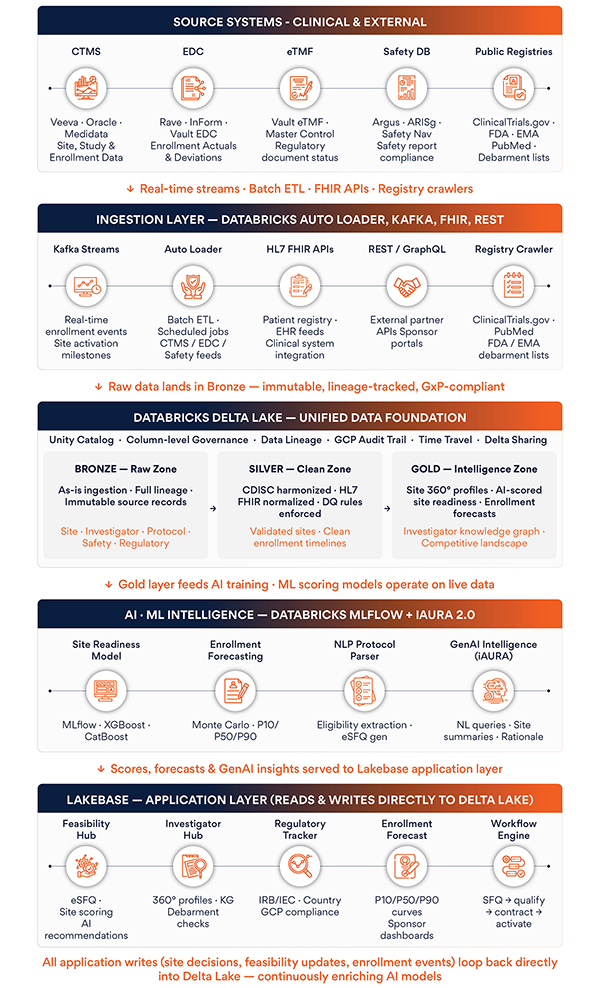
Architecture: Data Flow Through the Site Selection Hub
At the core of the Site Selection Hub is a five-layer architecture that connects clinical data, operational workflows and intelligence in one platform. Whether the trigger is a CTMS enrollment update or a site feasibility decision, every step is captured in a way that preserves traceability, supports governance and strengthens downstream analysis.
Why Persistent + Databricks for Clinical Operations
Persistent brings the rare combination of deep clinical domain expertise, that includes CTMS migrations, EDC integrations and CDISC harmonization projects with proven Databricks engineering capability. Our iAURA 2.0 platform provides the pre-built accelerators that make this architecture faster than a ground-up build:
| iAURA Component | Capability | Clinical Ops Value |
| iAURA Assessment Studio | Automated discovery | Clinical data landscape inventory and CTMS/EDC system profiling. |
| iAURA DQ Manager | Data quality automation | Auto-generated GCP-critical DQ rules and continuous Databricks monitoring. |
| iAURA Knowledge Graph | Clinical ontology | Investigator profile knowledge graph for AI context and semantic search. |
| iAURA MLOps | ML lifecycle | End-to-end site scoring model training, deployment, monitoring and retraining. |
| iAURA Insight Engine | GenAI interface | Natural language query and AI-generated site intelligence for clinical teams. |
| GAMP 5 Validation | Regulatory compliance | IQ/OQ/PQ documentation, 21 CFR Part 11 and GxP validation templates. |
Enterprise Data Readiness
Most AI projects won’t die in the model lab — they’ll fail in the data basement. Persistent’s EDR methodology ensures the Site Selection Hub is built on data that’s trusted, governed and AI-consumable from day one.’
Site selection doesn’t have to be a bottleneck. The data to make smarter decisions already exists inside every CRO. What’s been missing is the architecture to make it unified, trusted and AI-ready — and the application layer to put it in the hands of clinical ops teams at the moment they need it.
Delta Lake + Lakebase eliminates the duplication anti-pattern. iAURA 2.0 brings the clinical AI accelerators. And a four-phase implementation journey gets you from data landscape assessment to AI-powered site selection in under seven months.
Ready to Transform Your Site Selection?
Start with a 4-week Enterprise Data Readiness Assessment — a complete data landscape inventory, AI-readiness gap analysis and Site Selection Hub implementation roadmap.
Contact the Clinical Operations Practice.
Author Profile

Suraj Marathe
Engineering Partner, Data and Integration